The Neutrino Aria of Black Holes: Listening in on Silent Dark Matter ✦
Original: "Neutrino superradiance constraint on asteroid-mass PBH Dark Matter and beyond"
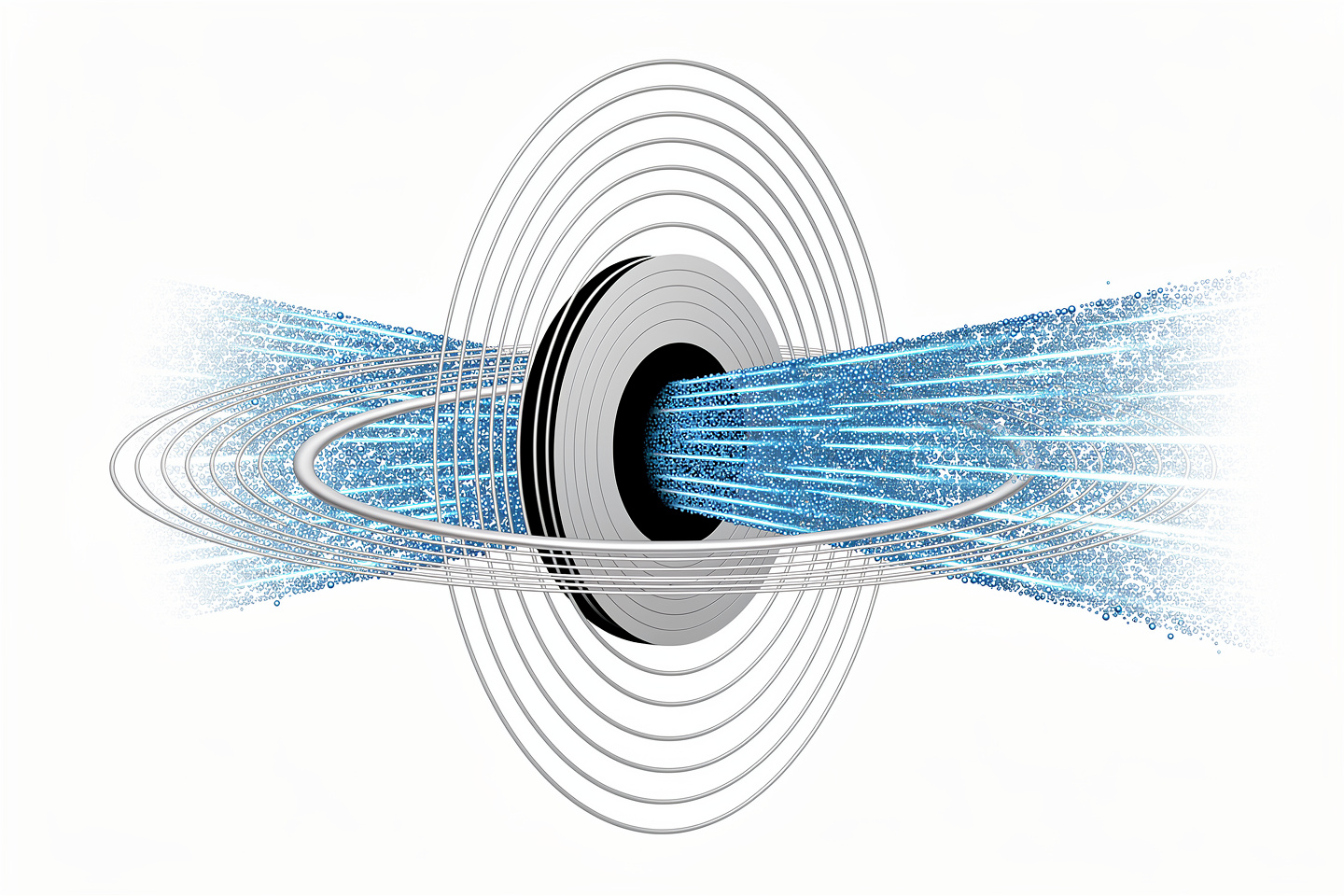
Rotating primordial black holes could turn into neutrino loudspeakers – their silence places the tightest limits on dark matter.
Links in the knowledge graph 1
A tiny black hole the size of a proton and the mass of an asteroid can become a gravitational amplifier, emitting neutrinos on a single pure note. Physicists scanned the sky with detectors — and the silence spoke louder than hundreds of hypothetical signals, placing unprecedented limits on dark matter. New observatories like JUNO may catch a solo performance from such a hole — and then we will hear the voice of the dark world for the first time.
🎯 If an asteroid-mass PBH of 10^20 g were to enter the Solar System, its size would be comparable to a proton (radius about 0.1 fm), and its spin could spawn a boson cloud radiating millions of neutrinos per second.
\alpha_g \equiv G_N m_\phi M_{\rm PBH}/(\hbar c) \approx 0.75 \left(\frac{m_\phi}{10^{-10}~\text{eV}}\right) \left(\frac{M_{\rm PBH}}{M_\odot}\right)
The gravitational fine-structure constant α_g is a dimensionless parameter that determines the coupling strength between a light scalar field and a black hole. When α_g ~0.3, the cloud efficiently extracts rotational energy.
\bar{E}_\nu^s \approx 2.7\times 10^{10} \left(\frac{g_{\nu\phi}}{10^{-4}}\right) \left(\frac{\Psi_0}{10^{12}~\text{GeV}}\right)~\text{MeV}
The energy of emitted neutrinos is proportional to the coupling constant g_{νϕ} and the amplitude of the scalar field. For weak coupling, neutrinos have energies of a few MeV — right in the detectors' operational range.
Scientists
Alan GuthAndrei LindeGeorges LemaîtreJames PeeblesAdam RiessBrian Schmidtdark matter
black hole
neutrino
gravitational lensing
redshift
galaxy
expansion of the universe
cosmic microwave background
dark energyLaws
Friedmann equationsHubble's lawDirac equationHawking radiationgravitational lensingBekenstein-Hawking entropy