The Neutrino Aria of Black Holes: Listening in on Silent Dark Matter ✛ ✎ ✦
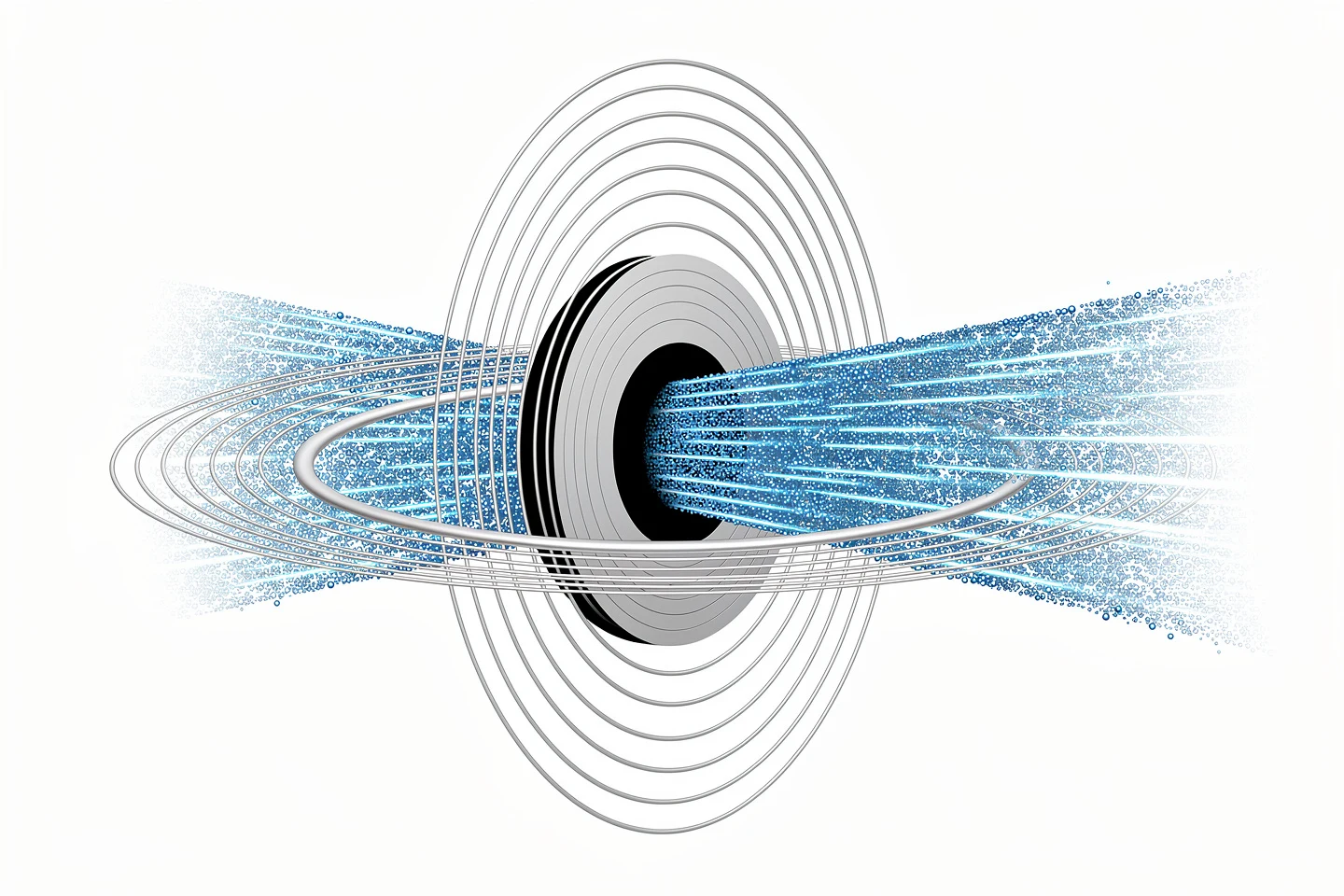
Dark matter remains the inaudible bass line of the cosmic symphony — it emits no light, but its gravitational pull shapes galaxies. Vera Rubin first caught this rhythm in the 1970s by observing the rotation of stars. Among the candidates for the invisible mass are primordial black holes, tiny objects born from quantum fluctuations in the infant Universe. They are especially attractive in the mass window from asteroids to small planets ($10^{17}$–$10^{23}$ g). These holes evade constraints from evaporation, discovered by Stephen Hawking, and traditional microlensing, making them nearly invisible — but not silent.
A new approach turns them into audible instruments using gravitational superradiance — the wave analog of a process discovered by Roger Penrose. Much like guitar feedback amplifies sound by resonating between the string and the speaker, a light scalar field around a rapidly spinning hole grows into a giant cloud. If this field has a Yukawa coupling to neutrinos, the cloud enters a saturated phase and begins emitting a steady stream of almost monochromatic neutrinos — a pure note at a frequency of a few MeV.
Armed with this insight, researchers calculated the neutrino fluxes from a population of primordial black holes in the Galaxy and distant galaxies. They accounted for cosmological redshift — a consequence of the expansion of the Universe, driven by dark energy. Comparing the predicted fluxes with the sensitivity of Borexino, KamLAND, and Super-Kamiokande detectors in the 2–31 MeV range gave a stunning result: the fraction of such black holes in dark matter cannot exceed millionths in the upper part of the asteroid mass window, orders of magnitude tighter than limits from gravitational lensing (the Subaru-HSC experiment). In other words, the neutrino “chorus” doesn’t sound loud — meaning primordial black holes don’t dominate the dark sector.
This discovery paves a new path for dark matter searches. Neutrino observatories, originally built to catch elusive particles from the Sun and supernovae, are turning into cosmology tools. Looking ahead, next-generation telescopes — JUNO, Hyper-Kamiokande — will not only refine the limits but may also catch the unique signal from a single black hole. Such a neutrino beam would be the cleanest signal in the Universe — almost scatter-free, like a laser pulse in a vacuum. Neutrino astronomy will then complement data on the cosmic microwave background and large-scale structure, creating a complete picture of dark matter. We are on the threshold of hearing the silent rhythm of the Universe.
If an asteroid-mass PBH of $10^{20}$ g were to enter the Solar System, its size would be comparable to a proton (radius about 0.1 fm), and its spin could spawn a boson cloud radiating millions of neutrinos per second.