Neutrinos Reveal Hidden Black Holes ✛ ✎ ✦
In the 1970s, Vera Rubin noticed that stars on the outskirts of galaxies were moving faster than expected — that's how dark matter was discovered. One hypothesis: it's made of primordial black holes — clumps of matter that formed in the first moments after the Big Bang. They were searched for via gravitational lensing, but black holes with the mass of a mountain, compressed to the size of an atom, remained elusive.
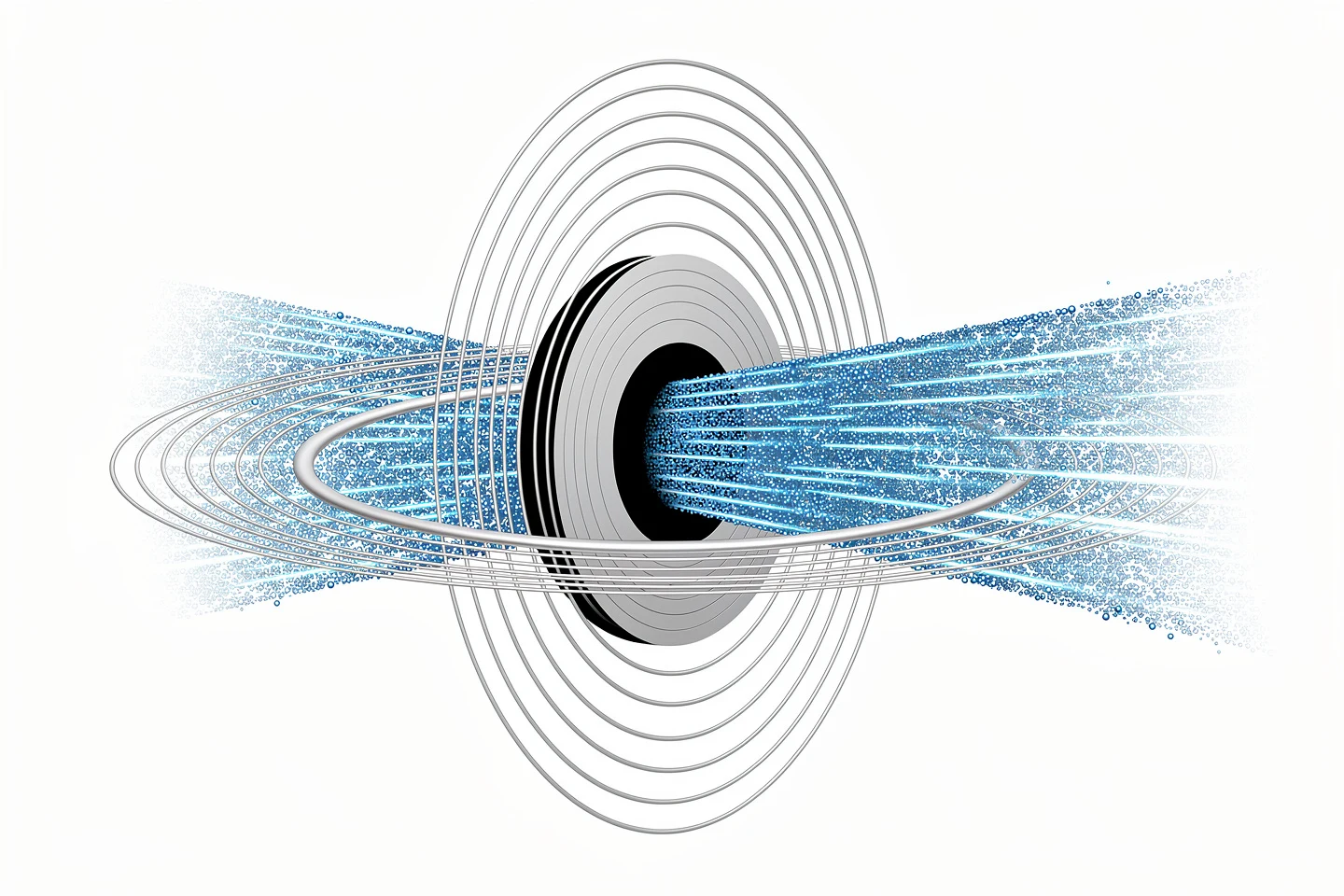
A new approach is to use neutrinos. A spinning black hole, like a spinning top in a puddle, splashes out energy, creating a cloud around itself and producing a stream of neutrinos. This mechanism was first described by Roger Penrose. Unlike the slow Hawking evaporation (discovered by Stephen Hawking), spin gives a detectable signal. Scientists calculated how many of these 'drops' reach Earth, accounting for the stretching of space and energy losses along the way — cosmological redshift, which is influenced by the accelerating expansion driven by dark energy.
Comparison with data from the Borexino, KamLAND, and Super-Kamiokande detectors showed that such black holes can make up only a tiny fraction of dark matter. So the main components are something else, and neutrinos become a tool to find them. The method is based on the echoes of the first moments in the cosmic microwave background.
A black hole with the mass of a mountain, compressed to a point smaller than an atomic nucleus, spinning, spews neutrino jets — millions of particles per second, like a tiny cosmic firehose.