Neutrino Signals from Superradiant Clouds around Primordial Black Holes ✛ ✎ ✦
Context
The nature of dark matter, first identified in the work of Vera Rubin, remains a central mystery. Among the candidates, primordial black holes (PBHs), formed from primordial inhomogeneities under gravity, attract with their simplicity. The asteroid mass window ($10^{17}$–$10^{23}$ g) is especially intriguing since PBHs within it could account for all dark matter, evading constraints from Hawking evaporation and microlensing. However, the lack of reliable probes in this range calls for new approaches. This work proposes using neutrino signals from superradiant clouds around PBHs, offering an additional search channel.
Methods
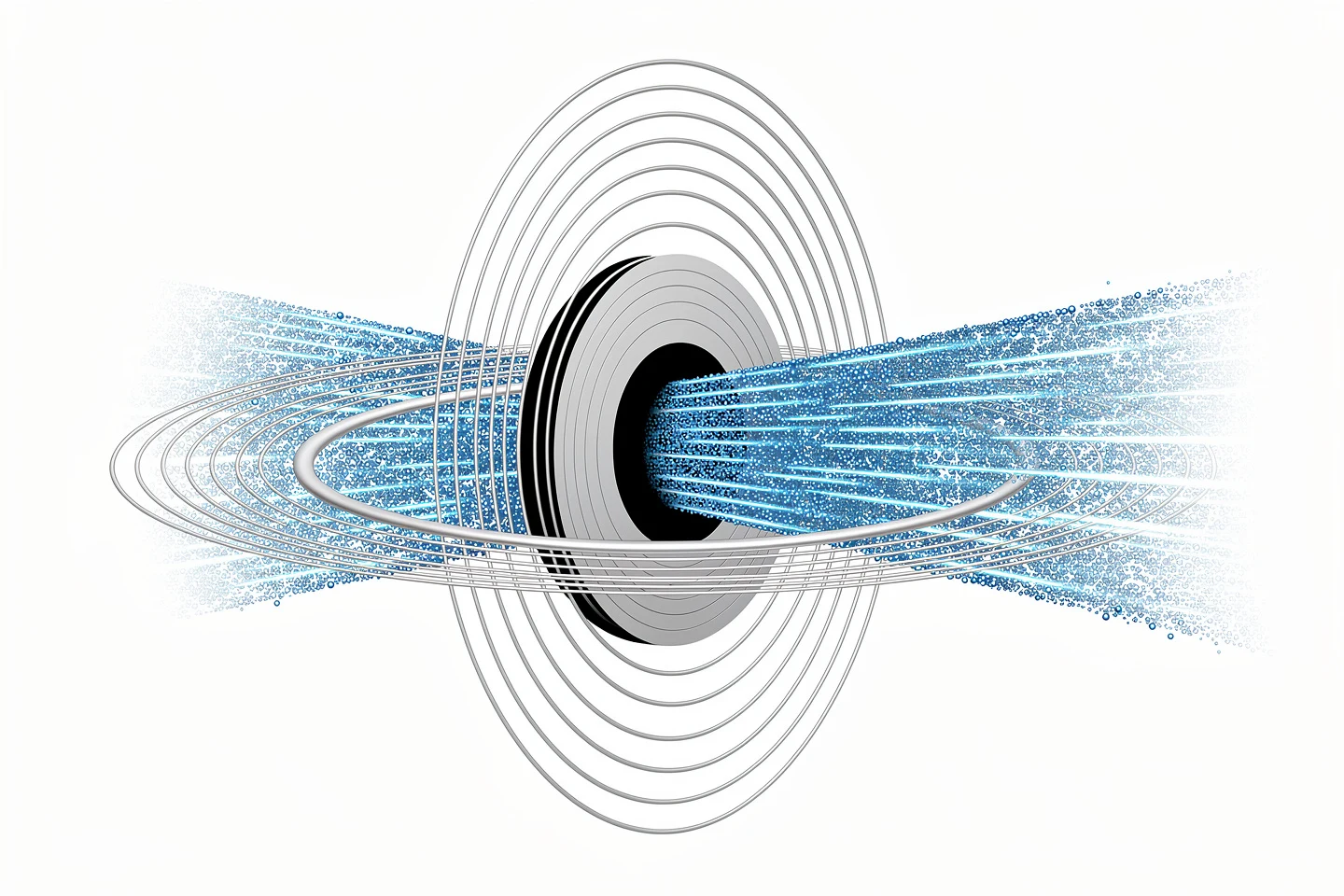
The authors consider a scenario where a cloud of a light scalar boson forms around a rotating black hole through superradiance—a wave analogue of the Penrose process. If this boson has a Yukawa coupling to neutrinos, the cloud enters a saturated phase, emitting a steady, nearly monochromatic neutrino flux. From the theory, fluxes from a single PBH are computed and then integrated over populations in the Galaxy (NFW profile) and beyond, accounting for cosmological redshift. The extragalactic flux is calculated using standard ΛCDM cosmology, with the expansion of the universe described by Hubble's law and accelerating due to dark energy. The resulting predictions are compared with experimental data from Borexino, KamLAND, and Super-Kamiokande for antineutrinos in the 2–31 MeV range.
Results
For a scalar boson with a gravitational fine-structure constant $α_g$ = 0.25–0.3 and a Yukawa coupling $g_{νϕ}$ ~ $10^{-3}$–$10^{-4}$, strong constraints on the PBH fraction of dark matter, $f_{PBH}$, are obtained. Specifically, for $α_g$=0.3 and $g_{νϕ}$=$10^{-4}$, values $f_{PBH}$ > $10^{-6}$ are excluded for PBH masses around 4×$10^{23}$ g, while for $α_g$=0.25 and $g_{νϕ}$=$10^{-4}$, $f_{PBH}$ ~ $10^{-7}$ is reached for $M_{PBH}$ ~ 2×$10^{22}$ g. These limits surpass constraints from microlensing (Subaru-HSC) by orders of magnitude in the upper part of the asteroid window. The vector case yields neutrino energies too low to compete with existing data. Interestingly, the galactic contribution is about 36% larger than the extragalactic one, thanks to the concentration of dark matter in the center of the Galaxy.
Implications
The results demonstrate that low-energy neutrino observatories can serve as powerful tools for probing dark matter in the form of PBHs, complementing traditional methods. This is especially important for the asteroid window, where direct astronomical observations are challenging. The connection to new light bosons also opens avenues for exploring physics beyond the Standard Model.
Future development
In the future, the analysis could be extended to other boson types (e.g., axions) and emission channels, including gamma rays. Using directional information from next-generation neutrino telescopes like JUNO or Hyper-Kamiokande will help separate the signal from backgrounds. Moreover, combining with data on the cosmic microwave background and large-scale structure could yield a more complete picture of the PBH population.
Impact
The method touches several areas at once: dark matter physics, neutrino astrophysics, early universe cosmology, and gravitational theory.
Next steps
Immediate next steps include more detailed modeling of cloud formation taking into account PBH accretion and mergers, as well as sensitivity analyses for future detectors like JUNO and Hyper-Kamiokande.
Key open problems
The work connects unresolved problems: the nature of dark matter, the formation mechanism of primordial black holes in inflationary models, the existence of light scalars, and the mass of neutrinos.
The knowledge machine's view
This section is addressed to the author of the paper and their colleagues. Neighbouring works were found by meaning-based search across our archive, not by word overlap. We do not review: we show the field around the work.
What the work does
The study explores a scenario where clouds of a scalar boson coupled to neutrinos form around spinning primordial black holes via superradiance. The authors calculated the expected flux of nearly monochromatic neutrinos from such clouds, integrated it over galactic and extragalactic populations, and compared it with data from neutrino observatories. They obtained strong constraints on the fraction of PBHs in dark matter within the asteroid mass window, significantly surpassing constraints from microlensing.
Where its strength is
The strength of the work lies in using the neutrino channel to probe PBHs in the elusive asteroid window, where traditional methods are ineffective. This opens a new way to test the hypothesis about the nature of dark matter, based on the connection between superradiance and particle physics.
Where it could go next
- It might be interesting to see how the constraints change when accounting for non-standard neutrino interactions with matter, which could modify the signal in detectors. A related paper on the archive discusses the influence of dark matter on neutrino properties, and its approaches could be adapted to estimate systematic uncertainties in our case.based on: Dark Matter Changes the Face of Neutrinos arXiv:2605.06777
- Another logical step would be to consider axion-like particles as an alternative candidate for the superradiant cloud. The archive contains an analysis of a model where black holes with axion enhancement act as a source of dark matter, and its results could suggest how to reformulate the neutrino constraints for a broader class of bosons.based on: Dark Matter from Black Holes with Axion Boost arXiv:2606.20524
Worth trying
- Investigate how the constraints change if the Yukawa coupling depends on neutrino energy, using a parametrization from a study on dark matter that alters neutrino properties.
- Test the method on data from other neutrino telescopes (e.g., IceCube) to extend the PBH mass range, building on the idea of 'black holes as neutrino factories'.
Why this may matter
The proposed method could become the basis for targeted searches of PBHs with existing and future neutrino observatories, turning them into tools for testing one of the leading hypotheses about the composition of dark matter.
Nearby works in our archive
- How Black Holes Light Up a Neutrino Beaconsimilarity 0.74
- Black Holes That Didn't Evaporatesimilarity 0.68
- Invisible Particles Leave Their Mark on Ancient Lightsimilarity 0.67
- Black Holes: Neutrino Factoriessimilarity 0.67
- Dark Matter Changes the Face of Neutrinossimilarity 0.67
- How Black Holes Give Birth to Mattersimilarity 0.67
- Dark Matter from Black Holes with Axion Boostsimilarity 0.66
The archive is crowded around this work: 9 reviews nearby, closest at 0.74. This ground is well walked — and there is plenty to compare against.
If an asteroid-mass PBH of $10^{20}$ g were in the Solar System, its size would be comparable to a proton (radius ~0.1 fm), and its rotation could generate a boson cloud emitting millions of neutrinos per second.
Key numbers
- Asteroid mass window for PBHs: 1017 – 1023 g
- Maximum constraint on f_PBH: ~10-7
- Typical neutrino energy: up to ~10 MeV
- Hubble constant: 67.66 km/s/Mpc
- Age of the Universe: 1.4×10¹⁰ years