Cellular Atlases: Who Reads the Language of Tissue Best express
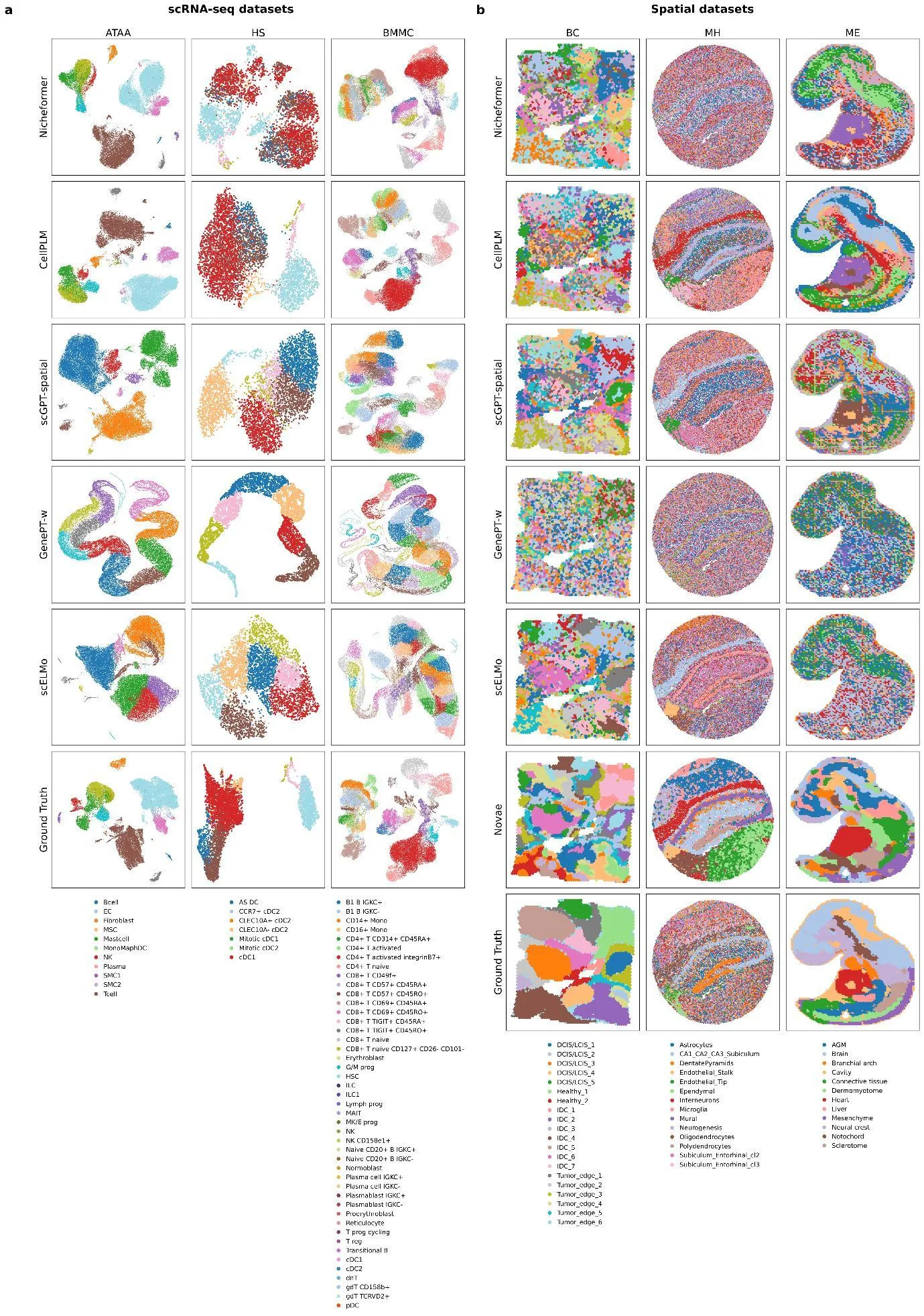
Biologists are increasingly trusting computers to read the "user manuals" of living cells. Six recent AI models (Nicheformer, CellPLM, scGPT-spatial, GenePT, scELMo, and Novae) are like six translators working from different dialects of the same cellular language. Each learned from its own corpus: some memorized sequences of active genes, others studied spatial maps of tissues, and still others started with plain human language.
The authors gave them a fair exam. The models were set the same tasks: cluster cells by type, find marker genes (molecular "passports" of cells), or predict how a cell will respond to a drug. The input data also varied — from simple lists of expressed genes to images showing the position of each cell within a tissue.
The results were sobering. Models trained on "flat" gene lists were best at determining cell types. Spatial models, which see the tissue map, more accurately preserved organ architecture. And language models, for which a gene is just a word in a sentence, unexpectedly did quite well at predicting drug effects. No model won in all categories, and the ranking shifted with the slightest nuances — the way data was preprocessed, the choice of metric, or even how genes were "chopped" into pieces for analysis.
This is not a race for an absolute champion. Rather, it's the emergence of a toolkit where each tool excels at its own job. The future belongs to models that can not only score points on tests but also explain to biologists why a cell took a particular developmental path.
Some models learned to understand genes simply by "reading" scientific papers. For them, a gene is like a word, and a cell is like a paragraph.