Gene expression is the process by which the information encoded in a gene is converted into a functional product, typically a protein. It involves two main steps: transcription, where the DNA sequence is copied into messenger RNA (mRNA), and translation, where the mRNA is read by ribosomes to assemble amino acids into a protein. This process is tightly regulated, allowing cells to respond to environmental signals and differentiate into specialized types.
History
The central dogma of molecular biology, describing the flow of information from DNA to RNA to protein, was articulated by Francis Crick in 1957. The detailed mechanisms of transcription and translation were worked out through the 1960s and 1970s.
How it works
Transcription begins when transcription factors bind to promoter regions of DNA, recruiting RNA polymerase to synthesize mRNA. The mRNA is then processed (splicing, capping, polyadenylation) and exported to the cytoplasm. During translation, ribosomes read the mRNA in triplets (codons), each specifying an amino acid, with transfer RNA (tRNA) delivering the correct amino acids. The resulting protein folds into its functional shape, often assisted by chaperones.
In practice
Gene expression analysis is used in medicine to diagnose diseases, tailor treatments (pharmacogenomics), and develop gene therapies. It is also central to biotechnology, where engineered cells produce insulin, antibodies, and other therapeutic proteins.
Fun fact
Only about 1-2% of the human genome codes for proteins, yet the rest is largely involved in regulating gene expression, including enhancers, silencers, and non-coding RNAs.
Four old maps were lying in different desk drawers. Each one marked genes linked to cellular aging, but the maps did not match: different names, different scales, different legends. A scientist hunting for a gene to test had to cross-check them by hand, at the risk of missing an important mark.
SenSASP stitched those maps into one.
A courier carrying a package enters a dense forest of intertwined ropes. He needs to deliver the cargo deep inside, but along the way he loses strength, and each step becomes harder. This is what an enzyme looks like as it degrades a dense gel of biological molecules. Until recently, no one could simultaneously see how the courier moves and how the forest thins out.
As you slowly turn the tuning knob of an old radio, the sound doesn't fade in gradually from the static: it bursts forth in a sudden jump, the moment the antenna hits resonance with the wave. Genes in a living cell behave much the same way.
In the long extensions of a neuron, the dendrites, tiny couriers are constantly bustling about. These are messenger RNA molecules carrying instructions for protein assembly. Their journey starts at the cell body and ends at synapses — contacts with other neurons.
A protein chain folds into a working tool in a fraction of a second, and almost never makes a mistake. For a long time, it was thought that evolution specifically polishes amino acid sequences so that a protein not only works but also easily finds its unique shape. New work turns this idea on its head.
A huge orchestra without a conductor. Each musician is a gene, and the melody is the cell's complex work. Previously, looking at a tissue photo, a computer tried to guess each instrument's part individually. It didn't know that violins usually play with violas, and trumpets with trombones. The program just output a list of notes, without sensing the harmony.
A protein slides along the DNA strand like a key along a keyring, searching for its lock. One wrong turn and a gene stays switched off. To know where a protein will grip firmly, you need to measure the strength of that grip — the binding energy.
WanSong creates music like a sculptor carving a statue: it starts with noise, akin to the roar of a waterfall, and gradually chisels away the excess until pure notes and voices emerge. This method, diffusion, turns chaos into order, like ink dispersing in water, only in reverse. The model doesn’t stitch sounds together from fragments; it births a complete song in one go.
When biologists measure the activity of thousands of genes, they usually just see a list of coincidences, like two ingredients in a soup that often end up together. The standard method looks for such pairwise connections but doesn't show who influences whom.
A new approach, like a detector of dark matter, uncovers hidden threads of causation.
Data on gene activity usually looks like a long string of numbers, like a rainbow stripe (spectrum) with no visible connections. In the scVision model, these numbers are turned into a meaningful picture — not a list of ingredients, but a photo of a finished dish.
You get a report: one 'letter' in your gene has been swapped. But what does that change? A protein isn't a flat string: it's a dense tangle, where each loop sits in its own pocket. A change deep inside that tangle is like a crack in the foundation, while one on the surface is like a scratch on the facade.
A protein in a cell is not a frozen sculpture. It is constantly in motion: bending, breathing, jittering. This motion, its dynamics, determines how the protein works. But peering directly into the dance is hard, and computer simulations often demand enormous computing power.
A new approach, named DynaMode, views protein motion as a musical piece.
In embryonic development, a cell resembles a musician in a vast orchestra: it must play its part, following a conductor — the gradient of signaling molecules. But the conductor is unreliable: morphogen concentrations constantly fluctuate. How then does a cellist not veer into a violin melody?
A cell is like a library where thousands of books are copied every day. Molecular machines, polymerases and ribosomes, slide along a template chain and assemble a copy, link by link. These machines have several states: they can slow down, make mistakes, or switch. Previously, calculating such a process took hours.
Imagine a flashlight that only lights up when you're near a road sign: that's roughly how drug discovery works when scientists follow genetic clues. A team of researchers examined over 26,000 target-disease pairs: combinations of a protein that a drug acts on and the disease it treats.
For a long time, we only saw proteins in their final form — like photographs of dancers frozen in a beautiful pose. Programs like AlphaFold learned to predict that pose from a chain of carbon links. But the real magic is how a protein finds this shape faster than you can blink, performing a swift dance.
Two road crews are paving a street from opposite ends. They move toward each other, and how well they coordinate determines when the street is finished.
A torn telephone wire is a nuisance, but a torn DNA is a catastrophe. A double-strand break, when both strands of the helix snap at the same spot, threatens the cell with death or transformation into cancer. Fortunately, the cell has its own 'glue': special proteins that gather into a droplet right at the accident site.
An artist paints a picture, glancing at the audience in the hall. If the viewer smiles, the artist adds more red and rounded lines to the canvas; if the viewer frowns, the artist removes blue and sharpens the angles.
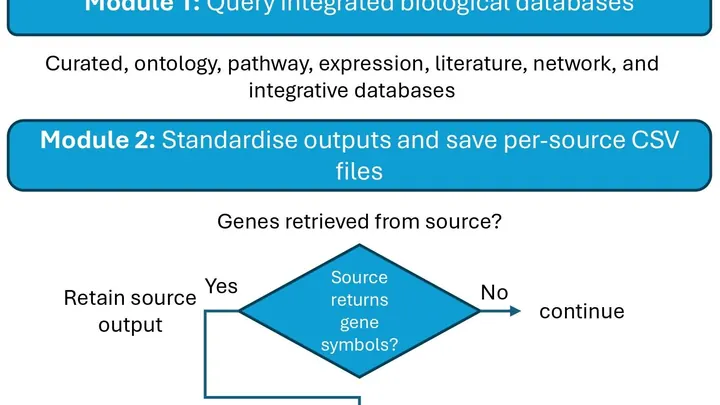
Assembling a puzzle when the pieces are scattered across 13 boxes with different numbering systems: that's roughly what it's like to search for genes linked to a specific disease. The data exist, but they're hidden in databases with their own interfaces, formats, and even descriptive languages.
A protein in a cell is like a tiny machine: each has its own precise blueprint and its own task. Some proteins cut molecules, others carry oxygen, and still others capture light. To build such a mechanism from scratch, you need to solve two problems at once: decide what job it will do and how it will fold into the right knot. If the knot goes wrong, the machine jams or breaks.
Long protein threads, their tangled entanglements, and random contacts: this is how the birth of cellular droplets was usually explained. These membrane-less organelles, where important reactions take place, resemble oil drops in water: they arise on their own when molecules separate into phases.
A translator who has never been in a meeting translates literally, and loses half the meaning. They don't know that the boss's nod means "do it like last time," and the phrase "well, we'll see" is a polite refusal. That's how a language model that writes code from a scientific paper works: it can read the equations, but not the unspoken agreements.
In a growing bacterium, genes that run protein factories don't drift solo. They clump into liquid droplets, like oily smears in water — no membranes, but sharp boundaries. The NusA protein fuels this condensation. When it piles up, it glues neighboring DNA stretches together, forcing them into foci.
Capsids are protein boxes that viruses use to carry their genetic material. In gene therapy, these boxes serve as couriers: you put a desired gene inside, and the outside retains the ability to enter cells.
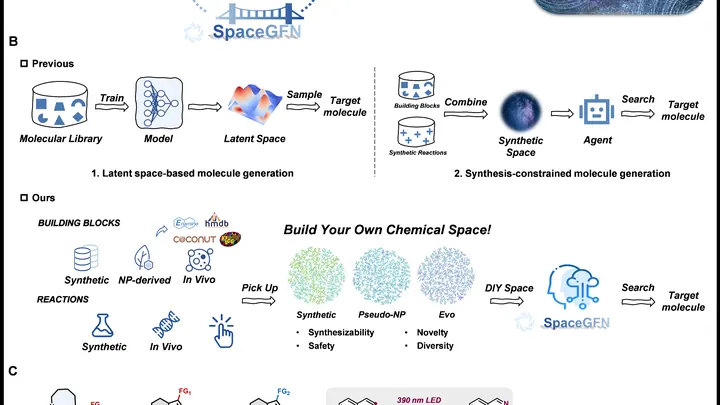
Previously, generative models for drug discovery worked like an artist painting without choosing a canvas. They learned from existing molecules and simply produced similar ones, without considering how the space of possible compounds is organized. SpaceGFN changes the approach: now chemical space is a construction set where the user specifies the parts and the assembly rules.
Proteins in nature are as numerous as grains of sand on a beach, and each has its own job: some break down food, others build cells. But to understand what a specific protein does, it must be studied in the lab — a slow and expensive process.
Inside a cell, work is in full swing: thousands of genes switch on and off like lights on a huge display. Neural networks trained to read this display have learned to guess what will happen if you 'turn off' one gene or add a drug. But how exactly they do it is a mystery.
At night, a person breathes, and the rhythm of that breathing can tell you a lot about their sleep. But usually, doctors look at the brain's electrical waves — recorded by sensors on the head. New work shows how to reconstruct those waves from breathing alone, without touching the head.
The model acts as a translator from the language of the body to the language of the brain.
A cell is like a kitchen where thousands of recipes (genes) are collected in one thick book (DNA). The chef-protein Klf4 flips through the pages and decides which recipe to cook today. But how does it find the right line among billions of letters? Previously, researchers thought the protein looked for a short 'password'—a few consecutive letters.
In every cell lives a tireless scribe — an enzyme that copies the long thread of DNA. It moves along it like a read head over a tape, building a new strand alongside. It picks letters by strict rule: opposite A it always places T, opposite G it places C. But sometimes, very rarely, its hand trembles, and a different letter slips in.
Primary human cells, taken straight from the body, are the most honest material for studying diseases and testing drugs. But getting foreign genetic material into them is tricky: cells don't like intruders. Standard methods either damage the cell or work unevenly, especially when the sample is heterogeneous — which it almost always is.
The new platform tackles this with a vortex flow.
On October 9, 2022, detectors on Earth recorded a gamma-ray burst of unprecedented power. GRB 221009A was so bright that its radiation ionized the upper layers of the ionosphere, and satellite instruments were temporarily blinded.