Transformers are neural network models using self-attention mechanisms for tasks like brain mapping, language translation, and context stitching in AI agents.
The Transformer is a neural network architecture where the entire sequence is processed in parallel. The word “bank” (meaning a financial institution or a bench) clarifies its meaning through connections with other words in the sentence, using the attention mechanism (dynamic importance weighting). This overcame the limitations of older models that got confused in long phrases. Similarly, a command center distributes tasks: each agent sees the big picture and identifies priority targets.
History
Proposed in the paper "Attention is All You Need" (2017) by Vaswani and colleagues at Google. The core idea of the attention mechanism dates back to work in the 1990s, but the Transformer established it as a self-sufficient building block. It first conquered machine translation, then generative models (GPT, BERT), computer vision, and even protein structure prediction.
How it works
The key element is self-attention: for the input sequence, matrices of queries (Q), keys (K), and values (V) are computed. Attention weights are obtained as the scaled dot product of queries and keys, followed by softmax. Formula: Attention(Q,K,V) = softmax(QK^T/√d_k)V, where d_k is the dimension of the keys. The encoder applies multi-head attention: several parallel heads project the input into different subspaces, then the results are concatenated. Positional encoding adds information about word order, since the model has no built-in notion of sequence.
In practice
Machine translation, voice assistants, and systems that understand long texts — from chatbots to automated reports.
Fun fact
Modern Transformers (like GPT) can contain hundreds of billions of trainable parameters — roughly the number of stars in a small galaxy.
A jazz trio plays in the dim light of a club. The pianist leads the melody, the bassist holds the rhythm, and the drummer sprinkles out rolls. If you listen only to pairs of musicians, you can catch how the pianist adjusts to the bass or the bass to the drums.
A navigator with a paper chart plots the route before setting sail. If the ocean changes—the current shifts, the wind picks up—the chart stays the same. The ship follows an outdated path, and the crew has to correct the course by hand.
In the Antarctic ice, a ghost particle leaves behind only a faint flash of blue light. The IceCube detector captures these flashes, and from them we need to infer where the particle came from. The PolarBERT model has learned to do this, but what exactly it sees inside has remained a mystery.
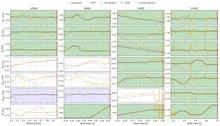
Holding in mind the exact position of a pen as it's slowly moved is a routine task for the brain. For artificial neural networks, it's nearly impossible. Standard recurrent networks like GRU and LSTM tend to break continuous motion into rigid steps: the pen doesn't glide smoothly but jumps from point to point.
The human mind is like a construction set that builds itself. New ideas don't die with their creators: they are passed on, mixed, and selected. This process is called cultural evolution: useful inventions stick, useless ones are forgotten. That's how a ratchet works — a mechanism that only turns forward.
But what exactly happens in the head when one thought displaces another?
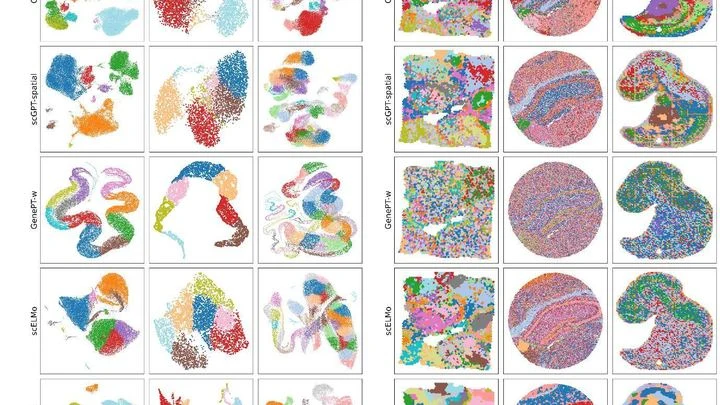
Biologists are increasingly trusting computers to read the "user manuals" of living cells. Six recent AI models (Nicheformer, CellPLM, scGPT-spatial, GenePT, scELMo, and Novae) are like six translators working from different dialects of the same cellular language.
The cameras of a self-driving car capture light like telescopes aimed at a distant galaxy. Each frame is a fragmented observation; together they must form a map of the road ahead.
The computer, like an astronomer, doesn't just stitch images together: it generates several possible bird's-eye views and compares them to real data.
The meditating brain is an orchestra, and attention is the conductor. When you're focused on your breath, all instruments play in harmony. But suddenly, a thought-cello plays a false note: that's mind wandering. An experienced conductor doesn't panic: they instantly catch the dissonance and gently guide the orchestra back to the main melody — the breath.
Communicating with a satellite is like trying to hear a whisper in a storm: the signal drowns in noise. Engineers have created an AI algorithm that runs directly on the satellite and, with minimal power consumption, detects distortions more accurately than previous methods.
A typical tracking program resembles a navigator steering a ship by the stars. But as soon as the sky clouds over, coordinates drift, and entropy (a measure of uncertainty) builds up in the data. The new algorithm gets a ‘co‑pilot’ — a module that monitors how confident the main navigator is.
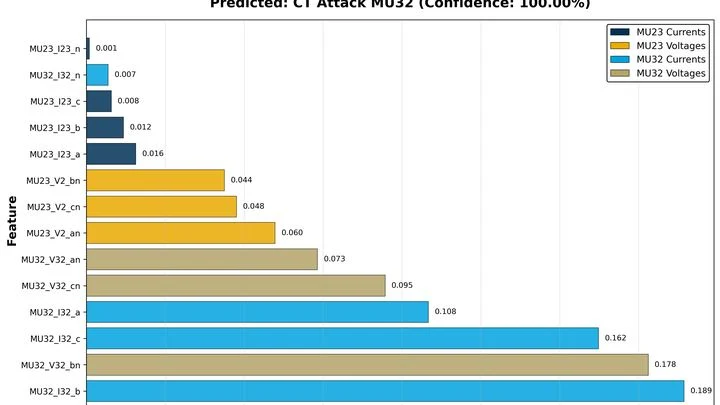
Solar panels and wind turbines, unlike old-school generators, connect through inverters, opening new loopholes for hackers: you can quietly falsify sensor readings or spoof GPS timestamps. To defend, engineers combined two approaches — an ultra-fast guardian and a thoughtful detective.
In calm water, the route is clear. But in turbulent flows, a robot needs a different strategy. Typical approaches demand an accurate map of currents, but in reality, you can't get one. Nature does it differently: fish feel pressure and vortices right against their bodies.
The modern standard approach to AI training is like a child locked in a library: he remembers millions of books but doesn't know that fire burns and falling hurts.
After a stone is thrown, the circles on water vanish, but the liquid retains microscopic oscillations. The slightest gust, and ripples appear again. Neural networks behave similarly. When electrical signals quiet down, the memory of them remains in the contact points — synapses.
In a soup pot, you only need two thermometers to gauge the temperature everywhere — if you know heat travels in circles from the bottom. Science works the same way: from a handful of measurements, you want to reconstruct the full heat picture.
The system captures the gist of heat flow, compressing it into a handful of governing numbers.
Models that turn text into audio are good at recreating single sounds, but get confused when the script has several in a row. For example, the script might call for a ring, then footsteps, then a door slam. The generator might shuffle events, so the listener hears footsteps before the ring.
A city signal bounces between walls like a ball, and your phone catches dozens of its 'reflections'—echoes. Each microsecond of delay adds 300 meters to the path.
The signal's speed is constant, like that of light (speed of light).
In a kitchen with gas burners, each heats differently. If the cook moves the pots, food may burn. Just so in a wireless network: the antenna-burners and user-pots require precise placement. Ordinary neural networks don’t distinguish positions, treating all burners as identical. So they struggle to estimate signal quality or adjust transmission.
The float in a toilet tank is an ideal controller: sensing the water level, it instantly brings the system into equilibrium without looking back at the past. Engineers applied this principle to neural networks.
A family tree becomes a tangle if you account for adopted children and remarriages. Evolution often resembles such a tangle: although the Standard Model, the traditional view of divergent evolution where species branch like a tree, paints a neat tree of species, in reality genes travel not only by inheritance but also directly between unrelated organisms — a process…
An electron microscope is a giant pipe organ: instead of pipes (electromagnetic lenses, instead of air) a stream of accelerated electrons. It once merely painted mute frescoes of the atomic world, condemning scientists to grueling decipherment.
The quantum many-body world is a jazz ensemble, where each electron improvises, continuously listening to all the others, and the overall wave function is born from this tense dialogue.
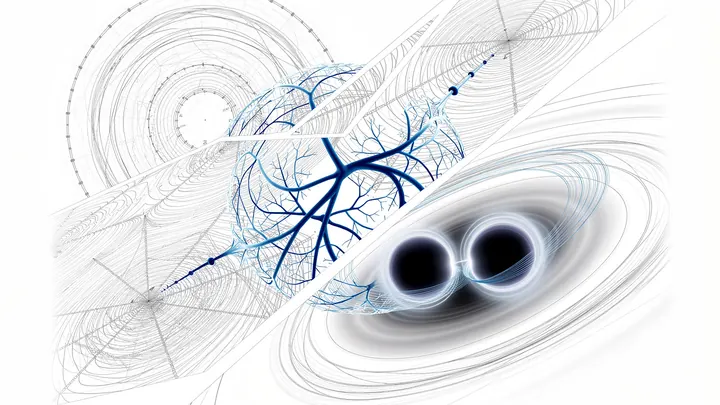
Isolating the signal from a single pair of supermassive black holes is like hearing a dancer's footsteps amid the roar of a hurricane. Somewhere in space, these monsters spin in a slow gravitational tango, distorting spacetime itself.
Recommendation systems that decide which post you’ll see next run on deep neural networks made up of thousands of operations — intricate computation Graphs (blueprints of operations on data). These systems are living, ever-evolving Dynamical Systems: the slightest architecture change cascades through the entire graph.
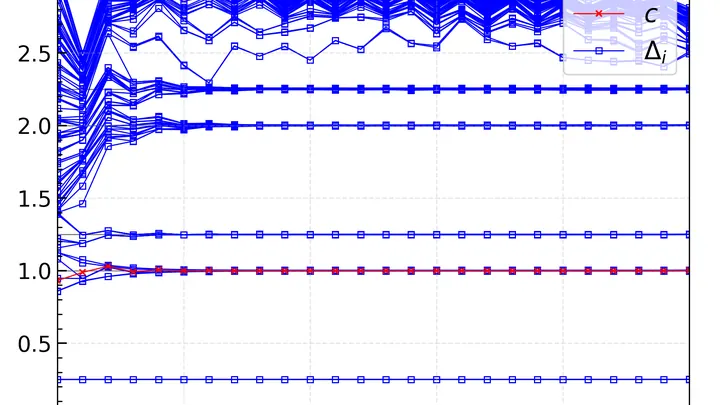
In quantum physics, there are theories where everything follows clear proportions, like a musical rhythm that always returns to the beginning of the bar. But there are also 'irrational' theories where the rhythm breaks and predicting the next beat is nearly impossible. One such theory is the compactified boson: a particle lives on a circle, and its behavior depends on the radius of that circle.
In the courtroom, a string is presented as input. Twelve jurors (computation paths) examine it symbol by symbol. Each can render a 'guilty' (accept) or 'not guilty' verdict. For a conventional nondeterministic automaton (NFA), one 'yes' vote suffices.
A tiny dust particle in a supersaturated solution sprouts into a large crystal in seconds. Neighboring particles remain invisible. A similar process was recently discovered in communities of language agents.
The depths of space are not silent — they are full of encrypted messages. Every star, every quasar sends its flickering light code: rhythmic like the Morse of a Cepheid, or chaotic like a cracked cipher of a supernova. Astronomers intercept these signals by the millions each night — but how to read them without a key?
During the dinner rush, a restaurant kitchen sizzles with oil, knives clatter, orders fly. The head chef can't wait for a pan to be washed: there's always an assistant who preps a clean one in advance. Modern LLM agents work the same way: they manage code, plan tasks, converse with users, generating long chains of messages.
These chains quickly overload the model.
Gold doesn't lie on the surface: it's hidden in tons of barren rock. To extract a gram of precious metal, prospectors sift through cubic meters of dirt.
The brain doesn't learn every task from scratch: it transfers experience from one activity to another. But how do you know which tasks are truly related? Neuroscientists came up with a clever trick: let an artificial network "peek" at brain activity during one task and try to predict activity during another. If it works well, the tasks are close.
A neuron resembles an electrical circuit with batteries and variable resistors. The resistors are played by ion channels — protein pores in the membrane that open and close, letting charged particles through. Whether a nerve impulse fires depends on how fast and at what voltage these pores operate.
An engineer tunes an antenna: pull one segment, the frequency drifts; change the angle, the gain drops. Developing therapeutic peptides (short protein chains) works much the same way.
A neural network, like a sheet of graph paper, receives homogeneous signals at its input, and draws its own coordinate grid. Initially, connections between inputs and network cells form a gentle hill: the response is strongest at the center and fades toward the edges.
Imagine an interpreter sitting in a meeting room, translating every word. But then they notice their translation could improve if they learned from their mistakes. They start noting which phrases caused confusion and adjust them. Within an hour, their translation is more accurate and the meeting runs smoother.
A supermarket cashier at rush hour doesn't memorize every scanned item: they keep the running total in their head and watch the queue. The brain allocates its resources similarly: the expensive, precise cortex (responsible for deliberation) and the simpler, economical subcortical nuclei (where habits live) work in tandem.
A person looks at a door lock and sees a keyhole. They know that a key is inserted and turned. But if instead of a keyhole there's a touch panel, the familiar frame breaks. The person doesn't just make a mistake: they realize that the usual approach won't work and can say, "There's no place for a key here; a different approach is needed."
Such an honest stop with an explanation is rare for machines.
A city is a living system: it consumes resources, produces waste, and its 'circulatory system'—the road network — delivers people and goods to their destinations. But while engineers design transport arteries as rigid geometry of straight lines, nature has spent millions of years perfecting ideal distribution networks.