concept

benchmark

A standard dataset or task used to evaluate and compare the performance of AI models.
57 related articles

Description

A benchmark is a standardized test or dataset used to measure and compare the performance of AI models. It provides a common ground for evaluating different approaches, ensuring that results are reproducible and comparable across research groups. Benchmarks are essential for tracking progress in AI, as they offer objective criteria for what constitutes improvement.

History

The concept of benchmarks in AI gained prominence with the rise of machine learning in the 1980s, but the term became widely used in the 2000s with the creation of standardized datasets like ImageNet for image recognition.

How it works

Benchmarks typically consist of a fixed set of tasks, questions, or data samples with known correct answers. AI models are run against these tasks, and their outputs are scored using predefined metrics, such as accuracy, precision, or recall. The scores allow researchers to rank models and identify which ones perform best on specific types of problems.

In practice

Benchmarks are used in academic research, industry development, and competitions to evaluate AI models for tasks like image classification, natural language processing, and scientific discovery.

Fun fact

Some AI benchmarks are designed to be 'adversarial', meaning they are specifically crafted to expose weaknesses in models, leading to more robust algorithms.

Related articles · 57

Scales for Thoughts: How to Measure Whether a Neural Interface Really Speaks
In the 1980s, the DARPA speech recognition challenge settled the debate between statistical methods and hand-written rules, setting a common standard for the entire field.
An Orchestra Without a Conductor: How Collective Light Measurement Lifts the Curse of Incompatibility
At night on a volcano summit, six telescopes stare at the same speck of light. Each catches its own copy of the wave, and if you combine their signals, you get an image that no single instrument could produce alone. But there's a catch: light captured by different stations cannot simply be added like photographs.
q-bio.BM2026-08-191 minarXiv:2608.18604express
How Protein Engineers Learn from Mistakes
A protein engineer is like a chef trying to make a dish that is tasty, healthy, and cheap all at once. Change one ingredient, and you risk ruining another. In the past, computer assistants could only evaluate protein properties one at a time, missing how they are connected.
q-bio.GN2026-07-192 minarXiv:2607.17227express
Cellular Atlases: Who Reads the Language of Tissue Best
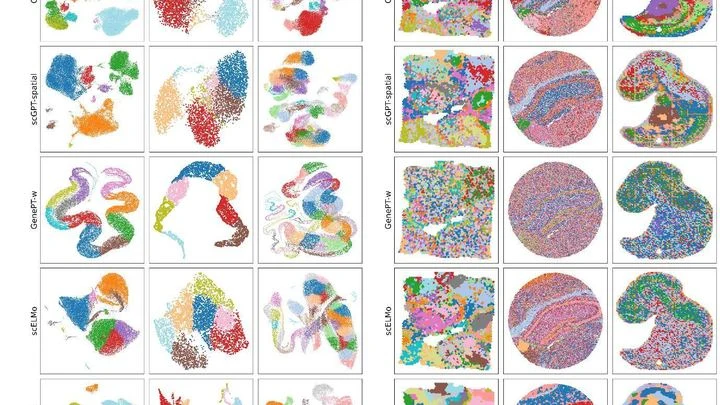
Biologists are increasingly trusting computers to read the "user manuals" of living cells. Six recent AI models (Nicheformer, CellPLM, scGPT-spatial, GenePT, scELMo, and Novae) are like six translators working from different dialects of the same cellular language.
Signal Processing2026-07-161 minarXiv:2607.14597express
Self-Taught Algorithm: How to Hear a Melody from Noise
Reconstructing a full picture from fragments is like discerning an orchestra's melody in a noisy hall. Such challenges arise in photometry, where a star's brightness is recovered from faint twinkling. Traditional methods need precise noise information, which is almost always unknown.
eess.AS2026-07-161 minarXiv:2607.15198express
How to fish out a friend's voice from a noisy conversation
A human effortlessly picks out the desired voice from the clamor of a party. For a computer, the same task is still at the edge of its abilities. Previous programs trained on sterile recordings, free of echo or the clinking of appliances.
eess.AS2026-07-151 minarXiv:2607.13408express
How AI Stopped Mixing Up Sounds in a Script
Models that turn text into audio are good at recreating single sounds, but get confused when the script has several in a row. For example, the script might call for a ring, then footsteps, then a door slam. The generator might shuffle events, so the listener hears footsteps before the ring.
cs.SD2026-07-151 minarXiv:2607.13477express
AI Judges Listen Not with Ears, but with Labels
Automatic speech judges are algorithms that evaluate pronunciation and emotions. However, they often work like a food critic who delivers a verdict after reading the menu but not tasting the dish.
cs.LO2026-07-151 minarXiv:2607.13531express
Chemical Soup Computes Numbers: How Reactions Became a Computer
In boiling soup, molecules collide chaotically and react. But if you measure how their concentrations change, patterns emerge. This is how carbon chemical networks work — mixtures of molecules that spontaneously 'cook' information, turning each reaction into an elementary computation. Previously they were used only for modeling nature.
Machine Learning2026-07-151 minarXiv:2607.14086express
Brain Signals: Learning to Understand Without a Teacher
The brain communicates in short electrical clicks. Previously, to learn this language, thousands of examples with translations from the experimenter were needed. MOJO takes a different path: like learning a language through immersion, it first listens to the 'stream of consciousness' without any hints and finds recurring patterns on its own.
Computer Vision2026-07-141 minarXiv:2607.12375express
AI with a magnifying glass and a spectrometer: image quality assessment
Assessing image quality is a job for a meticulous inspector with a toolbox. The IQA-T1 neural network acts exactly like that: it doesn't just stare at the picture, but applies either a spectroscope or a light meter.
eess.AS2026-07-142 minarXiv:2607.12703express
Audio Diarization: How an Algorithm Catches Any Sound Event Without Prior Knowledge
Human hearing is wired so that the brain prioritizes familiar patterns — a friend's voice, the patter of rain, a car horn. But a new system works on a different principle: it registers any sound burst, even one never encountered before.
Computer Vision2026-07-141 minarXiv:2607.12874express
Synthetic Deception: How Fake Images Teach Computers to See the Truth
A cook who learns to cook from hand-drawn pictures risks ruining every dish. The same trap awaits computer vision: models need thousands of labeled images, but collecting them manually is expensive and tedious. Synthetic frames solve the problem, but only if they look real.
How AI Quit Overreading
Code-writing assistants often behave like a chef who, to boil a single egg, rereads the whole cookbook. When asked to make a tiny fix, they reopen dozens of files and retrace long-familiar connections. This is unnecessary work — energy going to waste.
eess.SY2026-07-131 minarXiv:2607.11122express
Float Controller: Stability via an Instant Equation
The float in a toilet tank is an ideal controller: sensing the water level, it instantly brings the system into equilibrium without looking back at the past. Engineers applied this principle to neural networks.
q-bio.PE2026-07-131 minarXiv:2607.11520express
How Chance Drives Evolution
Evolution flows like water. In a wide river, changes are smooth and slow, while a mountain stream churns with every stone. Population size and mutation rate set the channel: broad and calm, or narrow and rapid-filled.
Materials2026-07-112 minarXiv:2607.10388
Symphony of Atoms: How AI Turned the Microscope into a Conductor of Matter
An electron microscope is a giant pipe organ: instead of pipes (electromagnetic lenses, instead of air) a stream of accelerated electrons. It once merely painted mute frescoes of the atomic world, condemning scientists to grueling decipherment.
Phantom Note: Why Technological Progress Hides Extraterrestrial Civilizations
Decades of radio astronomy have listened to space, hoping to catch narrowband radio transmissions — the technogenic 'voice' of distant exoplanets. But our own technological evolution reveals a paradox: loud analog signals, like 1960s TV broadcasts, are just a brief squawk of a newborn civilization.
Quantum Physics2026-07-042 minarXiv:2607.03982express
A Recipe for Quantum Experiments: Don't Forget a Thing
A quantum computer is like a finicky musical instrument: the slightest change in temperature, humidity, or string tuning, and the melody sounds different.
cs.PL2026-07-013 minarXiv:2607.00563
Code Customs: How to Ensure Foolproof Optimization of Kids' Programs
A child builds a simple game in Scratch: a character appears in the center and instantly jumps to a corner. The first move happens between frames — no one sees it. Removing that command is safe. But how does an automatic optimization optimizer know that? Today, the Scratch repository holds tens of millions of projects written by young authors.
econ.TH2026-07-012 minarXiv:2607.00869
The Exclusive Club of Alliances: von Neumann's Recipe for Stability
Eight hundred participants, firms and workers, enter the market. Each holds a strict preference list in mind. The challenge: pair up so that no one wants a do-over. In mathematics, this is called a game theory with a ban on repeat alliances, and its roots trace back to the work of John von Neumann and Oskar Morgenstern.
Who Heals Better: General AI or a Narrow Specialist
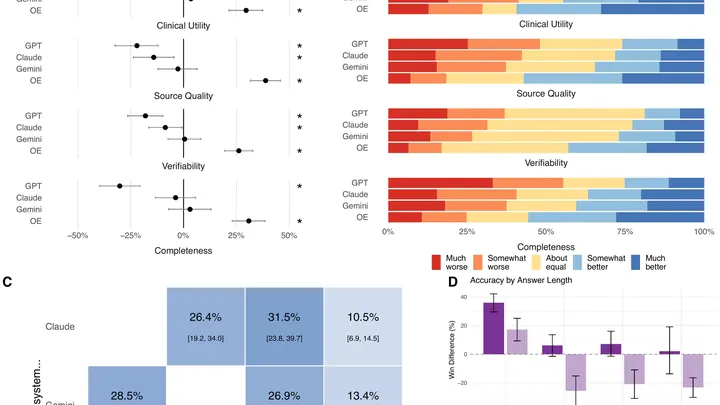
Every week, doctors ask AI assistants millions of questions at the bedside. But these tools are usually tested on exam-style problems, not on what clinicians actually ask in practice. A team of researchers set out to fix that. They collected 620 real questions from physicians across 30 specialties — from cardiology to oncology.
Popular Physics2026-06-261 minarXiv:2606.28437express
Traces of Mind: What We Miss in the Search for Aliens
Studying distant exoplanets, scientists look for signs of life — for instance, water and carbon — and signs of technology: radio signals, megastructures. But between these clues there is a yawning gap. If intelligence hasn't created machines or they've vanished, we won't notice it.
Fluid Dynamics2026-06-182 minarXiv:2606.20139express
How Invisible Vortices Turn Smooth Flow into Chaos
Air flowing over a wing or turbine blade behaves like a string: it starts smooth and layered: that's the laminar regime. But as speed increases or external ripples appear, the string breaks into chaotic vibration — turbulence. Predicting the exact moment of breakdown is crucial: it affects drag, heating, and noise.
How to Design the Perfect Therapeutic Peptide: Three Properties at Once
An engineer tunes an antenna: pull one segment, the frequency drifts; change the angle, the gain drops. Developing therapeutic peptides (short protein chains) works much the same way.
A Genetic Anchor for Health
You buy a new kitchen scale, but instead of exact weight, it only shows deviations from some "norm." To find out how much an apple weighs, you first have to weigh dozens of other apples and calculate the average.
cs.CE2026-06-051 minarXiv:2606.07258express
How to Test a Predictor Without Knowing the Answer
A lab sends a robot a list of a thousand candidate molecules for a new drug. The predictor robot, trained on old data, gives each one a 'fit or no fit' score. But when the list comes from an unfamiliar area, a different virus or a rare tumor, the robot starts to get confused. Its confidence stays high, while actual hits drop to zero.
The Brain as an Orchestra That Also Plays Jazz
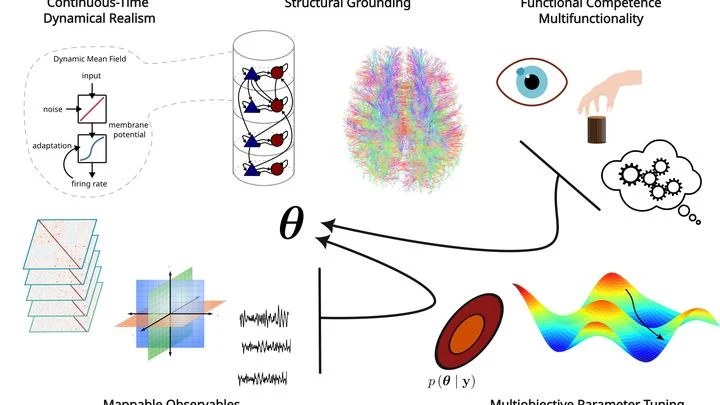
Engineers are building a car. Some assemble an exact replica of the engine, every piston and spark plug, but the car doesn't move: there's no steering wheel or wheels. Others build a fast self-driving go-kart, but its engine is made of playdough and doesn't resemble a real one. This is roughly the situation in brain science.
Machine Learning2026-05-082 minarXiv:2605.07878express
Why Some Questions Work and Others Don't
You're trying a dish at a restaurant, but you haven't seen the menu. You ask the waiter questions — too salty? what spices?—and from the answers you try to guess what kind of chef prepared it.
How the Brain Balances on the Edge
The brain is like a multi-story building: lower floors process simple signals, while upper floors assemble them into complex perceptions. Scientists have long suspected that this order is tied to how neurons work together. But exactly how has remained a puzzle.
Why the Second Touch Feels Different
Your hand rests on the table, and two short vibrations arrive at your wrist — one after the other. You need to say which is stronger. The task seems simple, but the answer depends on which vibration came first. If the first is weak and the second is strong, the difference feels larger than when they are swapped.
Popular Physics2026-04-211 minarXiv:2604.20896express
The Loeb Scale: When a Strange Rock Isn’t Just a Rock
Astronomers occasionally spot interstellar objects — rocky chunks or comets from other star systems. Most look ordinary, but some puzzle us with their shape, speed, or shine. To stop guessing, scientists applied the Loeb scale: from 0 (plain rock) to 5 (technosignature — an artificial signal from space).
The Artificial Scientist: Machine Minds That Still Can't Doubt
A lab assistant carefully follows every step of an experiment, but at the end, writes in the report what they wanted to write before they even started. That's how modern language models behave when given scientific research tasks.
Machine Learning2026-04-161 minarXiv:2604.15273express
Graph Labels: When Quantum Methods Yield to Simplicity
A city map: intersections are nodes, streets are connections. For an algorithm to understand the structure, each node needs a label. The classical approach — standard model — assigns simple tags, like house numbers.
q-bio.QM2026-04-111 minarXiv:2604.11824express
An Exam for AI Scientists
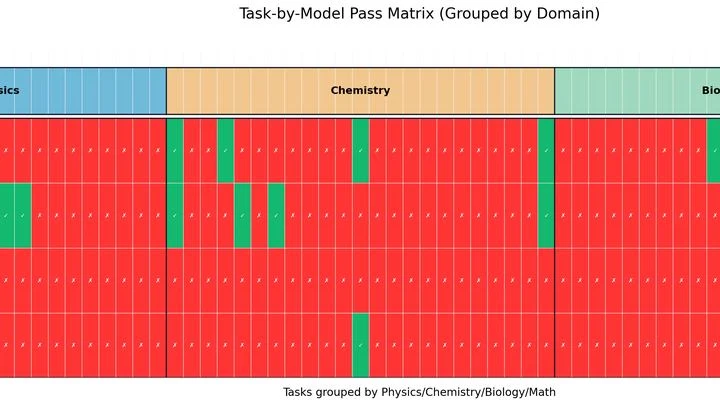
The best AI assistant for scientists scored worse on this exam than a C student on a pop quiz. Just 21% correct answers, and that's the ceiling for the four strongest models. The problems for the new test were written not by programmers but by graduate students: people who deal with real science every day. The test is called COMPOSITE-STEM.
When Code Isn't Born from the Paper
A translator who has never been in a meeting translates literally, and loses half the meaning. They don't know that the boss's nod means "do it like last time," and the phrase "well, we'll see" is a polite refusal. That's how a language model that writes code from a scientific paper works: it can read the equations, but not the unspoken agreements.
Chemical Physics2026-04-021 minarXiv:2604.02144express
How to Check the Accuracy of Quantum Calculations
When chemists calculate the behavior of molecules on a computer, they use approximate methods because exact calculations are too complex. For light atoms, there are well-established benchmarks, but for heavy atoms, where relativistic effects matter, such benchmarks did not exist. It's like checking a ruler against another ruler rather than against a standard meter.
Weather Forecast: Sharp Focus
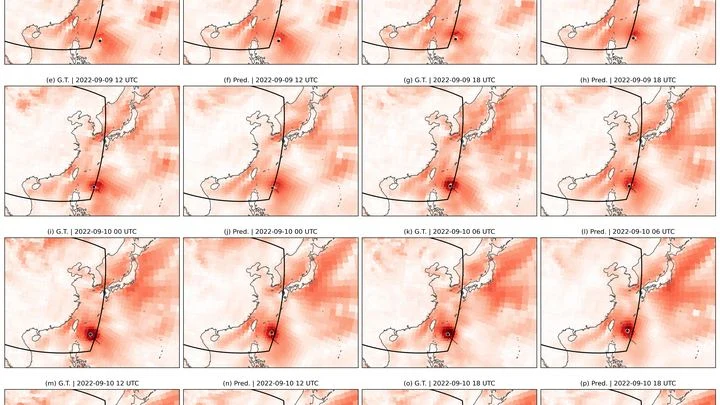
The atmosphere is a chaotic system, and a detailed global forecast requires monstrous computing power. StretchCast sidesteps this by working like the human eye: it creates 'sharp vision' over a selected region with an ultra-fine grid, while seeing the rest of the world blurry, but sharp enough to capture global connections.