An Electronic Guide for Artificial Vision express
An eye prosthesis sends the brain not a photograph but a sparse pattern of bright dots — phosphenes. To make out a cup or keys in this flickering noise, a person has to move their head like a flashlight in the dark, piecing together the object's outline bit by bit. It's a slow process, like assembling a puzzle where most pieces have been thrown away.
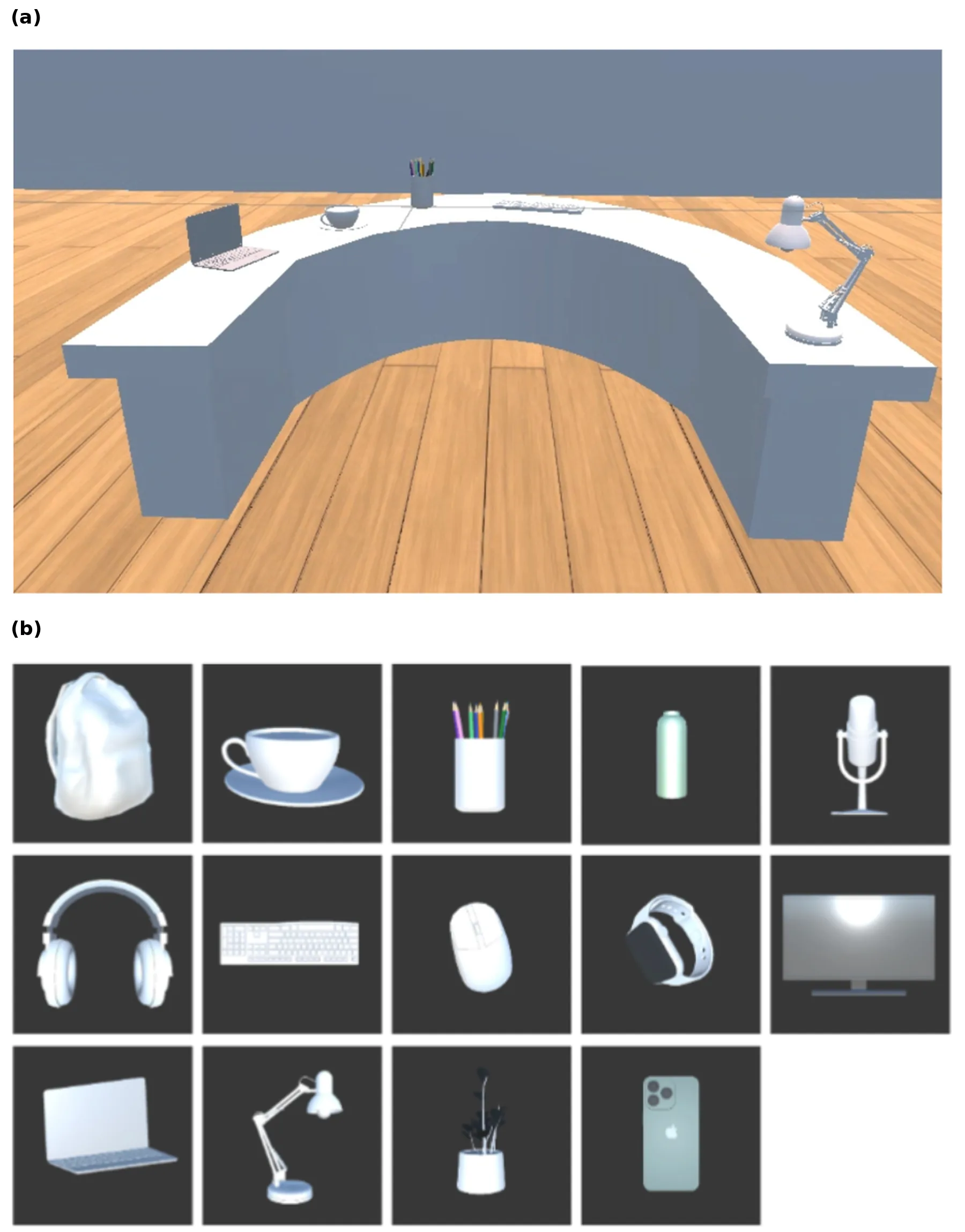
A team of researchers tried to nudge the brain when it was truly focused on the search. Twenty-two participants donned a virtual reality headset with dry electrodes that picked up the brain's electrical activity (EEG). In front of them appeared a virtual table drawn with a sparse scattering of glowing dots. The task: find a given object as quickly as possible. After each attempt, a colored marker appeared on the screen: a green light if a special engagement index, the ratio of fast beta waves to the sum of slow alpha and theta, was high, and red if it was low. A second group saw the same markers but random, unrelated to brain activity.
Everyone improved: by the end of the session, participants found objects faster and more accurately. But the "smart" hint gave no advantage — neither in speed, nor errors, nor perceived workload. The brain learned on its own, simply getting used to the phosphene mosaic and developing its own scanning strategies. The variation between participants was huge: in some, engagement grew in sync with success; in others, it didn't.
The authors aren't giving up on the idea of a neuroadaptive assistant. They showed that EEG and prosthetic vision can be combined in a single wearable system. But one training session and a crude engagement index aren't enough. Perhaps a future assistant will need to tune a personal rhythm for each user, like tuning a musical instrument before a concert.
Original abstract
as written by the authors arXiv:2607.23889
Visual prostheses require users to interpret sparse and distorted artificial percepts through active visual search. We developed an EEG-guided neuroadaptive training platform for simulated prosthetic vision in immersive virtual reality and evaluated its feasibility in a sham-controlled object-localization task. Twenty-two sighted participants searched a virtual desk scene rendered through a low-resolution phosphene simulation while EEG was recorded using a dry-electrode headset integrated with a head-mounted display. During training, participants received post-trial visual feedback based either on a commonly used EEG engagement index, $$\beta/(\alpha+\theta)$$, or on visually matched non-contingent sham values. Both groups showed comparable within-session improvements in localization performance, consistent with practice, increasing familiarity with the simulated percepts, or refinement of search strategies. EEG-contingent feedback did not produce reliable group-level benefits in localization accuracy, completion time, workload, or modulation of the targeted index. Exploratory analyses showed substantial individual variability, but did not establish a feedback-specific relationship between the engagement index and behavioral performance. These findings demonstrate the feasibility of integrating EEG-contingent feedback with immersive simulated prosthetic vision, while identifying important limitations of the EEG measure, single-session training protocol, and post-trial feedback design.
Phosphenes are those very 'stars' we see when pressing firmly on closed eyes. It's from such flashes that the image in most modern visual prostheses is made.