Flickering, or stellar variability, refers to the irregular or periodic changes in a star's brightness over time. These variations can arise from a wide range of physical processes: pulsations of the stellar surface, convection-driven granulation, starspots rotating in and out of view, or even the presence of a companion star or planet. In astrophysics, flickering is a powerful diagnostic tool because the timescale and amplitude of brightness changes encode information about the star's internal structure, magnetic activity, and evolutionary state.
History
The study of stellar variability dates back to ancient times with novae and supernovae, but systematic photometric monitoring began in the 19th century. The connection between flickering and stellar structure was established in the 20th century with the development of asteroseismology.
How it works
The mechanism depends on the cause. For pulsating stars (like Cepheids), the star's outer layers expand and contract, changing the effective surface area and temperature, which modulates the emitted light. For convective stars, hot and cold plasmabubbles rise and sink, causing a stochastic flicker. In binary systems, flickering can be caused by accretion of matter onto a compact object, producing rapid, irregular brightness fluctuations. By analyzing the power spectrum of the flickering, astronomers can infer the dominant physical process.
The Sun itself flickers at the level of about 0.1% due to granulation and solar oscillations, a phenomenon that must be carefully modeled when searching for Earth-like exoplanets.
In a binary star system, one star pulls matter from its companion. Over centuries, this material settles onto the surface of a neutron star — the ultra-dense remnant of a dead star. This process, called accretion, usually proceeds smoothly. Gravity behaves as general relativity predicts, without surprises.
The Sun is constantly struck by blows — magnetic reconnection in the plasma releases energy, making the corona flare up. After each such blow, magnetohydrodynamic waves linger in the plasma loops, like the fading ring of a bell.
For over a century, astronomers puzzled over the capricious behavior of RR Lyrae stars: their brightness periodically waxed and waned with unpredictable amplitude, like a lighthouse with a faulty mechanism. The Blazhko effect, discovered in 1907, taunted scientists for decades.
Since their discovery in 2007, fast radio bursts (FRBs) have teased astrophysicists with their elusive nature. These millisecond signals arrive from distant galaxies and carry colossal energy: for an instant, they radiate as much as the Sun does in a month.
Images from the James Webb Space Telescope have revealed unexpectedly intense light from the first galaxies — colossal star systems that formed shortly after the Big Bang. Imagine a toaster browning a slice of bread in a minute, while an oven takes an hour to bake a loaf — the result is essentially the same.
A lighthouse blinks steadily once per second. If it moves in a circle, its flashes arrive sometimes a bit early, sometimes a bit late, and they give away an invisible companion. That's exactly how astronomers exposed the hidden partner of the star IY Lyrae.
IY Lyrae is a pulsating variable star in the thick disk of the Galaxy.
A semiconductor film one atom thick is like a tightly stretched membrane. Light makes it flash: luminous points (excitons) are born, which quickly fade. Where the membrane is torn or crumpled, the glow flickers and stutters, like a string with a knot sounding off-key.
In the star cluster NGC 2158, which is over a billion years old, astronomers have counted how often stars live in pairs. The Hubble telescope stared at the cluster for a long time to catch even the faintest stars: those lighter than one-third of the Sun.
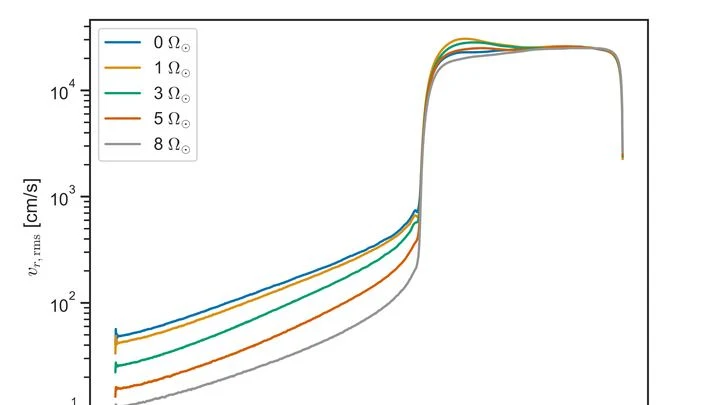
A star like the Sun hums like a bell: sound waves inside make its surface tremble ever so slightly. From this trembling, astronomers, like doctors reading a pulse, infer the star's temperature, density, and age. But the Kepler telescope spotted an oddity: many stars that spin fast and are covered in spots show no trembling at all. It's as if they've lost their voice.
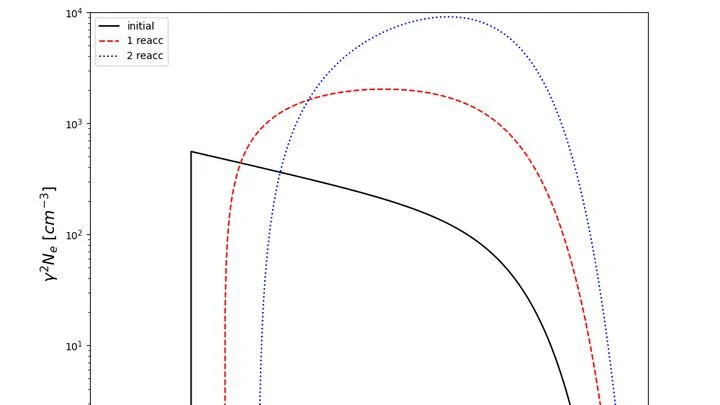
A blazar is a distant galaxy with a plasma jet shooting from its center, aimed almost directly at us. Inside this jet, particles are accelerated to near-light speeds and emit powerful radiation.
The young star RY Tau is like a finicky spinning top. Around it whirls a flat disk of gas and dust — the leftovers of the cloud from which the star was born. The star pulls some of the disk's matter toward itself like a vacuum cleaner, and flings some back out in a narrow wind cone like a fountain.
The Gaia space telescope has measured how fast more than a hundred thousand stars spin. It turns out that a star's rotation speed depends on its temperature. For stars cooler than 6500 degrees, the surface moves at 10–20 kilometers per second.
A star trembles like a bell after being struck. These tremors, tiny fluctuations in brightness and surface, can be caught by a telescope. From the frequencies of these 'stellar notes,' astronomers infer what's happening inside: how old the star is, how it's structured.