cs.HC cs.HC

11 articles

articles

The Gaze's Signature: How Eyes and Hand Agree on Timing
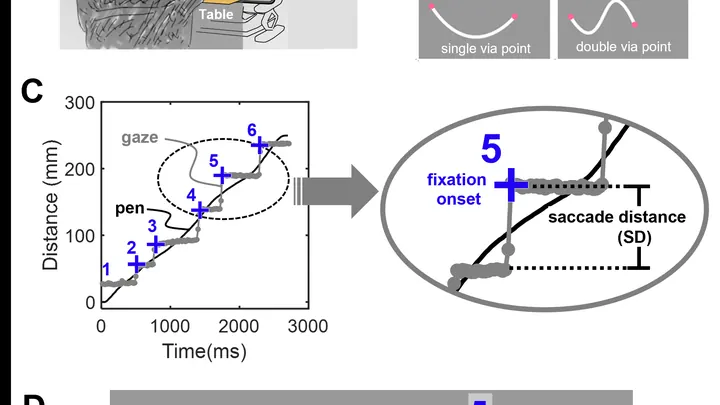
When the hand draws a line, the gaze almost always runs ahead, like a scout peeking around the corner before the column turns. But how far ahead? It turns out that each person has their own distance, and it does not change from attempt to attempt. In the experiment, professional calligraphers and ordinary people traced a contour on a screen while instruments recorded eye and pen movements.
Signal Processing2026-02-281 minarXiv:2603.16891express
AI Reads Cardiograms Around the Clock
An electrocardiogram is like a long strip of paper on which the heart leaves its signature. A doctor studies it to catch rhythm disturbances, but when the recording lasts for days, the strip stretches for miles. The eye tires, attention wanders, and rare but dangerous irregularities can slip by. AI-HEART works like a tireless assistant that scans the entire strip without a break.
Signal Processing2026-04-041 minarXiv:2604.24765express
The Brain Translator: How Different People Hear the Same Signal
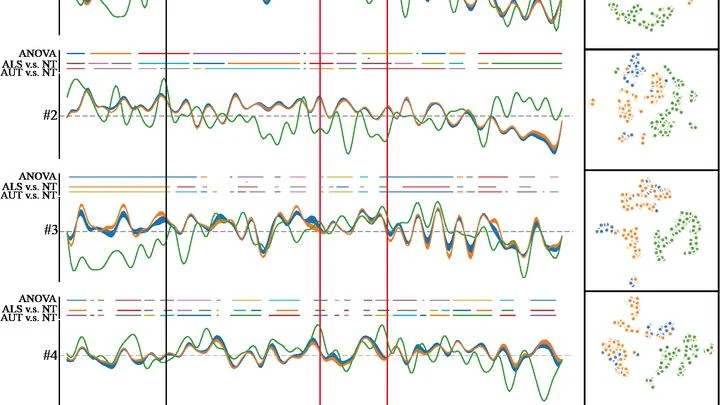
A person looks at flashing letters on a screen, and a computer guesses which one they chose by a burst of brain activity. It's like an interpreter who catches not words but the brain's electrical signals. But different people's brains 'speak' with an accent: one person's signal is bright and clear, another's is quiet and smeared.
When Code Isn't Born from the Paper
A translator who has never been in a meeting translates literally, and loses half the meaning. They don't know that the boss's nod means "do it like last time," and the phrase "well, we'll see" is a polite refusal. That's how a language model that writes code from a scientific paper works: it can read the equations, but not the unspoken agreements.
Instrumentation2026-05-272 minarXiv:2605.28916express
Two AI assistants hunted for gravitational waves: who did better?
Two translators were given the same tape recording of a whisper from distant stars. Their task was not just to translate, but to decipher, clean up the noise, and find in that static the barely perceptible rhythm of colliding black holes. That is exactly the job performed by two artificial intelligence systems: Claude Code from Anthropic and Codex from OpenAI.
A Genetic Anchor for Health
You buy a new kitchen scale, but instead of exact weight, it only shows deviations from some "norm." To find out how much an apple weighs, you first have to weigh dozens of other apples and calculate the average.
cs.HC2026-06-303 minarXiv:2607.00239
Retouching by the rules: where science ends and deception begins
On the screen is the result of a complex simulation: two planets collided, a shockwave ripples outward. A couple of clicks in an editor, and harsh shadows soften, noise smooths out, the background darkens. This kind of digital retouching (image editing to enhance appearance) has long been part of the scientist’s toolkit.
Robotics2026-07-161 minarXiv:2607.15129express
Robot Juggler: Synchronized Play with a Human
The robot juggler catches and throws balls in precise rhythm with a human, like two пульсара sending pulses in unison. Juggling three balls is a classic cascade, governed by a steady beat, like the uniform rotation of a cosmic lighthouse. Break the rhythm and the pattern crumbles.
cs.HC2026-07-262 minarXiv:2607.23889express
An Electronic Guide for Artificial Vision
An eye prosthesis sends the brain not a photograph but a sparse pattern of bright dots — phosphenes. To make out a cup or keys in this flickering noise, a person has to move their head like a flashlight in the dark, piecing together the object's outline bit by bit. It's a slow process, like assembling a puzzle where most pieces have been thrown away.
cs.HC2026-08-032 minarXiv:2608.01820express
Smartwatches vs. Sugar: Why the Accuracy Was a Mirage
A glucose meter that doesn't prick your finger but just looks at your wrist: that's the dream for millions of people with diabetes. It's the promise of algorithms that extract glucose levels from the ordinary pulse signal, the photoplethysmogram (the same one that measures heart rate in smartwatches).
Machine Learning2026-08-172 minarXiv:2608.16134express
Brain-Computer Interface: Teaching Machines to Read Minds Day After Day
Every day, the brain sounds a little different. Yesterday, the thought of moving your left hand produced one pattern of electrical waves; today, it's slightly different. For a brain-computer interface (a device that turns mental commands into actions), this is a big problem: yesterday's settings don't work today.