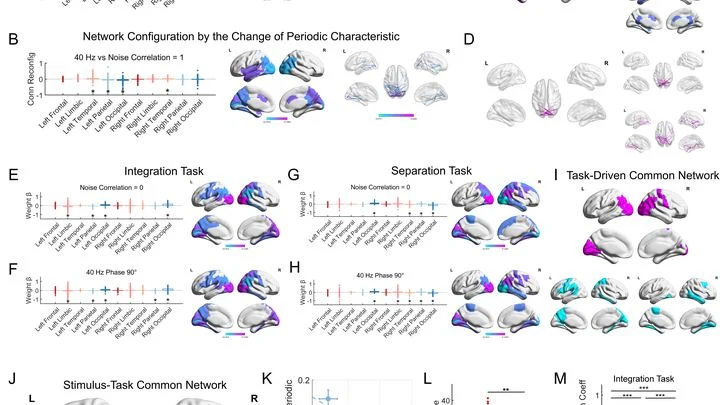
The parietal region is a part of the brain located near the top and back of the head, involved in processing sensory information and spatial awareness. It integrates signals from different senses, such as touch, vision, and hearing, to create a coherent representation of the body and its position in space. This region is essential for tasks like navigating a room, reaching for an object, and even understanding numbers and language. Damage to the parietal region can lead to difficulties in spatial orientation, coordination, and recognizing objects by touch.
History
The importance of the parietal region was recognized in the late 19th century through studies of patients with brain lesions. In 1876, Carl Wernicke identified the parietal lobe's role in language comprehension, and later work by Korbinian Brodmann in 1909 mapped its cytoarchitectural areas, providing a detailed anatomical framework.
How it works
The parietal region receives input from the thalamus, which relays sensory information from the body. It then processes this information through a network of neurons that map the spatial relationships between body parts and the external world. For example, the somatosensory cortex within the parietal region contains a map of the body, where different areas correspond to different body parts. The region also communicates with the frontal lobe to plan and execute movements, and with the temporal lobe to integrate memory and recognition.
In practice
Understanding the parietal region is crucial in neuroscience and medicine, particularly for diagnosing and treating conditions like spatial neglect, where patients ignore one side of their body or space. It also informs the development of brain-computer interfaces and rehabilitation strategies for stroke patients.
Fun fact
The parietal region contains a 'body map' called the homunculus, where the size of each body part's representation is proportional to its sensitivity, not its physical size—so the lips and fingers take up more space than the back.
When you're standing on a bus and the driver suddenly brakes, your brain manages to tense your muscles in a fraction of a second so you don't fall. This automatic response is born deep in the cortex, in an area that plans complex movements, the supplementary motor cortex.
Skin remembers touch the way an old map remembers roads: the lines we trace with a finger again and again grow deeper over time, while the ones we rarely follow fade away. In a new study, scientists asked 43 women of two age groups to apply cream to a cheek or forearm and describe their sensations using forty words.
A jazz trio plays in the dim light of a club. The pianist leads the melody, the bassist holds the rhythm, and the drummer sprinkles out rolls. If you listen only to pairs of musicians, you can catch how the pianist adjusts to the bass or the bass to the drums.
A radiologist looks at an abdominal scan and sees not just organs but their spatial relationships: which kidney is larger, where the tumor lies relative to a vessel. It's like reading a map, where it's not enough to know where a city usually stands; you also need to measure the distance between two points on the ground.
In an orchestra rehearsing a symphony, every musician must take their part on cue. If a violinist suddenly decides he's a cello, and a flutist starts playing the trumpet's part, the music turns into noise.
In 2023, in Belgium, 101 people aged 50 to 69 spent several days in a lab where their brains were scanned, their sleep was recorded, and they were asked to solve memory and attention tasks. That is how the COFITAGE dataset was born, describing each participant from five angles: molecular, structural, physiological, genetic and cognitive.
The brain as a house built too spacious: lovely to live in, but expensive to maintain. Parkinson's disease is usually pictured as the destruction of that house, with neurons dying and structures shrinking.
In a school report card, each grade speaks for itself, but you can only tell how a student is doing overall by looking at the full report. For drugs that act on the brain, such a report card was missing for a long time. Every test on a miniature brain grown in a dish gave its own signal: some genes switched on, others switched off, electrical impulses sometimes sped up and sometimes went quiet.
The classroom goes quiet after the lesson, but the echo still rings in the child's head: faces, objects, places. It is this echo, not the lesson itself, that decides what will stay in memory. For the first time, researchers have caught it in children aged 6 to 17.
Children memorized scenes inside an MRI scanner: they were shown a room, then an object or a face in a particular spot.
Getting lost in a hall of mirrors is easy: every wall reflects another, and you feel like you've been here before. The brain gets similarly confused when surrounded by many similar places. Neurons responsible for the spatial map can fire the same signal for two different corners of a room. This is called spatial ambiguity.
The brain is like an orchestra, with the cortex as the conductor and the thalamus as the first violin. The thalamus relays signals from the eyes to the visual cortex. But the cortex can also send commands back, tuning the thalamus for the task at hand. This was once a hypothesis, but now it's been tested in humans.
A stadium packed with fans hears the announcer’s voice for the first time, and instantly the whole place erupts. The message sounds again and again. Only a handful of people in nearby rows respond. That’s roughly how neural networks behave in brain organoids — tiny lab-grown replicas of the brain.
One hundred forty parsecs, a distance light traverses in four and a half centuries, separate us from the Taurus molecular cloud. Within its depths hide dark condensations: prestellar cores, where gas and dust slowly contract under their own weight.
A disease outbreak is like a wildfire: the fire runs through dry grass, and its speed depends on wind and humidity. But an infection has its own 'wind'—how often people infect each other. When this rate changes along with the fraction of already infected, the epidemic wave can behave differently.
An eye prosthesis sends the brain not a photograph but a sparse pattern of bright dots — phosphenes. To make out a cup or keys in this flickering noise, a person has to move their head like a flashlight in the dark, piecing together the object's outline bit by bit. It's a slow process, like assembling a puzzle where most pieces have been thrown away.
In a noisy room, a person picks out a desired voice thanks to two ears capturing the difference in sound arrival. A computer with several microphones does the same: it gets spatial cues — where each voice is coming from.
Previously, these cues were used to focus on one direction, like a flashlight beam.
Cleaning speech from noise is like tuning an old TV: twist the contrast knob too far, and faces become unnatural. Researchers separately adjusted the 'volume' and 'time shift' for each frequency of sound, as if splitting it into a rainbow — a method known as spectroscopy. It turned out the key knob is volume, not phase synchronization.
Imagine an old theater in the damp fog. On the stage, a scattering of actors, but only one is caught by the spotlight beam, made to freeze in the bright patch. The rest billow in the dim light, ready to dissolve at any moment.
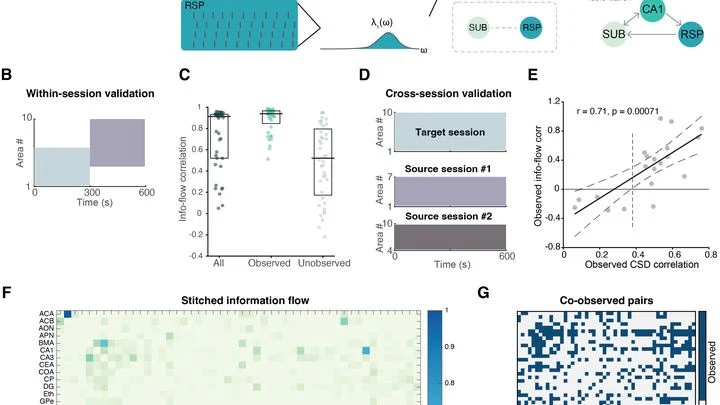
A patchwork quilt where each patch is a recording of activity from a small brain region. One patch was stitched on Monday in London, another on Tuesday in New York, and a third a month ago in Tokyo. This mosaic covers the brain only partially, and there is no common seam to join them.
A flashlight shines through skin and bone to gently switch on neurons at the right spot in the brain. That is how transcranial magnetic stimulation works — a coil on the head creates brief magnetic pulses that trigger electrical signals in cells. But if you tilt the flashlight or move it away, the light goes astray.
The brain constantly juggles tasks: it reacts to a sharp sound, solves an equation, or drifts into daydreams. Scientists have long suspected that switches between different "scenarios" of neural network activity underlie this, but extracting them from the chaos of electrical signals was difficult.
The brain is like a multi-story building: lower floors process simple signals, while upper floors assemble them into complex perceptions. Scientists have long suspected that this order is tied to how neurons work together. But exactly how has remained a puzzle.
Your hand rests on the table, and two short vibrations arrive at your wrist — one after the other. You need to say which is stronger. The task seems simple, but the answer depends on which vibration came first. If the first is weak and the second is strong, the difference feels larger than when they are swapped.
Seismologists listen to the Earth the way a doctor listens to a heart. Surface waves from earthquakes travel across the planet, and their speed reveals what lies beneath our feet — solid rock, melt, or water. Usually, this requires building complex physical models.
Speech is like an orchestra where every note must sound at just the right moment. The brain turns a thought into a chain of sounds in a fraction of a second, and until now it was unclear how it manages this hierarchy — from individual sounds to syllables to whole words.
The placenta is like a bustling market where oxygen passes from mother to child. If the stalls are neatly arranged and goods are delivered quickly, everyone gets enough. But when the aisles get clogged, traffic jams start: some places are crowded, others empty.
The brain is like a sprawling city: districts-regions communicate via streets-neural pathways. If traffic lights at an intersection fail, traffic grinds to a halt. Similarly, in the brain, when bundles of nerve fibers (white matter) malfunction, distant regions stop working in concert, and thought stalls.
When moving to a new apartment, a person doesn't relearn how to open doors or turn on lights. Experience from the old home transfers automatically: a kitchen is a place with a stove and a sink, a bedroom is a place with a bed. The brain doesn't store an exact map but a flexible schema that it overlays onto unfamiliar space.
Scientists have built a computer model of this transfer. It has two levels.
A pea-sized brain region brings a rat to a halt mid-step. A laser beam hits light-sensitive cells, and the animal stops as if it hit an invisible wall. This is the rostral pedunculopontine nucleus — a cluster of neurons in the brainstem that controls movement.
The authors built a low-cost setup with a camera and a mini-computer.