Ant death: size isn't everything express
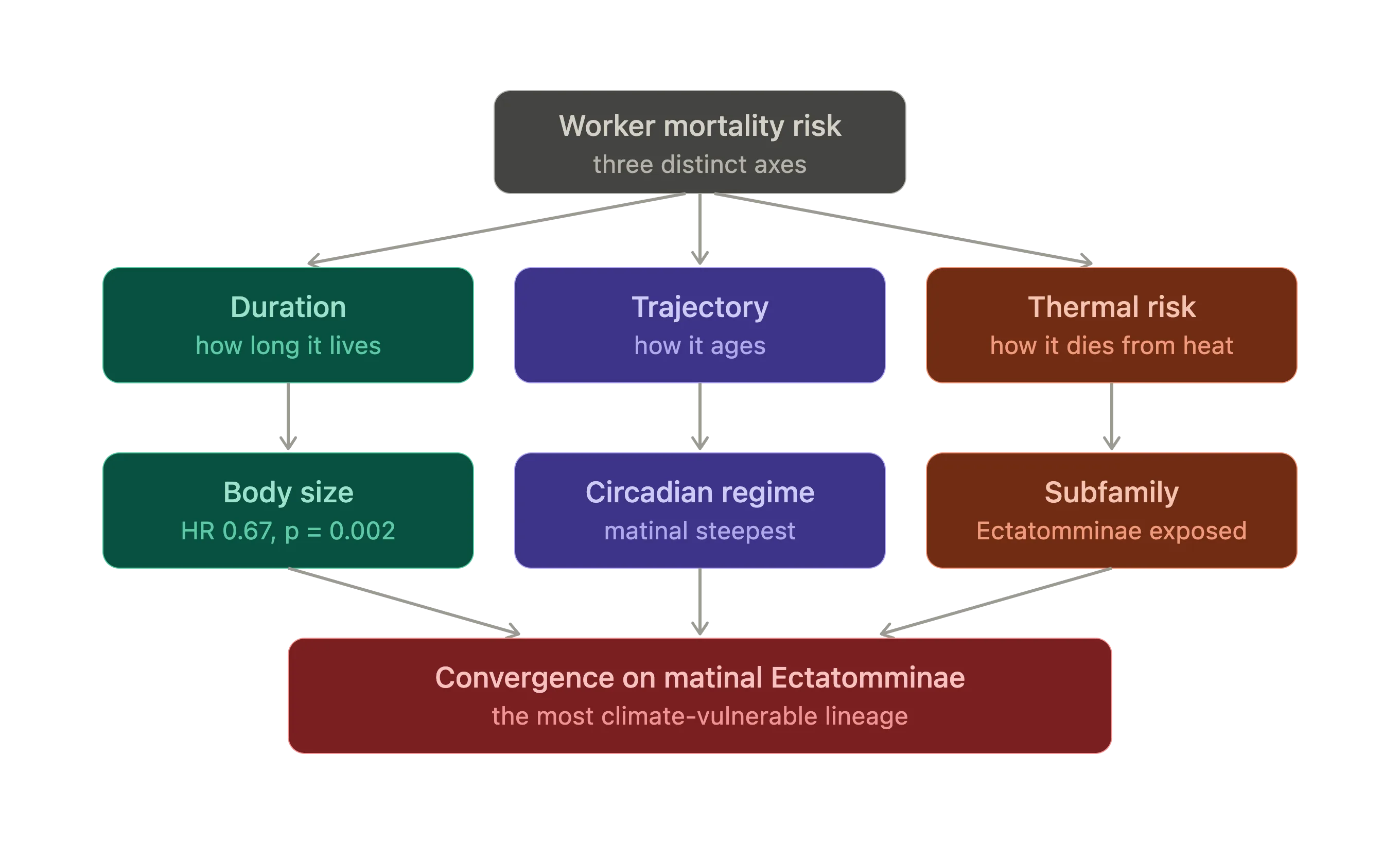
An ant the size of a grain of rice lives longer than its neighbor half its size. But when heat strikes, the bigger one isn't necessarily tougher. Researchers in Australia collected 18 species of ants and checked three things: how long workers live, how quickly they deteriorate, and at what temperature they start to die.
It turned out that body size reliably predicts only one thing — lifespan. Larger ants live longer (their risk of dying at any given moment is a third lower). But the rate of aging is not linked to body mass: it depends on what time of day ants are active. Morning species age more steeply than twilight ones. Heat sensitivity also doesn't depend on size. Above 20 degrees, mortality rises sharply in all species, but in one subfamily, Rhytidoponera, each additional degree adds 5% risk.
To predict how insects will survive climate warming, size alone is not enough. You also need to know activity time and the species' lineage. Otherwise, you might overestimate the resilience of some and underestimate the vulnerability of others.
Original abstract
as written by the authors arXiv:2608.14245v1
In social insects, mortality risk comprises distinct components that may not share the same predictors: lifespan duration, senescence trajectory, and thermal vulnerability. We tested these three axes in 18 Australian ant species using paired field-laboratory survival assays (2,363 cohort-day observations; 1,148 workers). Body size predicted duration (Cox HR = 0.67, p = 0.002), while colony size (p = 0.60) and the size x temperature interaction (p = 0.72) showed no detectable moderating effect. A weak but significant size x foraging-rate interaction was detected (LRT p = 0.014), suggesting that intrinsic physiology remains the most parsimonious explanation for the main size-longevity pattern, although ecological context may contribute. Senescence trajectory was associated with circadian niche rather than size: it was steepest in matinal species (Kruskal-Wallis p = 0.009; matinal vs. crepuscular p = 0.002) and was uncorrelated with body mass (Spearman p = 0.32). Thermal hazard plateaued above 20 degrees C (Delta AIC = -38; p < 0.001), with elevated thermal sensitivity in Rhytidoponera (Ectatomminae) above the plateau (5% per degree C, p = 0.015). Circadian regime and lineage identity, not body size, therefore emerge as the most climate-relevant axes, although they are strongly collinear (Cramer's V = 0.85). These results show that body size captures only one dimension of mortality risk and that size-based vulnerability indices may misrank taxa when senescence and thermal sensitivity are decoupled from body size.
Morning-active ant species age faster than twilight-active ones — possibly because their activity falls during the hottest and driest part of the day.