Shelford's law of tolerance states that an organism's survival and reproduction are limited by environmental factors exceeding its upper or lower tolerance thresholds.
Victor Shelford formulated the law of tolerance in 1913: the presence and prosperity of a species in an ecosystem is determined by how well the values of environmental factors match its range of endurance. For each factor (temperature, humidity, light, salt concentration), there is a zone of tolerance — the interval between minimum and maximum values in which life is possible. Within this zone lies the optimum point, where conditions are ideal, and toward the edges, viability declines. If even one factor exceeds the tolerance limits, the species disappears, even if everything else is normal. This principle supplemented Liebig's law of the minimum, which only addressed the deficiency of substances. Shelford showed that excess is also harmful: one can overwater a plant or overfeed it with fertilizers.
History
Victor Shelford, an American zoologist and ecologist, published the work "Animal Communities in Temperate America" in 1913, where he outlined the concept of tolerance. He studied the distribution of insects and fish in relation to temperature, humidity, and other factors and noticed that species disappear not only with a deficiency but also with an excess of a resource. His ideas advanced the concepts of physiological ecology and became the foundation for the theory of the ecological niche. Later, the law was supplemented with the notion of a species' "ecological amplitude" and used in predicting the consequences of environmental pollution.
How it works
The law is applied in agriculture to determine the cultivation boundaries of crops, in conservation biology to assess species' vulnerability to climate change, and in toxicology to establish safe doses of substances. Limits of applicability: the law describes stationary conditions and does not account for acclimation (gradual habituation) and adaptation; the interaction of factors can shift tolerance limits (for example, high humidity makes heat less tolerable). For species with a wide ecological amplitude (eurybionts), the limits are blurred.
In practice
The law is used to predict how climate change will affect crops or the spread of pests. For example, knowing the temperature limits of the Colorado potato beetle, one can estimate how far north it will advance.
Fun fact
Brine shrimp live in salty lakes where other animals perish. Their tolerance limit for salt is so high that they survive in water almost saturated with salt — where crystals are already precipitating to the bottom.
Swimming season opens when the water feels tolerable. But everyone has their own threshold: one person shivers at twenty degrees, another swims comfortably at fifteen. Scientists decided to figure out where this difference comes from.
They compared a swimmer's body to a house trying to keep heat in while a cold wind blows outside.
A lone fish sees a shadow overhead. Should it flee? If it's just a leaf, it wastes energy and gives away its position to a predator. If it's a heron, hesitation is fatal. That's the eternal trade-off of the solitary individual: quick reactions mean many false alarms, while caution means risking being eaten.
In a school, it's different.
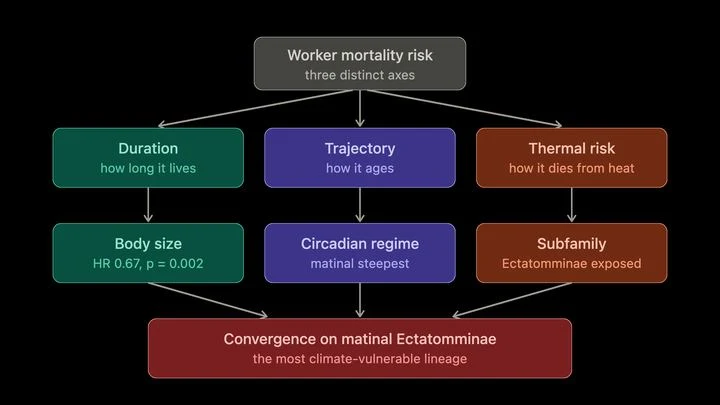
An ant the size of a grain of rice lives longer than its neighbor half its size. But when heat strikes, the bigger one isn't necessarily tougher. Researchers in Australia collected 18 species of ants and checked three things: how long workers live, how quickly they deteriorate, and at what temperature they start to die.
Two daughter cells receiving equal shares from the mother: that's the familiar picture of division. But what if one gets almost everything and the other just crumbs? Stochastic modeling shows that sometimes unequal division is more advantageous.
Each cell stores a protective reserve that helps it weather hardships. During division, this reserve is distributed between daughters.
A choir where every singer hits the notes precisely sounds louder than you'd expect from a simple sum of voices. A hundred singers aren't just a hundred times louder than one: they're ten thousand times louder. In the world of atoms, something similar happens. In collective behavior discovered by Robert H.
In 1970, mathematician John Conway invented the Game of Life — a cellular field where just three rules generate surprisingly complex patterns. Forty years later, SmoothLife appeared: a version where space is no longer cellular but smooth, like a blurred patch. The authors of the new study took an even simpler variant of this continuous game: now everything changes smoothly in time as well.
Two gardeners haggle over water from a magical well. One proposes how many buckets to take, the other can agree or refuse. If the deal goes through, the water decreases; if not, the well gradually refills. This haggling repeats hundreds of times, and the gardeners' habits sometimes change randomly, as if they're trying new tactics.
In the web of life, predators and prey exchange carbon and water, and each act of eating slightly increases the universe's disorder. But the intrusion of disease turns this system into a giant seesaw. When a mid-level predator gets sick, its hunting abilities decline, and it becomes easy prey.
Ecosystems are not chaos but a complex dance where every species plays its part. Scientists modeled such a dance: two prey compete for carbon and water (the building blocks of cells), while a predator eats both. Sixteen scenarios emerged — from predator extinction to a steady rhythm for all three species.
A runner loses on both a smooth track and sticky sand. Seems hopeless. But if the surface underfoot starts changing every few seconds (track, then sand) the runner suddenly stops falling behind. He doesn't get faster; the environment just doesn't get a chance to 'crush' his weakness.
That's exactly what the authors found when studying a simple predator–prey model.
Life is a constant dance between order and chaos. Back in the mid-20th century, Erwin Schrödinger noted that living things feed not so much on matter as on "negative entropy"—the ability to maintain their own order by increasing disorder around them.
A tightrope walker inches across a chasm. As long as they keep their balance and avoid sudden moves, they're safe. But one overcorrection, and a fall is inevitable. Life works much the same way at every level — from proteins inside a cell to entire ecosystems.
A vast hall with a thousand doors, and only one leads to the stars. The rest are locked, and the keys aren't just hidden: they're wrapped in other keys and tangled into a knot. That's the Great Filter in a new reading: not a chain of failures but a tangled hierarchy where each step depends on the previous one nonlinearly.
Schrödinger's cat, according to quantum rules, can be both alive and dead at once. But a table can't pull that off. When a massive object tries to be in two places, its mass curves spacetime so drastically that instead of two points, a single deep depression forms, and the object rolls into it.
In two neighboring ponds, the same microorganisms swim. Food appears now in one, now in the other — randomly, with no rule. After a month, there are a hundred times more of them in the first pond than in the second. No one chose where to live. Just luck.
This is how disequilibrium works. While the environment keeps changing, abundances don't have time to even out.
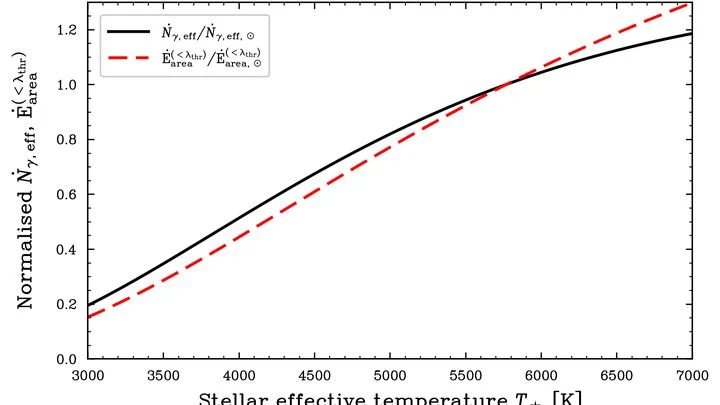
Oxygenic photosynthesis requires splitting water. It's kind of like a water wheel: to make it spin, you need a strong current. Light acts as the current, and light particles are the streams. For red dwarfs, the most common stars, the light is "cool" and weak — the streams barely move the wheel.
An infection is spreading through a city, and residents are watching each other: some have already been vaccinated, others are hesitant. Every day, they update their decisions — whether to imitate neighbors or friends who support vaccination.