A species is the fundamental unit of biological classification, defined as a group of organisms that can interbreed and produce fertile offspring, while being reproductively isolated from other such groups. This concept is central to understanding biodiversity, evolution, and ecology. In the context of the provided articles, species are the actors in ecological dynamics — from predator-prey models to microbial communities — and the units whose diversity is shaped by environmental noise, spatial structure, and evolutionary pressures.
History
The modern biological species concept was formalized by Ernst Mayr in 1942, building on earlier ideas from naturalists like John Ray and Carl Linnaeus. However, the concept has been debated and refined since, with alternatives like the phylogenetic species concept gaining traction.
How it works
The biological species concept relies on reproductive isolation: members of the same species share a gene pool, while barriers (geographic, behavioral, genetic) prevent gene flow with other species. In practice, species boundaries are often fuzzy, especially for microbes or organisms with asexual reproduction, where researchers may use ecological or genetic criteria instead. The dynamics of species populations — their growth, competition, and coexistence — are often modeled mathematically, as seen in the articles on predator-prey systems and stochastic noise maintaining diversity.
In practice
Species identification is essential for conservation biology, agriculture, and medicine — for example, tracking invasive species, managing fisheries, or identifying pathogens. In research, species are the units of study in population dynamics, ecosystem modeling, and evolutionary biology.
Fun fact
Some bacteria that look identical under a microscope can belong to different species based on their genetic sequences, and they may exchange genes across species boundaries, blurring the line between species in the microbial world.
Dutch family archives hold marriage records going back to 1600. From these records, like entries in an old ledger, you can extract two columns: how many children a person had and how many years they lived. Evolutionary biologists have been arguing for half a century over whether these columns are connected.
A forest does not live in a static world. Between winter and summer, day and night, conditions shift, and each fluctuation is like a rhythm that all its inhabitants must keep pace with. Yet until now, ecologists have mostly studied how communities of living beings persist in an unchanging environment, like testing a bridge's strength only in calm weather.
Rare species in a large community are like thin branches on a tree: a random gust can easily snap them. Even if conditions are stable, a small population simply lacks enough individuals to survive a bad season. In a new study, scientists added this factor to an ecosystem model and watched the community clean itself out.
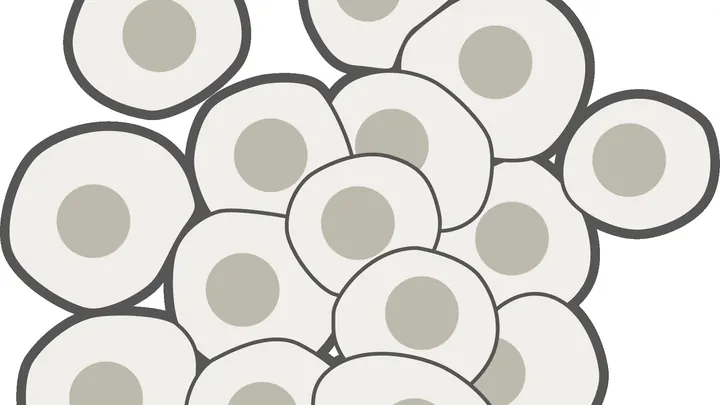
Two daughter cells receiving equal shares from the mother: that's the familiar picture of division. But what if one gets almost everything and the other just crumbs? Stochastic modeling shows that sometimes unequal division is more advantageous.
Each cell stores a protective reserve that helps it weather hardships. During division, this reserve is distributed between daughters.
When an antibody meets a virus, it doesn't latch on with a single death grip. Rather, it's like two bunches of grapes tumbling in water, catching each other with dozens of short tendrils. Each tendril is weak on its own, easily torn by the thermal jitter of water molecules, but together they hold tight.
A mosquito swarm resembles a living cloud — hundreds of bodies circle together, but no one lines up or mimics a neighbor's movements like starlings or fish. For a long time, it was unclear what held such unity together. The authors of a new study suggested that the insects communicate by sound.
In 1970, mathematician John Conway invented the Game of Life — a cellular field where just three rules generate surprisingly complex patterns. Forty years later, SmoothLife appeared: a version where space is no longer cellular but smooth, like a blurred patch. The authors of the new study took an even simpler variant of this continuous game: now everything changes smoothly in time as well.
Two gardeners haggle over water from a magical well. One proposes how many buckets to take, the other can agree or refuse. If the deal goes through, the water decreases; if not, the well gradually refills. This haggling repeats hundreds of times, and the gardeners' habits sometimes change randomly, as if they're trying new tactics.
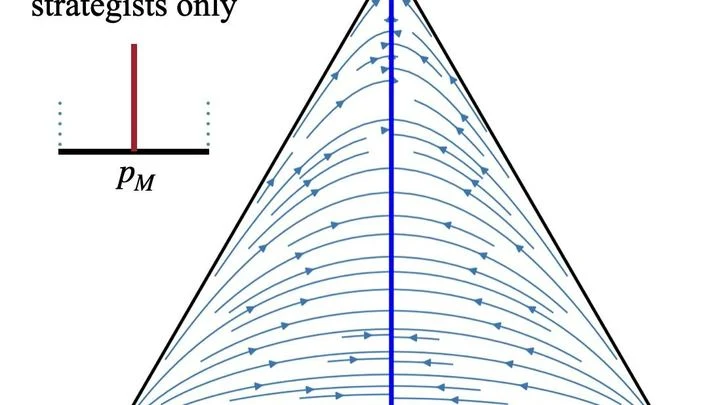
For a long time, biologists argued: if a herd of animals stably maintains a mix of aggressive and peaceful individuals, does each one alternately change behavior, or do some always fight while others always yield? In classical equations, these options are indistinguishable.
In the web of life, predators and prey exchange carbon and water, and each act of eating slightly increases the universe's disorder. But the intrusion of disease turns this system into a giant seesaw. When a mid-level predator gets sick, its hunting abilities decline, and it becomes easy prey.
Ecosystems are not chaos but a complex dance where every species plays its part. Scientists modeled such a dance: two prey compete for carbon and water (the building blocks of cells), while a predator eats both. Sixteen scenarios emerged — from predator extinction to a steady rhythm for all three species.
Evolution flows like water. In a wide river, changes are smooth and slow, while a mountain stream churns with every stone. Population size and mutation rate set the channel: broad and calm, or narrow and rapid-filled.
A desert where every step reshapes the terrain. Dunes settle, new slopes emerge, and the next step is dictated by what you've just trampled. That's roughly how "sandscapes" work — a mathematical model inspired by living systems.
A runner loses on both a smooth track and sticky sand. Seems hopeless. But if the surface underfoot starts changing every few seconds (track, then sand) the runner suddenly stops falling behind. He doesn't get faster; the environment just doesn't get a chance to 'crush' his weakness.
That's exactly what the authors found when studying a simple predator–prey model.
In embryonic development, a cell resembles a musician in a vast orchestra: it must play its part, following a conductor — the gradient of signaling molecules. But the conductor is unreliable: morphogen concentrations constantly fluctuate. How then does a cellist not veer into a violin melody?
In 1944, Erwin Schrödinger asked the question "What is life?", foreshadowing quantum explanations of biology. Almost a century later, physicists return to this puzzle, armed with the apparatus of quantum field theory.
Tiny seeds of life can cross the black void on icy wanderers like comet 3I/ATLAS. The James Webb Space Telescope found water and methane on it for the first time, and light analysis revealed an unusual gas composition.
Imagine a book being simultaneously copied by trillions of scribes. As long as most of them check against the original, the narrative remains meaningful. But once control weakens, the text accumulates typos, which multiply until the manuscript turns into gibberish.
A person reaches out to a stranger across town. That stranger will never return the favor: they'll never meet. So why help? Biologists call this indirect reciprocity: kindness comes back not from the person you helped, but from someone else, down the line.
In a new study, two variants of this idea were pitted against each other.
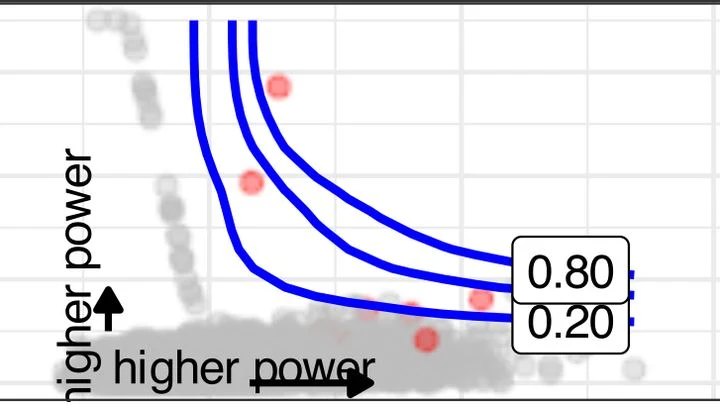
When you're planning a renovation, you don't buy paint by eye: you measure the wall area. In science, deciding how many samples to collect is a similar guess, but the stakes are higher. Skimp on samples, and your study becomes a lottery: you might miss a real effect, or you might mistake noise for a discovery. Overshoot, and you're wasting tubes, months, and, in animal experiments, lives.
Life is a constant dance between order and chaos. Back in the mid-20th century, Erwin Schrödinger noted that living things feed not so much on matter as on "negative entropy"—the ability to maintain their own order by increasing disorder around them.
From carbon, nitrogen, oxygen, and sulfur, you can assemble 10⁶⁰ different small molecules: that's a 1 with 60 zeros, more than the stars in the visible universe. Life uses only a tiny fraction of this menu, but not randomly.
A tightrope walker inches across a chasm. As long as they keep their balance and avoid sudden moves, they're safe. But one overcorrection, and a fall is inevitable. Life works much the same way at every level — from proteins inside a cell to entire ecosystems.
The search for extraterrestrial life is like a detective investigation: from tiny clues, you must distinguish traces of life from random imprints of non-living nature. On Saturn's moon Enceladus, the investigators are lucky — geysers burst from cracks in the icy crust, ejecting water from the subsurface ocean straight into space.
A vast hall with a thousand doors, and only one leads to the stars. The rest are locked, and the keys aren't just hidden: they're wrapped in other keys and tangled into a knot. That's the Great Filter in a new reading: not a chain of failures but a tangled hierarchy where each step depends on the previous one nonlinearly.
A patchy landscape isn't just a picture from a geography textbook. For microbes, cells, or animals, the world is a mosaic of patches: warmer here, more food there, and behind that rock — almost poison. When a mutant with a new trait appears in such a mosaic, its fate depends on which patch it lands on.
This new work ties two factors together.
An orchestra plays without a conductor. Each musician has a score: that's the genes. But the volume and tempo depend on the acoustics of the hall, the mood, and the neighbors on stage. That's roughly how heredity and daily life together shape a teenager's behavior.
A crowd in a city square behaves differently depending on whether people hold hands. If each person only lightly touches a neighbor's elbow, people easily spread out in all directions — the crowd expands as a smooth carpet. But if they interlock fingers, movement slows down and the crowd breaks into clumps: dense clusters form here and there, with empty corridors between them.
The microbial community in the gut is like an orchestra: what matters is not only the musicians but how they play together. When disease strikes, it's not just the lineup of microbes that changes: their interconnections shift too. Researchers built interaction networks of microbial genes in healthy and sick individuals.
Every group has its unspoken trios: three friends who are always together. And there are pairs that exist on their own. It turns out that how much trios "contain" pairs determines how everything, from a virus to a new idea, spreads through the group.
Scientists introduced a measure they call the nesting coefficient.
Imagine a mountain range where height represents an organism's fitness. Every point on the slope is a particular set of genes. Evolution climbs upward, but the terrain of this phylogenetic network landscape is cut by ridges and valleys.
A pot of water sits on the stove. The temperature drops: plus one degree, zero, minus one — the water stays liquid. But at some point, a light breath is enough to make the whole mass instantly freeze into ice. Physicists call such jumps first-order phase transitions.
A landscape cut by roads or rivers into isolated patches resembles a shared apartment after partitions are installed: residents no longer bump into each other in the common hallway. Species that once competed for the same food or space now live apart. Competition weakens, and those that would have lost to pushier neighbors in a continuous landscape now survive.
The nose is an amazing instrument. A single coffee molecule entering a nostril can awaken a memory of a morning kitchen. Another, nearly identical in shape, smells like rotten eggs.
Before measurement, a quantum object lives in a world of possibilities, where wave amplitudes add up like sound waves in a studio before pressing the “record” button. Crests amplify each other, troughs cancel out.
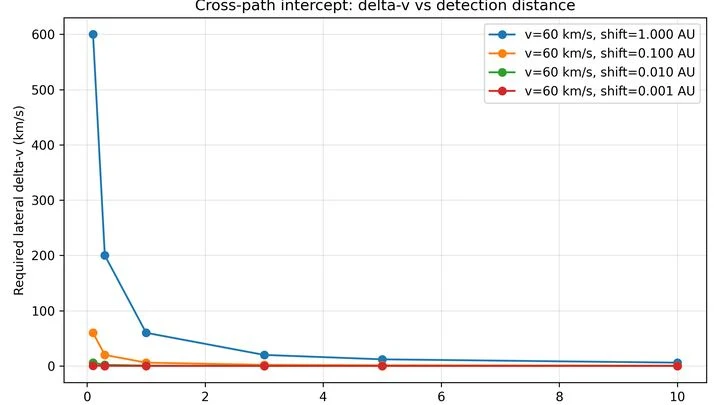
A rock knocked off one planet by an asteroid impact hurtles through space and lands on another. If microbial spores are hiding inside, they might survive the cold, the radiation, and the rough landing. That's panspermia — the idea that life travels between worlds. But imagining such a journey is one thing; calculating every step is quite another.
An epidemic is like a fire in a dry forest: a spark flares up, the flames leap from tree to tree, and within a week the whole area is burning. A hundred years ago, scientists devised a simple mathematical model for such a fire: they divided people into those who had not yet fallen ill, those who were ill, and those who had already recovered.
In two neighboring ponds, the same microorganisms swim. Food appears now in one, now in the other — randomly, with no rule. After a month, there are a hundred times more of them in the first pond than in the second. No one chose where to live. Just luck.
This is how disequilibrium works. While the environment keeps changing, abundances don't have time to even out.
An ecosystem is like a swing that someone is subtly pushing. Previously, it was thought that the main concern was that the swing wouldn't swing too wildly. But the authors of this work showed that the greater danger is when the equilibrium point itself slides toward a place where the swing can no longer return.
A stag beetle the size of a fingernail stands on the ground with its legs spread wider than its own height. An elephant as tall as a room, on the other hand, towers above the ground like a tower. Why is that? Both animals walk on the same ground, but they see it differently. For a beetle, each pebble is a boulder, while for an elephant, it's a grain of sand.