Sensitivity in physics refers to the smallest change in a measured quantity that a sensor or instrument can reliably detect. It is crucial for precision measurements in fields like quantum sensing, where detecting tiny magnetic fields, forces, or frequencies can reveal new physics or enable advanced technologies. High sensitivity often involves minimizing noise and amplifying the signal from the phenomenon of interest.
History
The concept of sensitivity has evolved with measurement science, from early galvanometers in the 19th century to modern quantum sensors. Specific milestones include the development of SQUIDs (superconducting quantum interference devices) in the 1960s, which achieved unprecedented magnetic field sensitivity.
How it works
Sensitivity is achieved by designing sensors that respond strongly to small perturbations, often using resonant effects, quantum coherence, or amplification. For example, atomic magnetometers use the precession of spins in a magnetic field, where even minute field changes alter the precession frequency, which can be measured with high precision. Noise reduction techniques, such as cooling or shielding, further enhance sensitivity.
Some quantum sensors can detect magnetic fields a billion times weaker than Earth's magnetic field, enabling them to pick up signals from a single neuron firing in the brain.
A tiny diamond, invisible to the naked eye, sits on a chip and senses heat like no ordinary thermometer can. Hidden inside it are two defects: places where a carbon atom is replaced by a nitrogen atom, with a vacancy nearby.
An electron beam is a stream of tiny particles carrying an electric charge. When such a beam hits a material, it doesn't just heat it or knock out atoms: it also gives the surface a slight push, like a jet of water pushing against your palm.
A magnet weighing just a few grains of sand hovers in midair with no support. It doesn't touch the walls, doesn't rub against bearings — it just hangs in a magnetic trap like a speck of dust in a sunbeam. Researchers have turned this tiny object into an ultra-sensitive compass: the device detects changes in the magnetic field of 23 femtotesla.
A handful of pebbles drops into a pond: each one sends out ripples. If the pebbles are different, the ripples will be different too: some sharp, some smooth. But when you look at the water from a distance and see only a small part of the ripples, all those differences blur together.
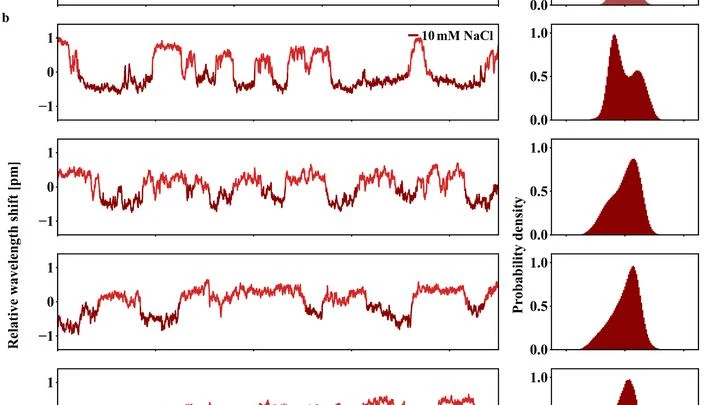
If a smell seeps into a room through a slightly open door, you could stand in the middle and sniff. But the most accurate way to catch the moment the smell arrives is to stand right at the threshold. A cell behaves much the same way when it needs to measure the concentration of a substance around it.
A protein in a cell is not a frozen sculpture but a restless mechanism. Its parts are constantly vibrating, and these movements determine how it grabs molecules, transmits signals, or builds the cellular scaffold. But filming the life of a single protein was hampered by two nuisances at once. First, the movements last millionths of a second — ordinary cameras simply cannot catch them.
The quantum many-body world is a jazz ensemble, where each electron improvises, continuously listening to all the others, and the overall wave function is born from this tense dialogue.
In the pitch darkness of a vacuum chamber, a tiny magnet floats. It touches no walls and loses almost no energy — an ideal sentinel, ready to catch the faintest nudge. Such a sentinel is exactly what you need for axion hunting. These particles are prime suspects in the case of the Universe's hidden mass, which we call dark matter.
Ordinary magnetic sensors lose sensitivity as they shrink. But scientists turned a tiny diamond into a light-based compass. Unlike jewelry diamonds, what matters here isn't purity but artificially created defects — these are what turn the crystal into a compass.
A magnet the size of a grain of rice floats in a vacuum without touching the walls. It is held by the magnetic field of a superconducting trap — a ring cooled to a state where current flows without resistance.
In 1948, engineer Claude Shannon laid the foundations of information theory. The Nyquist–Shannon theorem gave the first answer: to avoid losing a signal, you need at least twice as many measurements as the fastest feature in the signal. In 2006, the method of compressed sensing relaxed this requirement.
Four tiny puddles, and in them ripple droplets of a superfluid. These droplets are atoms cooled to near absolute zero and paired up like little magnets. When the whole setup rotates, the fluid flows between the puddles. Simply counting how many droplets end up in each reveals the angle and angular velocity.
Imagine a factory where hundreds of tiny assembly lines run nonstop. Each line is a molecular motor that converts chemical fuel into motion. To make the motor go faster or in the right direction, an engineer tweaks the settings — the shape of parts, the strength of interactions.
An ultra-sensitive microphone tries to catch the whisper of a distant galaxy. But the microphone itself trembles from heat: its atoms jitter like popcorn in a pan. Physicists call this jitter thermal noise, and it often drowns out weak signals.
Earth's magnetic field, the one that swings a compass needle, is strong. The new sensor picks up fields a hundred thousand times weaker, and it needs neither liquid helium nor bulky setups. Everything fits on a circuit board, just like the one inside your smartphone.
A modern hospital sensor is like a sensitive microphone in a noisy hall. It picks up a weak signal from the heart or brain, but along with it comes the hum of machines, footsteps, the breathing of neighbors. Separating the desired sound from the interference is a science in itself.
A detector that hunts for rare particles is like an ear trying to catch a whisper in a noisy room. The quieter the signal, the harder it is to tell apart from random noise. In the NUCLEUS experiment, such detectors, cryogenic calorimeters, are cooled to near absolute zero so they can pick up even a faint pulse of heat from a single particle.
A quantum magnetometer based on hydrogen nuclei works like noise-canceling headphones. It alternately "listens" to the field in two different ways: the noise is the same for both, but the desired signal is different. By subtracting one from the other, the device extracts the signal, reducing interference by more than 1000 times.
In a lab, you measure a very weak signal — say, a tiny change in a magnetic field. The instrument trembles from passing cars, from the experimenter's breathing, from wires heating up. This technical noise can't be fully eliminated, and it sets a limit on precision. An ordinary sensor works like a scale that sways with any draft.
In laboratories where atoms are cooled to near absolute zero, even a tiny change in the magnetic field throws off all the settings. Conventional sensors, Hall plates or coils with ferrite cores, sit a few centimeters away from the vacuum chamber because they themselves create interference.
Even Einstein predicted gravitational waves — a trembling of the very fabric of spacetime. Today they are captured by gigantic installations like LIGO, created thanks to Rainer Weiss and Kip Thorne.
Ultra-precise scales that catch the slightest changes in gravity work like a keen ear: they hear even the whisper of distant underground voids or the tremors of the Earth's crust. But such instruments have a hidden enemy: their own internal clocks. Time inside the sensor also jitters, and this jitter smears the picture.
A speck of glass floats in a laser beam. Air molecules, photons, even Earth's gravity give it little pushes, and by watching its jitter, you can tell what pushed it. But every measurement has a limit: the particle's own noise hides weak signals. Quantum mechanics sets that limit, but it can be bypassed.
A particle trapped in a light field behaves like a ball on a spring: give it a nudge and it starts to oscillate. If you suddenly stiffen the spring, the ball freezes for an instant at the very bottom, where its position is known most precisely. That's exactly the moment physicists exploited to turn a nanoparticle into an ultrasensitive accelerometer.
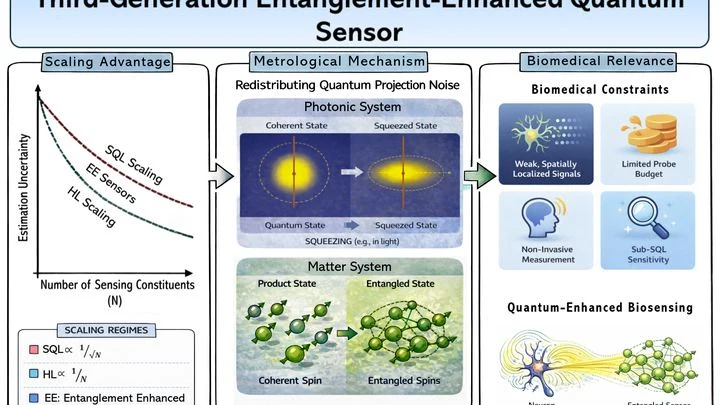
An ordinary sensor is like a scale that always shakes a little on its own. Even in total silence and at zero temperature, every particle jitters — this is quantum jitter, and it limits the precision of any measurement.
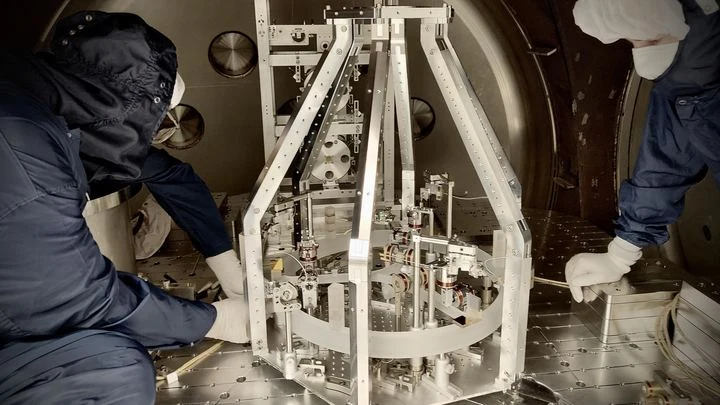
Since the days of Galileo, it was believed that in a vacuum all bodies fall identically. Einstein elevated this to a principle: gravity travels at the speed of light and is the curvature of spacetime.
In a dark room, a tiny diamond glows red when a green laser hits it. This glow isn't just for show: it's a signal: its brightness changes when a magnetic field is nearby. Inside the diamond sit defects — nitrogen atoms with an empty neighboring site. They act like sensitive needles that rotate under the influence of a magnet.
Detecting a faint signal against a noise background is like trying to hear a distant bell in a storm. Ordinary amplification only makes the din more deafening. Quantum error correction solves the problem in an unexpected way.
Picking up an ultraweak microwave signal is like trying to hear a whisper in a storm. Rydberg atoms, inflated to the size of bacteria, promise to become perfect antennas. But there's a fatal catch: during optical readout, up to 98% of messenger photons vanish without a trace in the detector.
Quantum mechanics gave us a captivating image: a system’s state is not a frozen point but a wave of possibilities, dancing in an abstract space. Thanks to the work of Шрёдингера and Дирака, we represent it as vectors in Hilbert space.