Bergmann's rule is an ecogeographical principle stating that within broadly distributed taxonomic groups, larger species are found in colder environments and smaller species in warmer regions.
Carl Bergmann, an anatomist and physiologist from Göttingen, published an article in 1847 titled 'On the relationship between heat economy in animals and their size.' He noticed that among closely related species of mammals and birds, those living in high latitudes are noticeably larger. Bergmann explained this with simple physics: heat production is proportional to body mass (volume), while heat loss is proportional to surface area. Since volume increases faster than area with increasing size, large animals have a more favorable ratio of heat production to heat loss. This allows them to survive in harsh climates. Later, ecologists confirmed the rule for many groups: from deer to penguins. Interestingly, Bergmann's rule often does not apply to insects and reptiles — they depend on external heat.
History
Carl Georg Lucas Christian Bergmann, professor of anatomy and physiology at the University of Göttingen, published the work 'Über die Verhältnisse der Wärmeökonomie der Thiere zu ihrer Grösse' in 1847. By comparing collections of stuffed animals from different regions, he was the first to quantitatively substantiate the link between climate and body size. Bergmann relied on Newton's laws of heat transfer and emerging ideas about metabolism in physiology. His conclusions were long disputed, but in the 20th century they were confirmed by mass measurements: from wolves in North America to wild boars in Eurasia. In 1937, David Lack showed that the rule also applies to birds when considering not only latitude but also altitude above sea level.
How it works
Bergmann's rule is used in paleoclimatology to estimate past temperatures from the sizes of fossil mammals. In agriculture, it is considered when acclimatizing livestock breeds: Holstein cows in Canada are larger than in Texas. The rule also helps predict the consequences of global warming: many species are expected to decrease in size. Limits of applicability: the rule does not apply to ectothermic animals (fish, reptiles), whose thermoregulation is behavioral rather than metabolic.
In practice
When breeding fur-bearing animals in northern latitudes, larger individuals are selected: their fur is denser and heat loss is lower, which increases the yield of high-quality raw material.
Fun fact
Emperor penguins, living in Antarctica, are the largest of all penguins: their height reaches 120 cm and weight up to 45 kg. Meanwhile, Galapagos penguins from the equator are half the size. Yet they manage to survive on scorching lava shores by hiding in the shade of rocks.
A crowd of pedestrians in a square moves chaotically: each person goes their own way, occasionally bumping into others. If every third person in that crowd wears a protective suit that blocks the pathogen, the rhythm of disease spread changes abruptly. That is exactly the scenario scientists reproduced by simulating 3000 self-propelled particles that repel each other and become infected upon close contact.
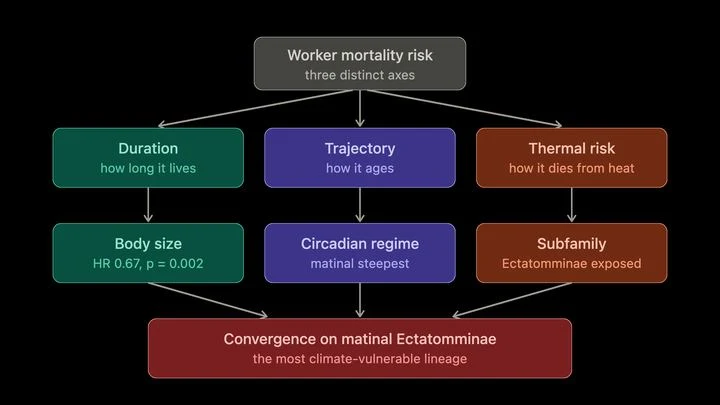
An ant the size of a grain of rice lives longer than its neighbor half its size. But when heat strikes, the bigger one isn't necessarily tougher. Researchers in Australia collected 18 species of ants and checked three things: how long workers live, how quickly they deteriorate, and at what temperature they start to die.
Rare species in a large community are like thin branches on a tree: a random gust can easily snap them. Even if conditions are stable, a small population simply lacks enough individuals to survive a bad season. In a new study, scientists added this factor to an ecosystem model and watched the community clean itself out.
Every tumor writes its own cosmology. Its cells are galaxies, and mutations are stellar flares marking the branches of a genealogical tree. The key to its history is the rhythm of accumulating genetic typos.
A billiard ball strikes another, and the sum of their velocities before and after the collision obeys strict rules. The same happens in the microscopic world: energy, momentum, and charge cannot simply vanish.
Every quantum system (whether an atom, a crystal, or the entire Universe) has its own set of allowed energies, like the steps of a ladder. The hotter the system, the more readily particles climb to higher rungs.
In a football stadium, the crowd's emotions arise from the chatter of individual fans. If mood could be both joyful and sorrowful at once, you'd have a quantum superposition. But the murmur of thousands of voices instantly forces that blend into a single definite state.
A patchy landscape isn't just a picture from a geography textbook. For microbes, cells, or animals, the world is a mosaic of patches: warmer here, more food there, and behind that rock — almost poison. When a mutant with a new trait appears in such a mosaic, its fate depends on which patch it lands on.
This new work ties two factors together.
If you pour sand into a glass, it settles in a flat layer. But instead of sand, take the tiniest particles of gas: in a gravitational field they don't just fall: each particle races along its own trajectory, collides with neighbors, and all this commotion creates pressure.
An eight-kilogram rhesus macaque can live up to forty years. A cat of the same weight rarely sees its twentieth birthday. This difference is no accident: across all primates, from tiny marmosets to gorillas, lifespan is markedly longer than in other mammals of similar body mass. Standard models linking lifespan to metabolic rate fall short here.
Every shell is a stone diary of growth. The mollusk doesn't build it from a blueprint like an architect; it simply adds material along the edge, following the same rule over and over. It's as if a snail glued a new strip to its house each day, nudging it slightly sideways and making it a bit bigger. It's this repetition, not complex control, that creates the species' characteristic shape.
In a thin semiconductor channel, electrons behave not like lone runners but like a crowd at rush hour. They constantly bump into each other, and these collisions determine how easily heat and electric current pass through the material.
The heart doesn't push blood in a steady stream but in pulses. Each beat sends a wave racing through the arteries, like ripples along a taut garden hose. For a long time, it was thought that an animal's metabolic rate depended only on how vessels branch, like pipes in a house. But new work flips that view: what matters isn't the shape of the pipes but the pulse itself.
Toss a handful of sand on the floor: there are few large grains, many medium ones, and even more tiny ones. This skew, where small events are common and large ones are rare, is described by a power law. It shows up in city sizes, earthquake magnitudes, and citation counts of scientific papers.
In two neighboring ponds, the same microorganisms swim. Food appears now in one, now in the other — randomly, with no rule. After a month, there are a hundred times more of them in the first pond than in the second. No one chose where to live. Just luck.
This is how disequilibrium works. While the environment keeps changing, abundances don't have time to even out.
A stag beetle the size of a fingernail stands on the ground with its legs spread wider than its own height. An elephant as tall as a room, on the other hand, towers above the ground like a tower. Why is that? Both animals walk on the same ground, but they see it differently. For a beetle, each pebble is a boulder, while for an elephant, it's a grain of sand.