Narrow and Wide Windows: Why a Galaxy Looks Different ✛
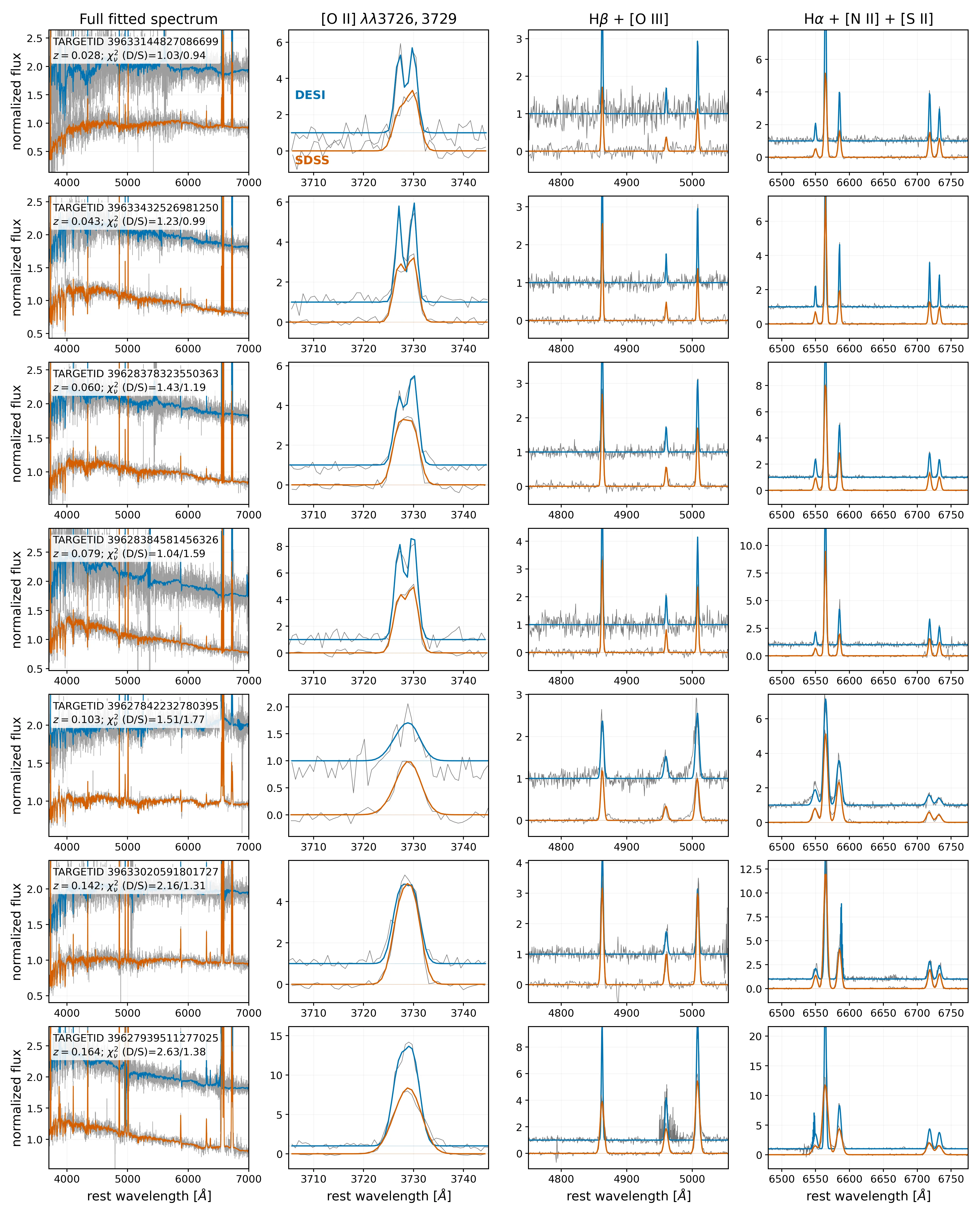
If you look into a room through a keyhole, you see only the lamp in the center. Open the door wider, and the walls and the furniture by the window come into view. Telescopes observe galaxies in much the same way: their light is gathered through a thin glass fiber, and different instruments have fibers of different thicknesses. In the DESI survey, the fiber is as narrow as a drinking straw, capturing only the bright core of a galaxy. In the SDSS survey, it is twice as wide and also sees the outer arms. So the same object can look different in the two catalogs, even if the telescopes are side by side.
The scientists took 20,545 galaxies observed by both instruments and reprocessed all spectra in the same way, so that any difference would be due solely to the window size, not to different software. After quality checks, 20,200 objects remained. They found that the narrow window systematically shifts several indicators: O3N2, which estimates the oxygen and nitrogen abundance, decreases by 0.033 dex, and the Balmer decrement, related to dust, by 0.020 dex. These are small changes, about 3–7%, but they are noticeable because the sample is large. The shift depends on the galaxy's distance and on how the fiber falls across it, so a correction is needed when combining DESI and SDSS data.
Now astronomers know how much the narrow window alters a galaxy's portrait and can translate measurements from one survey to another. It is as if two people described the same house, one through a keyhole and the other through an open door, and then agreed on how to reconcile their accounts. Without such an agreement, one might conclude that the house is different, when in fact only the windows were.
The DESI fiber has a diameter of 1.5 arcseconds, which on the sky corresponds to the size of a one-cent coin seen from about 2.5 kilometers away. Meanwhile, a galaxy at redshift 0.06 subtends a much larger area on the sky, so the fiber captures only its central region.