The Sloan Digital Sky Survey (SDSS) is one of the most ambitious and influential astronomical surveys ever undertaken. It has mapped millions of galaxies, quasars, and stars, creating a three-dimensional map of the universe that has become a foundational resource for cosmology and astrophysics. The survey uses a dedicated 2.5-meter telescope at Apache Point Observatory in New Mexico, equipped with a wide-field camera and spectrographs capable of measuring the distances to hundreds of objects simultaneously.
History
The Sloan Digital Sky Survey began operations in 2000, named after the Alfred P. Sloan Foundation, a major funder. It was the first large-scale survey to use a mosaic CCD camera and multi-fiber spectrographs, and its data releases have been widely used in thousands of scientific papers.
How it works
SDSS works by taking deep images of the sky in multiple optical and infrared bands, then selecting objects for follow-up spectroscopy. The spectra provide redshifts, which, combined with the positions on the sky, yield a three-dimensional distribution of matter. This data allows astronomers to study the large-scale structure of the universe, the clustering of galaxies, and the properties of individual objects like quasars and stars. The survey has been conducted in multiple phases (SDSS I, II, III, IV, and now V), each adding new capabilities and sky coverage.
In practice
SDSS data has been used to measure the baryon acoustic oscillation scale, constrain dark energy models, discover new galaxies and quasars, and map the structure of the Milky Way. It also serves as a training ground for machine learning algorithms in astronomy, such as identifying gravitational lenses.
Fun fact
The SDSS telescope has observed over 500 million objects, and its data has been used in more than 10,000 peer-reviewed publications, making it one of the most scientifically productive astronomical facilities in history.
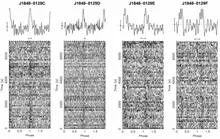
At night in fog, a searchlight works worse than in daylight: tiny droplets scatter the beam, and distant objects drown in the murky haze. Much the same way, radio waves from pulsars get lost in the interstellar medium when there are many free electrons between us and the star.
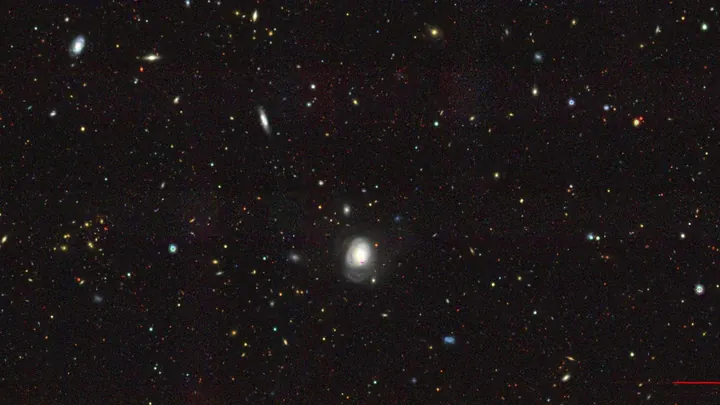
Two astronomical surveys look at the same galaxy through different windows. DESI's window is narrow, just 1.5 arcseconds across, and it catches only the bright core. SDSS's window is twice as wide, 3 arcseconds, and it also includes the outer spiral arms.
A storm in the upper atmosphere lasts a few millionths of a second. A cosmic ray, a proton or a helium nucleus, strikes air molecules, sending a swarm of particles downward. Most of them stay together, but occasionally one particle gains so much energy that it surges ahead.
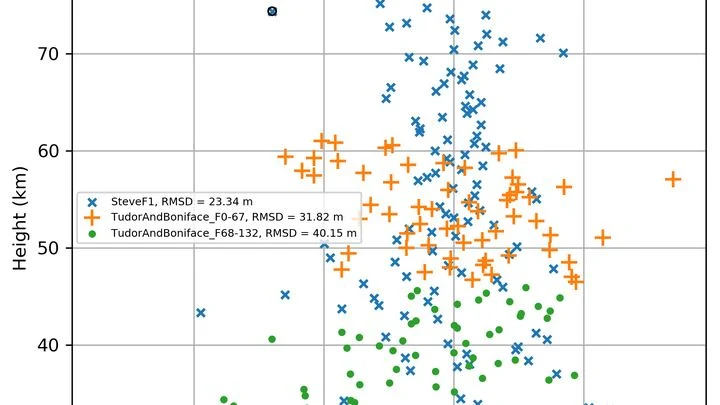
A star blinks every 38 seconds. This is no random twinkle: inside the white dwarf WD 0158−160, steady oscillations run like the beats of an invisible metronome. From the rhythm of those beats and the star's precise distance, astronomers have computed its mass and temperature — without ever looking at its spectrum.
A radio telescope, like a sensitive ear, picks up the whispers of distant galaxies. Hidden among that noise are giants — giant radio sources. These are clouds of charged particles ejected from the vicinity of supermassive black holes.
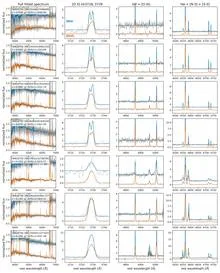
14 seconds. That’s all it takes for a new code to weave the full spectrum of a star, from ultraviolet to near-infrared. This spectrum is not just a rainbow but a detailed tapestry of thousands of dark absorption lines, each left by a specific atom in the star's atmosphere.
Each morning, dozens of telescopes swing toward the Sun. Their cameras catch a narrow band of red light — the Hα line, discovered by Johann Balmer. The images reveal dark, whimsically curved threads. They look like stitches in a giant tapestry sewn through the blazing corona.
A neutron star is the collapsed core of a massive star, squeezed to the size of a city. A teaspoon of its material weighs as much as a mountain. But inside this superdense sphere, a surprise may lurk: under unimaginable pressure, neutrons break apart into quarks, giving the star a new, more compact core.
The Universe is a giant labyrinth of curved mirrors. The mass of galaxies and clusters distorts the light of distant quasars, as if toying with our perception of the cosmos. Hidden in this hall of mirrors is the key to the greatest mystery: dark energy, which is pushing space apart ever faster.
The Sun is not just a source of heat; it's also the largest lens in the solar system. Its gravity bends light rays like glass, focusing them into a bright ring far beyond Pluto's orbit. If light from a distant planet enters this ring, astronomers could reconstruct its portrait — not a point, but a map with surface details.
The cosmological constant is causing the universe to expand at an accelerating rate. In the far future, when all matter has dispersed, only empty de Sitter space will remain — an ideal cosmic backdrop.
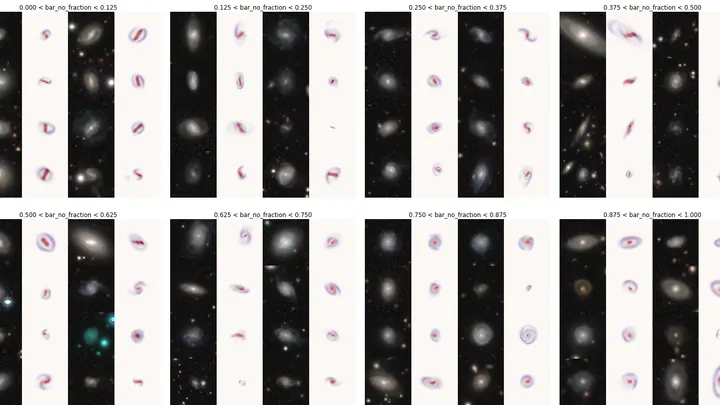
An ordinary photo editor highlights objects in an image. The ZooBot:3D neural network works with distant galaxies like a cartographer drawing a map of an unexplored land.
Light from a distant galaxy travels across the universe, passing through vast clumps of dark and ordinary matter. Their gravity slightly bends the path of the rays, like a river's current flowing around invisible boulders. In images, this shows up as a barely noticeable elongation of galaxy shapes, as if they were stretched on an invisible frame.
The Universe resembles a dense forest: up close, individual galaxy-trees are visible, gathered into groves, but from a distance everything merges into a solid green canopy. The boundary beyond which the cosmos becomes homogeneous is called the angular scale of homogeneity: it's the size of a patch of sky from which galaxies are distributed evenly.
Through the ripples on the water, pebbles at the bottom of a pool look shifted and warped. In a similar way, the gravity of invisible dark matter bends the light of distant galaxies — a phenomenon known as weak lensing.
Astronomers, like chefs, have long been preparing a description of the Universe using the same cumbersome recipes. These recipes — complex mathematical formulas — estimated how many galaxies of different luminosity and mass fill the cosmos, as well as how the invisible frameworks of dark matter are distributed. But the dishes lacked accuracy.
Take two heavy balls and place them a meter apart: they attract each other with a force that weakens by a factor of four when you double the distance. Newton discovered this law, and it works in a room, in the solar system, in a galaxy. But does it still hold when we're talking about hundreds of millions of light-years?
Astronomers found a way to test this directly.
Beneath your feet in the forest, a quiet life unfolds: fungi weave around tree roots and trade nutrients with them. But how do you count how many fungal species are in the soil without digging up the whole forest? It turns out the answer can be seen from space.
Hot massive stars are the kitchens of the Universe, where heavy elements are cooked up. They end their lives in supernova explosions. To understand their recipe, astronomers use spectroscopy — the analysis of the rainbow band of light passed through a prism. Previously, deciphering such a 'menu' took hours.
Astronomers have tested the new Vera C. Rubin telescope in Chile, much like adjusting the focus and aperture on a brand-new camera. The first images covered a patch of sky the size of 60 full Moons, and immediately revealed millions of galaxies and stars. The imaging was done in various colors, from invisible ultraviolet to thermal infrared.
On April 24, 2025, a celestial drum boomed over Alaska. Sunlight outshone the flash, and satellites missed the meteor. But the earth and air acted like a giant percussion instrument: dozens of ground microphones picked up a low rumble, and vibration sensors detected tremors. This provided a precise 'melody' of its flight.
Thousands of kilometers of fiber-optic cables lie on the ocean floor. They carry internet traffic, but the cables themselves sense the slightest vibrations in the water and the seabed. If you listen closely to such a cable, you can hear a blue whale singing or the ground trembling thousands of kilometers away.
Light from a distant star cuts through dust like a flashlight beam through fog. Dust holds back blue rays more than red ones, making the star appear redder than it really is. From this reddening, astronomers gauge how much dust lies in the light's path.
Some stars end their lives as white dwarfs — dense remnants the size of a planet. A small fraction of these objects have very strong magnetic fields, millions of times more powerful than a refrigerator magnet. Such stars are called magnetic white dwarfs.
For a long time, astrophysics was dominated by the belief that giant jets of radio emission, radio outbursts blasting from central regions, were the exclusive privilege of elliptical galaxies. It was thought that only their calm, featureless internal environment could allow such colossal fountains of energy, powered by supermassive black holes, to form.
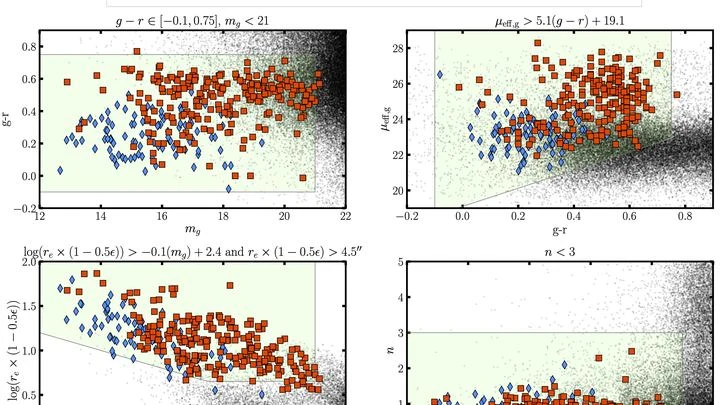
A population census, but instead of houses (galaxies, and instead of residents) stars. Astronomers set out to count the smallest and faintest "homesteads" in our cosmic neighborhood: dwarf galaxies. They are thousands of times fainter than the Milky Way, and spotting them in images is as hard as picking out a firefly in front of a spotlight.
Light from a distant star, after passing through air and telescope lenses, loses its sharpness, like looking at a streetlamp through wet glass. Astronomers call this blur the telescope's "fingerprint": each instrument has its own, and you need to know it down to the smallest detail.
A radio telescope has caught signals from three galaxies that existed when the universe was less than a billion years old. Their radio glow is so powerful that each seems to be birthing a thousand suns per year in a short span. For comparison, our Milky Way produces only a couple of stars per year.
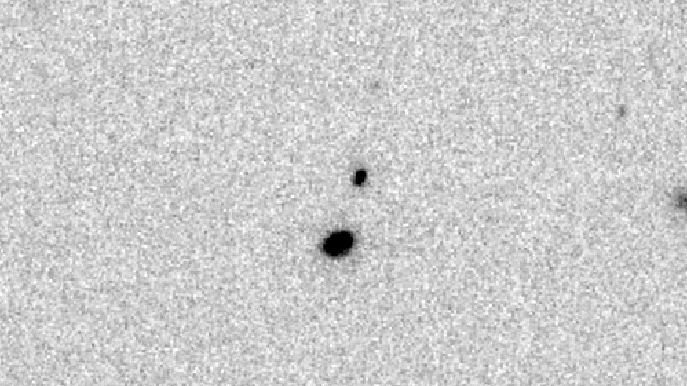
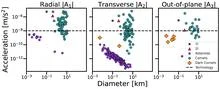
In October 2017, the Pan-STARRS telescope in Hawaii spotted an object moving too fast to belong to the solar system. It was 1I/ʻOumuamua, the first interstellar visitor ever recorded by astronomers. Since then, two more have joined it: comet 2I/Borisov and object 3I/ATLAS.
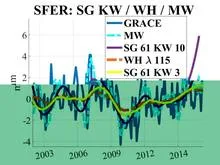
Imagine sensitive scales scattered across Europe. Each GPS station is one such scale, recording daily how much the ground beneath it has risen or fallen. When water accumulates underground, the surface sags slightly; when water leaves, the surface lifts. These movements are tiny, on the order of millimeters, but the stations pick them up.
Every night, an invisible sentinel hangs over the Andes. The GOES-12 satellite, and later its successor GOES-13, watches Earth from an altitude of 36,000 kilometers, recording how the mountains breathe clouds. For five straight years, it tracked where the sky stayed clear and where it got wrapped in cotton.