An arcsecond is a unit of angular measurement equal to one-sixtieth of an arcminute, which itself is one-sixtieth of a degree. Thus, an arcsecond is 1/3600 of a degree. It is used to measure extremely small angles, particularly in astronomy for the apparent separation of celestial objects, and in optics for the resolution of telescopes and microscopes.
History
The sexagesimal system for angles dates back to ancient Babylonian mathematics, but the specific term 'arcsecond' came into common use in the 19th century as telescopic measurements became more precise.
How it works
The concept is purely geometric: a full circle is divided into 360 degrees, each degree into 60 arcminutes, and each arcminute into 60 arcseconds. To appreciate its smallness, the Moon's apparent diameter is about 1,800 arcseconds. A human eye can resolve objects separated by about 60 arcseconds; a good telescope can resolve down to a fraction of an arcsecond.
In practice
Arcseconds are essential for measuring stellar parallax—the apparent shift of nearby stars against distant background stars as Earth orbits the Sun—which is the basis for the parsec (parallax of one arcsecond).
Fun fact
The smallest angle that the Hubble Space Telescope can resolve is about 0.05 arcseconds, equivalent to reading a newspaper headline from a distance of 1.5 kilometers.
Systems:SICGSAn angle equal to 1/3600 of a degree, defined as (π/648000) radians.
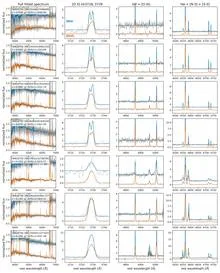
Two astronomical surveys look at the same galaxy through different windows. DESI's window is narrow, just 1.5 arcseconds across, and it catches only the bright core. SDSS's window is twice as wide, 3 arcseconds, and it also includes the outer spiral arms.
A globe sits on a table, and a ruler lies beside it: one is curved, the other straight. X-ray telescopes have lived with this mismatch for years. Their mirrors gather light onto a curved surface, like the globe, while the detectors that catch that light have been flat, like the ruler.
Cosmic rays aren't rays in the usual sense: they're fast particles bombarding Earth from all directions. Mostly they're protons and atomic nuclei. Their energies vary widely, from modest to fantastically huge. When such a particle heads our way and the Moon or Sun gets in its path, it gets absorbed.
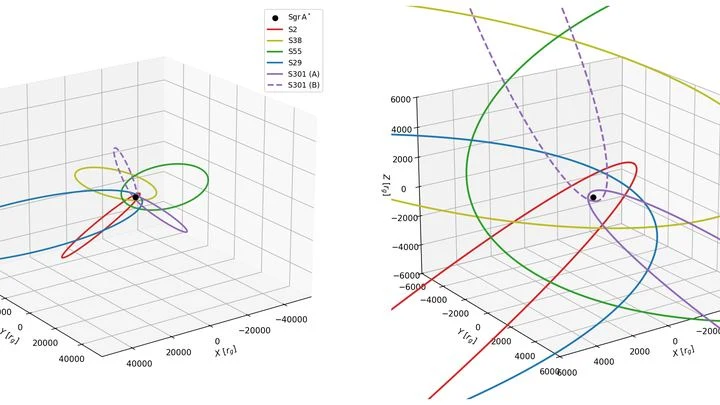
26,000 light-years from Earth, in the heart of the Milky Way, star S301 tears through space at 18,000 kilometers per second. It loops around the supermassive black hole Sgr A* on an elongated orbit. At its closest approach, just 280 gravitational radii separate the star from the black hole — roughly the distance from the Sun to Uranus.
Light waves are never perfectly smooth — they are constantly jittered by quantum ripples. These almost invisible nudges were studied by Nobel laureate Roy Glauber, who laid the foundations of quantum optics. Now physicists have learned to freeze these ripples.
A charged particle streaks through a silicon sensor, leaving behind a trail of free electrons. The time it takes for this charge to be collected at the electrode depends on how deep in the crystal it was born. A particle entering head-on carves identical paths through neighboring pixels: their signals arrive almost simultaneously.
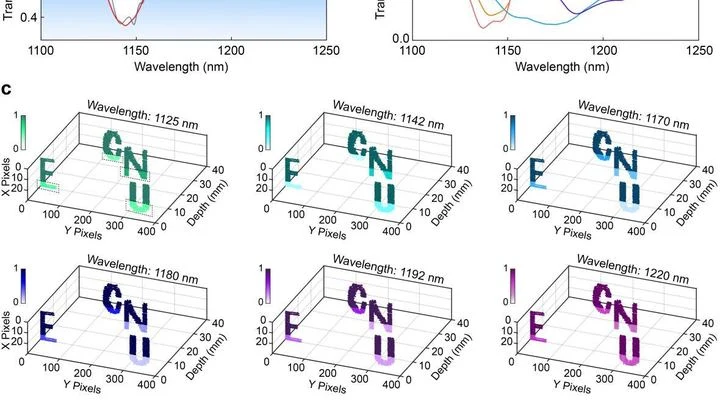
A conventional lidar is like an artist who paints a landscape but sees only gray shadows. It measures distances to each point accurately, but can't tell whether it's looking at rock, wood, or plastic. To learn the composition, you need a spectrometer — a separate device that works slowly and can't keep up with a fast scanner.
The new system takes a different approach.
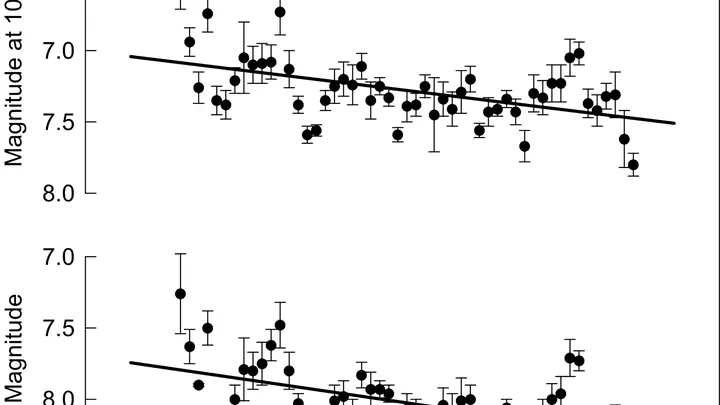
For five consecutive years, the automated MMT9 observatory measured the brightness of Starlink and OneWeb satellites using photometry (precise light measurement). The results were surprising: VisorSats, equipped with visors to reduce glare, became brighter by 0.6 magnitudes, while OneWeb, on the contrary, dimmed by 0.4.
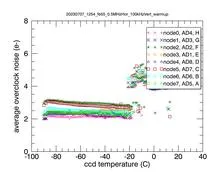
In a particle accelerator, nuclei shatter into fragments like a porcelain cup dropped on the floor. Each fragment flies through silicon wafers, which register the impact and its strength. But to distinguish a real signal from random noise, you need a threshold: below it, readings are considered interference.
A regular camera captures the world as a series of frames: twenty-four, sixty, or even a hundred images per second. That's enough for filming a falling drop, but inside a living cell, events unfold a thousand times faster. Protein molecules carry cargo, membranes bubble, ions slip through channels — all in fractions of a millisecond.
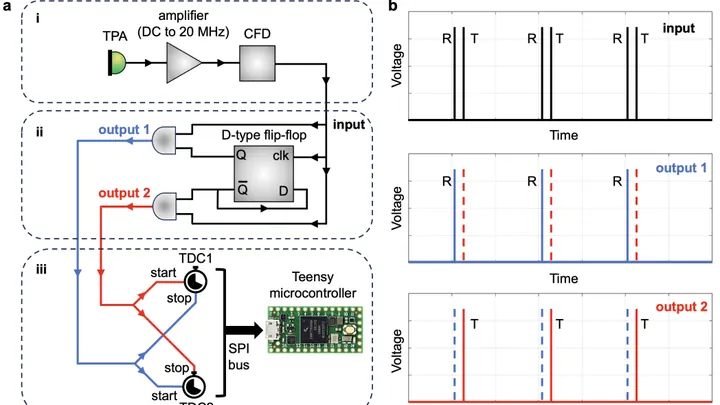
A standard laser rangefinder works like a stopwatch on a 100-meter dash: it times how long light takes to run to the target and back. But such a stopwatch has a limit: it ticks in steps of tens of picoseconds (trillionths of a second). In that step, light travels about a centimeter, so finer details are invisible.
Two laser beams, like two pencils, draw an invisible scale on the wall. One tip moves slightly faster than the other, and by the way their strokes alternately coincide and diverge, you can calculate the distance to the wall with an accuracy down to the thickness of a spider's thread.
In the new work, physicists made these two beams work continuously, without pauses.
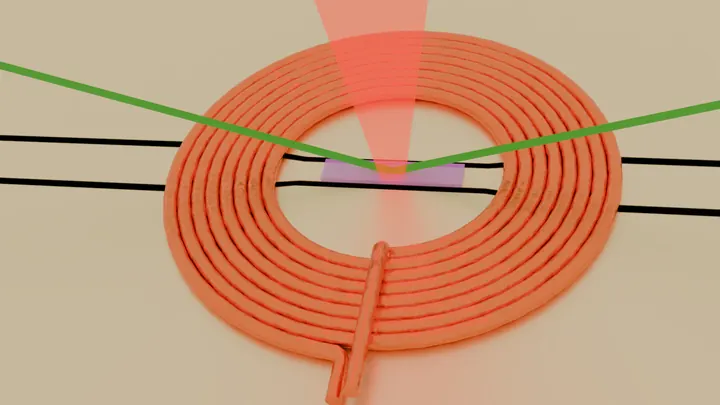
A tiny defect in a diamond crystal works like a sensitive antenna. When a magnetic field oscillates nearby, this defect, a nitrogen vacancy, responds by glowing. Previously, to hear the signal, you had to accumulate many repeated measurements, like listening to a whisper with your ear pressed against a door. Now a single short "look" suffices.
Light from a streetlamp passing through blinds flickers: the stripes shift, and brightness rises and falls. From that rhythm, you can guess how wide the lamp is. The new method for measuring stars works similarly: instead of capturing a sharp image, astronomers monitor the "twinkling" of light collected by two or more telescopes simultaneously.