The Reynolds number is a dimensionless quantity that characterizes the flow regime of a fluid — whether it is smooth and orderly (laminar) or chaotic and mixing (turbulent). It represents the ratio of inertial forces to viscous forces in a flow. When the Reynolds number is low, viscosity dominates and the flow is laminar; when it is high, inertia dominates and turbulence sets in.
History
Introduced by Osborne Reynolds in 1883, who demonstrated the laminar-to-turbulent transition in his famous dye-injection experiments in glass tubes.
How it works
The Reynolds number is calculated as Re = ρvL/μ, where ρ is fluid density, v is flow velocity, L is a characteristic length scale, and μ is dynamic viscosity. This single number collapses the complex interplay of these parameters into a universal predictor of flow behavior. For pipe flow, the transition to turbulence typically occurs around Re ≈ 2300, but this critical value depends on the geometry and flow conditions. The concept allows engineers to predict flow regimes without solving the full Navier-Stokes equations.
In practice
Essential in aerospace engineering for predicting boundary layer behavior on wings, in chemical engineering for designing mixers and reactors, and in biomedical engineering for understanding blood flow in arteries.
Fun fact
A blue whale swimming at 10 m/s and a tiny copepod swimming at 1 mm/s have Reynolds numbers differing by a factor of about 10^8 — meaning they live in completely different fluid worlds, one dominated by inertia and the other by viscosity.
In 1934 Jean Leray proved that the Navier–Stokes equations always have solutions "in a generalized sense". Whether a solution stays smooth or can break down into a singularity he could not tell, and nobody could for ninety years. In 2000 the Clay Institute made the question one of its seven Millennium Prize problems.
The churning cauldron of turbulence burns energy in two distinct ways. Vortices, like whirlpools in a maelstrom, twist the fluid and rub layers against each other. Shock waves, like a sudden clap, abruptly compress the gas and turn motion into heat.
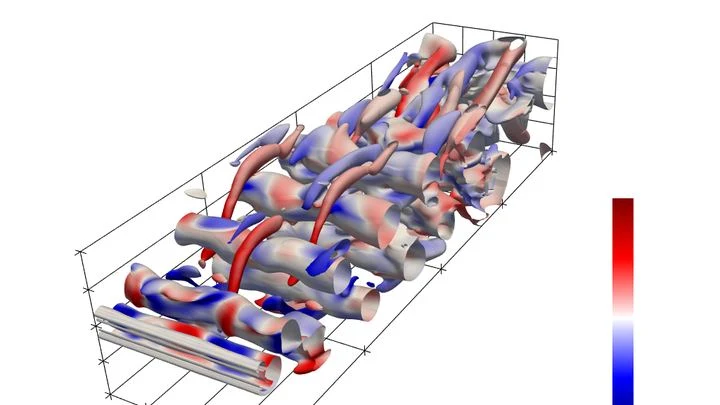
Water confined between two cylinders flows in smooth layers when the inner one rotates. But once the speed crosses a certain threshold, the layers crumple into toroidal rolls, like a stack of bagels. Physicists call these Taylor vortices: the flow loses stability and a regular pattern emerges.
A superfluid gas is like a crowd of people marching in step: each atom knows where to go and doesn't fall out of the common rhythm. But this crowd has three 'valleys'—three different directions it can take. In a new experiment, physicists made one valley slightly more 'favorable' than the others and watched how the crowd darted between them.
Soil is not a solid sponge but a labyrinth of pores of various sizes. After rain, water does not fill them all at once: first the narrowest ones, then the wider ones. Physicists built a theory of this process based on a simple image — a set of communicating vessels.
An ocean current hundreds of kilometers wide lives its own life, fed by energy from tiny eddies. Something similar happens in the atmosphere: small swirls pass their power on to huge air currents. This process, the inverse energy cascade, has been known for a long time.
A superfluid flows without friction, like water that never stops. But when you spin it, it doesn't just rotate: each tiny vortex remembers exactly how it was spun. This 'trace' is not a metaphor but a real geometric imprint, which physicists call the Berry phase (the phase acquired by a wave as it travels along a closed path).
In the intricate dance of active turbulence, where invisible engines spawn chaos, a soft droplet takes on the role of a detective. Its shape is not merely an outline but a sensitive cipher: it reads the hidden signals of its environment.
When physicists drive electrons through an ultrapure gallium arsenide channel at helium temperatures, they expect to see a well-behaved, almost ideal fluid.
Air flowing over a wing or turbine blade behaves like a string: it starts smooth and layered: that's the laminar regime. But as speed increases or external ripples appear, the string breaks into chaotic vibration — turbulence. Predicting the exact moment of breakdown is crucial: it affects drag, heating, and noise.
A lump of sugar drops into hot tea, a spoon stirs a few times, and the sugar disappears. But how exactly does it spread through the churning liquid? Physicists have peered into this process with unprecedented detail: they simulated turbulence on a grid of 8192³ points. If you were to split every millimeter of the cup into a hundred cells, you'd get a similar resolution.
A clap of the hands compresses the air, and it flies outward — the simplest shock. In space, exploding stars play the role of hands: their shock waves sharply compress gas and trigger chaotic mixing — turbulence.
Mountain river water doesn't flow smoothly: it churns, swirls into eddies, and suddenly accelerates. This chaotic motion is called turbulence. But even within it, there are hidden rhythms — rare and intense bursts that briefly alter the entire flow pattern.
A drop of honey spreads slowly across a table, while water spreads quickly. The resistance to flow, viscosity, differs from one fluid to another. But what if the viscosity changes on the fly, as the substance compresses or expands?
When you squeeze ketchup out of a bottle, you're battling its stubbornness: it sits still at first, then suddenly shoots out in a blob. That's typical non-Newtonian behavior — resistance to flow changes with how hard you push. But the authors of a new study found a way to almost completely eliminate that resistance.
Sugar dissolves in tea, and then with a single motion gathers back into the spoon. In an ordinary kitchen, you won't see that — viscosity and disorder get in the way. But in the world of ultra-slow motions, where inertia vanishes, such tricks become reality.
A boiling pot, a gust of wind, a wisp of smoke from a campfire — all obey equations that mathematicians call 'nonlinear and dissipative.' In plain terms, energy is lost to friction, and parts of the flow influence each other so strongly that predicting the motion ahead of time is a task on the edge of feasibility.
A ship gliding through water constantly rubs against it, like a palm against a rough surface. This friction eats fuel and slows progress. One way to reduce it is to blow air under the hull: water stops sticking to the hull, and drag drops. But air is finicky: sometimes it helps, sometimes it hurts.
In superfluid helium, a vortex is like a tornado in a bottle, but instead of water, it's a quantum liquid that flows without friction. Such a vortex doesn't dissipate on its own, so the question of where its energy goes has long remained open.
Inside the kidneys, liver, and other organs, fluid flows through channels that squeeze and release like a hose underfoot. The walls of these channels are not rigid: they are porous, elastic, and soaked with moisture.
In a wind tunnel, air accelerates to enormous speeds and breaks into a chaos of eddies. To see how this chaos dies on the smallest scales, scientists took a sensor thinner than a human hair and placed it in the flow.
Inside the tunnel, they created a shear layer — a region where fast air rubs against slow air, spawning vortices.
A supersonic gas jet is like a highway where some cars zoom past faster than sound while others crawl. Measuring each car's speed at once without disrupting traffic is a tough challenge.
In turbulent air, droplets don't fly in straight lines: they get tossed around like dust motes in a beam of light. Physicists have built a setup that tracks each droplet, which is about a tenth of the thickness of a human hair. A camera captures their motion, and a computer reconstructs their trajectories.
A sudden gust hits a wing, and a huge vortex swirls above it. Such a vortex can abruptly change lift, making the plane's nose dip. Engineers have long sought ways to predict these vortices, but complexity gets in the way: fast airflow is full of small chaotic eddies.
The lymphatic system is like a city's network of canals, through which water slowly moves, carrying away waste from tissues. But it has no single pump-heart. Instead, along the vessels are placed small station-locks — lymphangions. Each such lock squeezes itself like a fist and pushes fluid onward. How they coordinate their work has long remained a mystery.
A thin wire made of a special material, a topological insulator, behaves like a city street: the interior is empty, and all traffic runs along the edges. Electrons in such a wire move only along the surface, like pedestrians on a sidewalk, never stepping onto the roadway.
A superfluid flows without friction, like water in a perfectly smooth pipe, but the moment it hits an obstacle, the picture changes. In a new study, researchers looked at how a superfluid stream flows around rectangular walls and pits with sharp corners.
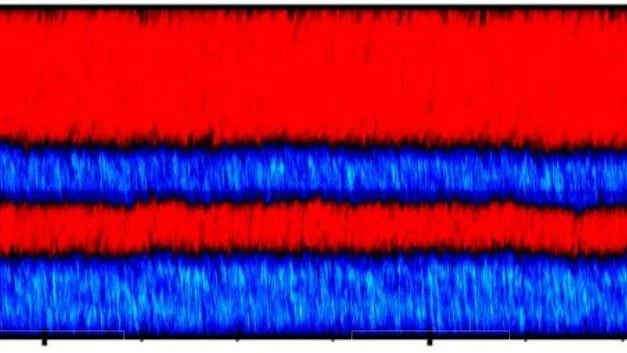
A pot of water heated from below is a simple example of turbulence. Hot fluid rises, cold fluid sinks, and the flow spontaneously breaks into rotating cells that look like horizontal rolls. In a new study, physicists took a wide rectangular container (ten times longer than its height) and tracked how many such rolls appear.
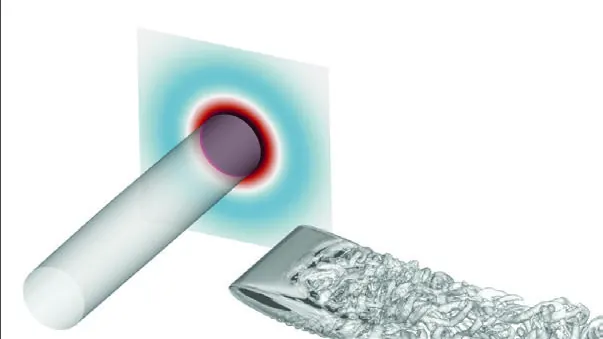
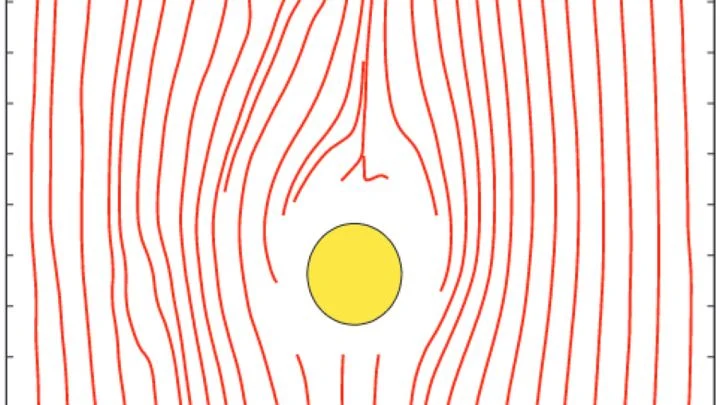
Liquid helium cooled to near absolute zero behaves like two fluids at once: a normal viscous part and a superfluid part that flows without friction. When such a flow hits a cylinder, vortices are born behind it. But sometimes vortices appear in front of the cylinder — where classical laws say they shouldn't be.
A blunt cylinder flying at six times the speed of sound isn't the most elegant object, but it's the star of a new simulation. The surface of such a vehicle is never perfectly smooth: during atmospheric entry, the heat shield ablates, leaving bumps and pits.
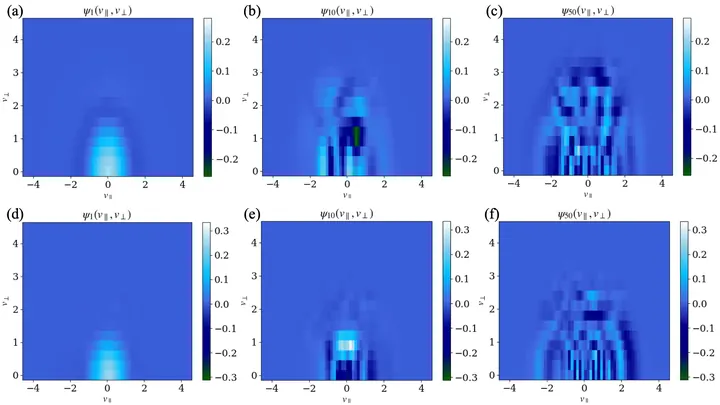
Hot plasma in a future fusion reactor is like a packed dance floor: billions of particles whirl in a complex rhythm, colliding and changing speed. Figuring out how tangled this dance is — no easy task. Scientists have found a way to measure its complexity without watching every move.
Bacteria in a drop of water jostle and swim: each on its own, but together they create patterns. With weak motion, the fluid churns like soup on a high flame: vortices collide, and the flow direction changes every second. This is called bacterial turbulence.
A thin plate stands across a flow of water or air. Behind it, a wake forms — a region where the flow becomes tangled and mixed. Usually, such a wake becomes turbulent when the flow speed is high enough, quantified by the Reynolds number.
When water churns behind a boat, the energy of motion is converted into heat through a cascade of vortices. Measuring how quickly this happens directly is difficult: you'd need to track all the vortices at once. So scientists use a simplification: they look at only one velocity component at a single point.
Water in a glass settles down, but before that, vortices go through a stage where energy losses spike. Physicists seek early signs of this stage to predict flow behavior — from the atmosphere to pipelines. In a new study, they test one such sign: the curvature spectrum of vortex lines, that is, how twisted small and large eddies are.
The wind blows steadily, but suddenly a gust hits, and leaves swirl up in a vortex. Inside such a gust, the air speed changes not smoothly but in jumps — sometimes sharply forward, sometimes sideways. These rare and strong bursts are called intermittency, and they are the main mystery of turbulence.
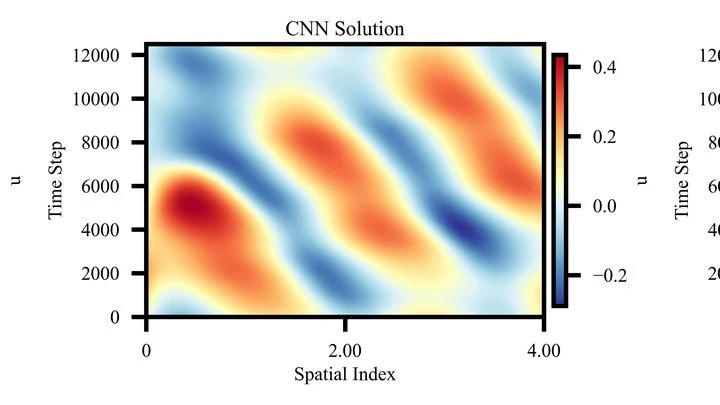
Water in a stream bends around rocks, but the math of that motion hides in a black box: that's how ordinary neural networks work. They give an answer but don't say why. Engineers can't trust a prediction if they can't see its reasoning.
Fluid dynamics now has a transparent model.
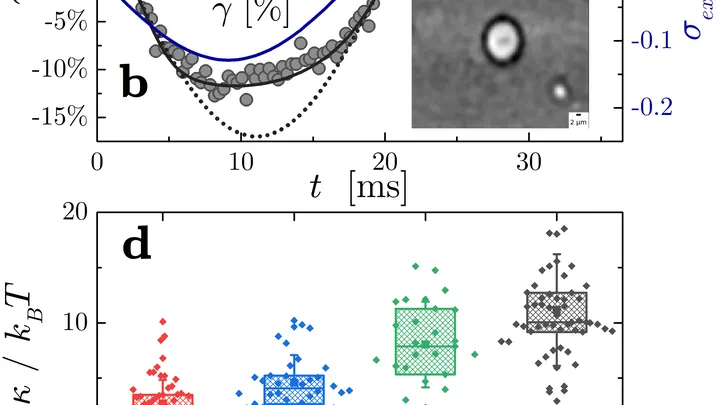
A microscopic gel bead or a tiny oil droplet squeezes through a narrow channel whose walls rhythmically contract and relax. The particle flattens and then recovers its shape, and by how quickly it does so, you can infer its internal elasticity and viscosity.
Water swirls into a ring, and that ring flies through the bulk without breaking apart. Such vortex rings, from smoke rings to underwater currents, follow laws that are hard to capture on paper. Usually, the flow is divided into millions of cubic cells, and each one is tracked.
A thin stream of water flows down a cold inclined board and, before your eyes, turns into an ice ridge. At first, the water paves itself a straight icy path, as if reinforcing its own banks. Then the trickle starts to meander, and the ice quickly spreads sideways. Finally, the ridge stops growing outward and begins to thicken, smoothing out irregularities.