A vortex lattice is a regular, repeating pattern of quantized vortices that forms in a rotating superfluid or a Bose-Einstein condensate. When a superfluid rotates, it cannot rotate as a solid body; instead, it forms tiny whirlpools, each carrying a fixed amount of angular momentum. These vortices arrange themselves in a triangular (hexagonal) lattice to minimize energy, much like a crystal of atoms. This phenomenon is a direct macroscopic manifestation of quantum mechanics.
History
The concept of quantized vortices in superfluids was proposed by Richard Feynman in 1955. The first experimentalobservation of a vortex lattice in a superconductor was made by U. Essmann and H. Träuble in 1967, and in a rotating superfluid helium by E. J. Yarmchuk and colleagues in 1979.
How it works
In a superfluid, the wavefunction of the particles is a single coherent entity. Rotation is accommodated by creating vortices, where the phase of the wavefunction winds by an integer multiple of 2π around a core. The circulation around each vortex is quantized. The vortices repel each other and arrange into a lattice, typically hexagonal, to minimize the total energy of the system.
In practice
Vortex lattices are studied to understand the properties of superfluids and superconductors. In type-II superconductors, the vortex lattice affects their ability to carry current without resistance, which is crucial for applications like superconducting magnets.
Fun fact
The vortex lattice in a rotating superfluid is a perfect example of a 'crystal' made of nothing but swirling motion, with no solid matter at its core.
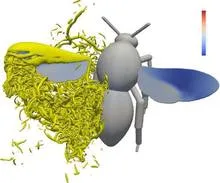
A metronome beats the rhythm, and the musician adjusts to it without thinking about note lengths. Similarly, vortices on an insect's wing follow a single rhythm set not by the mechanics of the flap but by a universal law of separated flow.
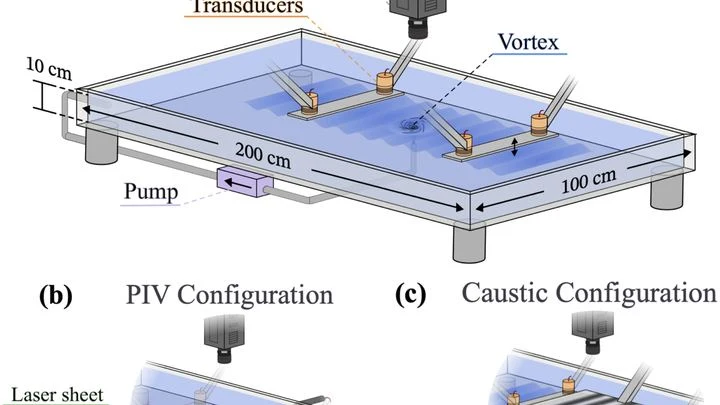
Water in a tank spins at nearly four revolutions per second, and, as if by magic, a column the size of a dinner table emerges. The vortex lives for dozens of rotations, even though everything around it churns and trembles. Where does such stability come from?
The secret is that the vortex is not isolated.
A vortex in a magnetic disk usually behaves like a large spinning top: to keep it from toppling, you need a spacious platform and a strong self-field that returns it to the center. But what if you shrink the platform to the size of a virus? Then the usual support disappears, and the vortex should fall apart.
Water confined between two cylinders flows in smooth layers when the inner one rotates. But once the speed crosses a certain threshold, the layers crumple into toroidal rolls, like a stack of bagels. Physicists call these Taylor vortices: the flow loses stability and a regular pattern emerges.
A laser pulse slams into a gas cloud and knocks electrons out of it, leaving behind a bubble: a cavity almost devoid of particles. This bubble races through the plasma at nearly the speed of light, and its walls drag along the electrons trapped inside, much like a speedboat tows a water skier.
In a ring accelerator, a beam of electrons circles millions of times. If the electrons are twisted like strands in a rope, their vortex motion should persist. But along the way, random jolts from imperfect magnets can disturb them.
Scientists have described how vortex motion changes under such perturbations.
A vortex in a magnetic material is like a whirlpool, but instead of water, the directions of magnetization twist. An electron flying through such a vortex feels not just a magnetic field, but a curvature of space: its path bends as if it were rolling down a funnel with a narrow neck.
A black hole isn't just a cosmic vacuum cleaner. If it rotates, it can amplify waves around it, much like a mountain echo repeats sound. For ultralight dark matter (particles billions of times lighter than an electron), this effect, called superradiance, can create a huge cloud.
89 milliseconds. That's how long a vortex avalanche lasts that abruptly speeds up the rotation of the Vela pulsar — one of the most famous 'glitching' pulsars. Pulsars are rapidly spinning neutron stars born in the collapse of supernovae.
At the center of many galaxies lurks an invisible cloud — a halo of dark matter. If this matter is cold and light enough, it behaves like a superfluid: it flows without friction, and any rotation in it twists into tiny quantum vortices — threads the size of an atomic nucleus.
A superfluid flows without friction, like water that never stops. But when you spin it, it doesn't just rotate: each tiny vortex remembers exactly how it was spun. This 'trace' is not a metaphor but a real geometric imprint, which physicists call the Berry phase (the phase acquired by a wave as it travels along a closed path).
In accelerators like the Large Hadron Collider, heavy nuclei collide at enormous speeds. For an instant, quark-gluon plasma (QGP) is born — a state of matter where quarks and gluons float freely, just like in the first microseconds after the birth of the universe.
This plasma is not just hot.
At the center of many galaxies lurks an invisible halo of dark matter: it holds the stars at the edges, keeping them from flying apart. For a long time, it was described as a dilute gas of particles, but new work offers a different view: dark matter might gather into a quantum droplet.
A blob of cold helium swoops dangerously close to a black hole. But this isn't just a blob: it's a dead star the size of Earth, yet with a mass comparable to the Sun's.
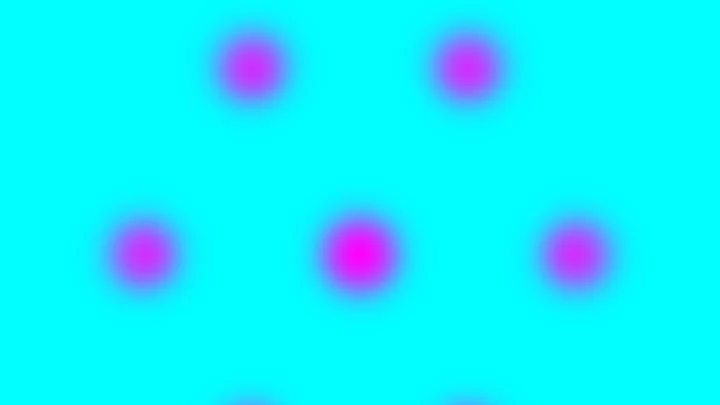
A supersolid is matter that is both crystalline and fluid. It is created from atoms cooled almost to absolute zero. In new work, physicists obtained such a substance as a triangular lattice of droplets. Each droplet oscillates in its own rhythm.
Imagine a spinning top the size of a city, weighing more than the Sun and making hundreds of revolutions per second. That's a neutron star — the remnant of an exploded star. Occasionally, its rotation suddenly speeds up, as if something inside has switched. Astronomers call these jumps glitches and suspect that invisible vortices in the star's superfluid interior are to blame.
In the quantum world, dark matter particles can merge into a single superfluid droplet — a state where matter flows without friction, like an ideal fluid. When near a black hole, this droplet doesn’t just disappear into it but twists into stable vortices, like water swirling around a rock in a stream.
River water often swirls into funnels. But in semiconductors, the foundation of microchips, electrons at low temperatures and high purity also turn into a fluid. If you create a circular cavity, vortices appear, just like in a river backwater.
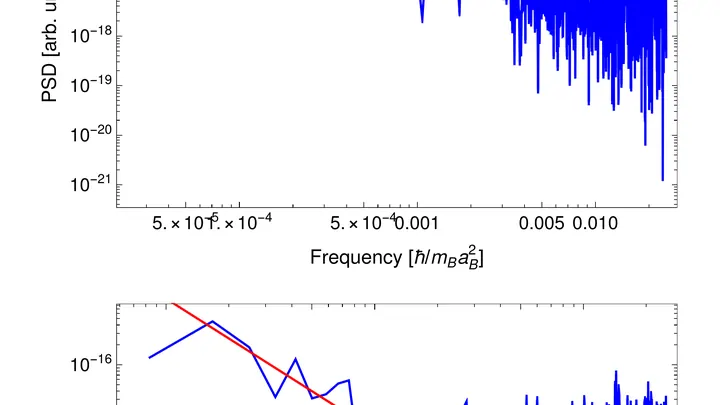
A pot of water has just been stirred: the whirlpools and eddies gradually calm down, and the liquid becomes smooth. A similar process, but in the quantum world, occurs in superfluid helium or in a cloud of ultracold atoms.
Inside a superconductor, a magnetic field typically twists into tubes, vortices, each carrying one quantum of magnetic flux. That's how the classic Abrikosov lattice works. But in LiFeAs crystals, the picture is different.
Muon spectroscopy showed that the field penetrates not as individual vortices but as stripes. Each stripe contains pairs of 'coreless' vortices.
Water going down the drain swirls into a vortex. An everyday sight in the kitchen. But this very vortex turned out to be able to reproduce two effects that physicists usually associate with black holes and the rotation of planets.
The first effect is the shift of a wave as it goes around an obstacle.
According to the Standard Model, the vacuum is not emptiness but an ocean of virtual ghost particles. An ultra-strong electromagnetic field, like a storm, yanks electron-positron pairs into reality.
A neutron star is a spinning top with the mass of the Sun, crushed to the size of a city. It's born in the fire of a supernova and usually only slows its spin. But sometimes, for no apparent reason, it suddenly speeds up — such a jerk is called a glitch.
In a pot of boiling water, steam bubbles rise and pop. In the quantum world of a superfluid, bubbles behave differently: they can collide and give birth to vortices — tiny swirling flows, like whirlpools in a river.
Scientists modeled such a liquid using a holographic approach.
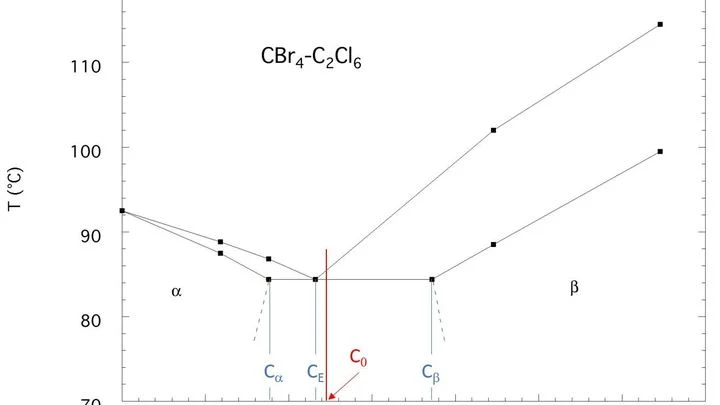
In a solid piece of tin-lead alloy, the layers of the two metals lie like pages in a book. When heated from one side, the layers don't melt uniformly but in whimsical tongues and fingers. Scientists studied this process using a transparent alloy that can be seen through under a microscope and compared it with a computer model.
A cold cloud of atoms is like a swarm of fireflies drawn to one another. The attraction between atoms tries to pack them into a single dense ball. But quantum jitter, the unavoidable motion of particles, keeps the ball from collapsing. When the attraction is strong, the cloud breaks into separate clumps.
The void can produce particles if a strong enough field is applied. Physicists call this the Dirac–Klein paradox. Previously, explaining it required the most complex calculations of quantum field theory. But we can make do with a visual image: a tightly stretched rubber band with a knot. The knot is a particle.
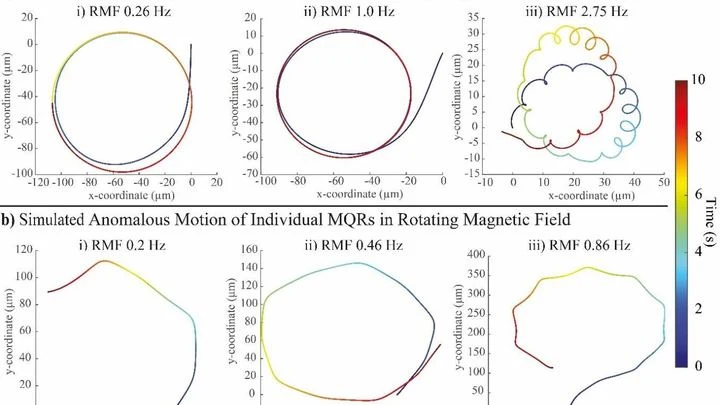
A small ball with an iron core lies on a surface while a magnetic field spins around it. The ball starts rolling like a wheel and usually goes in the direction the field rotates. But sometimes it suddenly turns around and rolls the other way — against the field.
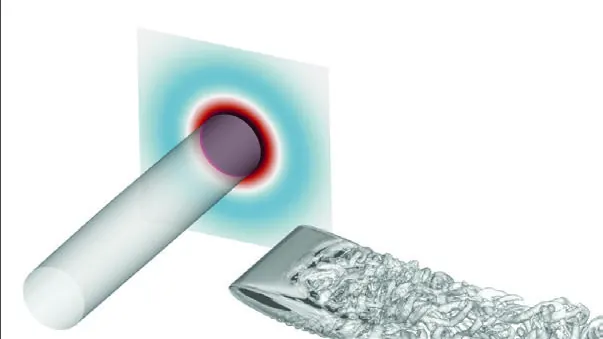
A sudden gust hits a wing, and a huge vortex swirls above it. Such a vortex can abruptly change lift, making the plane's nose dip. Engineers have long sought ways to predict these vortices, but complexity gets in the way: fast airflow is full of small chaotic eddies.
Ordinary tiles form a repeating pattern. But atoms can do more: under certain conditions, they themselves lay out a complex mosaic where the pattern never repeats, like on antique tile panels.
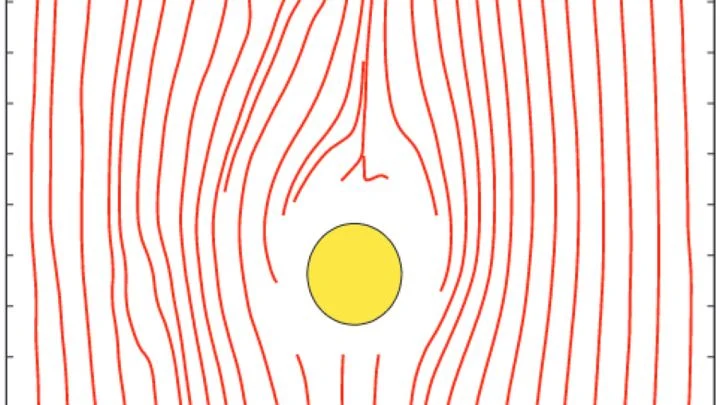
Liquid helium cooled to near absolute zero behaves like two fluids at once: a normal viscous part and a superfluid part that flows without friction. When such a flow hits a cylinder, vortices are born behind it. But sometimes vortices appear in front of the cylinder — where classical laws say they shouldn't be.
A vortex in a superfluid gas is like a whirlpool in a sink: the fluid swirls around an empty core. If you spin such a vortex three times harder than usual, it won't hold: it breaks into three separate whirlpools, much like a thick stream of water splits into droplets.
Water swirls into a ring, and that ring flies through the bulk without breaking apart. Such vortex rings, from smoke rings to underwater currents, follow laws that are hard to capture on paper. Usually, the flow is divided into millions of cubic cells, and each one is tracked.
A supersolid is ice that flows. Think of a pond with a frozen crust, but beneath it, a liquid depth without friction. Usually, creating that crust means changing the liquid's properties throughout its entire volume.
In superfluid helium, a state where liquid flows without friction, quantized vortices spontaneously arise: microscopic funnels resembling whirlpools in ordinary Water, but governed by quantum mechanics.
Dark matter is an invisible ocean that, as shown by observations by Vera Rubin, keeps stars in galaxies from flying apart. Physicists suspect that if dark matter consists of ultralight particles, in the cosmic cold it turns into a frictionless fluid — a so-called condensate.
A spinning black hole acts like a giant funnel, but instead of just sucking in everything around it, it twists space itself, like a swift river current. New calculations show that in this maelstrom, stable vortices can be born from ultralight particles — likely building blocks of dark matter.
According to the laws of the microworld, an electron obeying the Dirac equation trembles even at complete rest. This is Zitterbewegung — an oscillation with an amplitude of trillionths of a millimeter, like a spinning top on an invisible axis.
When liquid is swirled in a cup, a vortex with an empty center forms. In this empty core, waves find a trap: bouncing off the walls, they siphon energy from the vortex and grow like a flame along a fuse — each wave stronger than the last, until a surge breaks loose.
Astrophysicists have described the same chain reaction around black holes.