An excitation is a state of a physical system that has higher energy than its ground state. In many-body systems, excitations are often described as quasiparticles — collective disturbances that behave like particles. For example, a phonon is a quantized vibration of a crystal lattice, and a magnon is a quantized spin wave. Excitations are central to understanding how energy is absorbed, transported, and emitted by matter.
History
The concept of excitations as quasiparticles was developed in the early 20th century, with the introduction of phonons by Einstein (1907) and Debye (1912), and later extended to other collective modes like magnons (Bloch, 1930) and plasmons (Pines and Bohm, 1952).
How it works
When energy is added to a system (e.g., by heating, light absorption, or particle impact), it can promote the system from its ground state to an excited state. In a many-body system, this excitation typically involves the coordinated motion of many particles, which can be described as a quasiparticle with its own dispersion relation (energy vs. momentum). These quasiparticles can move, interact, and decay, carrying energy and information through the material.
In practice
Excitations are exploited in technologies such as lasers (photon excitations), semiconductors (electron-hole pairs), and magnetic storage (magnons), as well as in quantum sensing and quantum computing.
Fun fact
The dynamic Casimir effect can create real photons from the quantum vacuum by rapidly moving a mirror, effectively converting vacuum fluctuations into excitations.
A massive aluminum cylinder weighing a ton hangs in a vacuum. A gravitational wave, a ripple in spacetime, passes through it, and the bar begins to tremble almost imperceptibly. That trembling can be heard as sound: gravitational waves turn into a phonon — a quantum of sound vibrations.
In 1984, the world of crystallography was turned upside down: sharp diffraction peaks with fivefold symmetry were discovered in an alloy of aluminum and manganese – as if nature had mocked the strict theorems forbidding repeating patterns from having axes of order 5, 8, 10, or 12.
Two tiny mirrors in a vacuum are like figure skaters in a pairs routine. Their oscillations are synchronized by an invisible gravitational thread. When cooled to millionths of a degree above zero, this thread turns them into a single quantum link — the motion of one instantly echoes in the other.
Strike a bell, and it rings. But the sound isn't arbitrary: the bell itself picks out the notes to which its metal is tuned. It turns out a black hole behaves the same way. When something falls into it, or its spacetime gets warped, it starts to oscillate.
In superfluid helium, friction disappears — the liquid flows like a mountain stream, but without a single eddy. A short laser pulse rippled this smooth surface, and scientists using spectroscopy captured the spreading ripples — quantum waves with many speeds.
A crowd of people suddenly starts moving as one. In physics, this happens with atomic spins — tiny magnetic arrows. When many spins come together and interact through a shared medium, they form one big magnet, or a macrospin. This macrospin doesn't just point in one direction; it can get stuck in several positions, like an ice cube that refuses to melt even when it's warm.
Electrons in a crystal sometimes behave like a stadium crowd doing the wave: areas of higher density alternate with nearly empty ones. This wave blocks the free flow of charges — under normal conditions, the material is not superconducting. But apply pressure, and the wave vanishes, letting electrons move without resistance.
Magnetic moments in a crystal are like compass needles fixed at lattice sites. In the normal state, they line up in neat order, but if an electromagnetic wave strikes the crystal, the needles start to sway, like wheat stalks in the wind. These oscillations are called magnons, and they carry energy without the atoms themselves moving.
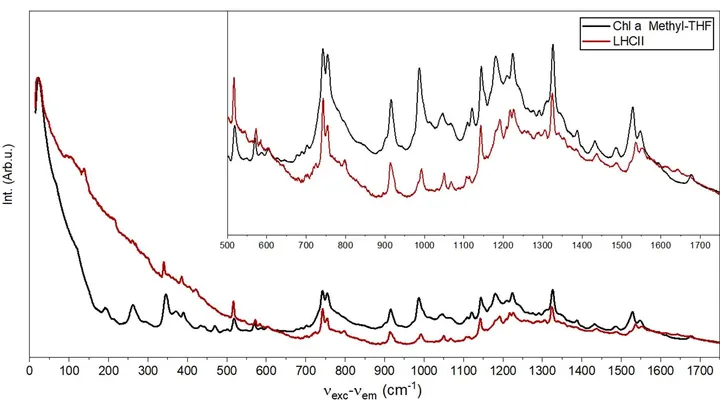
When a sunbeam hits a leaf, a relay race begins inside it. The energy of light passes from one chlorophyll molecule to the next until it reaches the reaction center — the place where the chemistry of life kicks off. This relay runs with astonishing accuracy: nearly every quantum of light finds its way.
If you toss a stone into a pond, ripples spread across the water. Tiny magnetic crystals also host waves — except it's not water that oscillates but the direction of magnetization. These are called spin waves. They travel through the crystal like ripples on a surface and can carry information.
When a molecule absorbs light, it doesn't just heat up: it transitions into a special, excited state. Its electrons rearrange, like musicians who, after a loud chord, start playing a new melody.
Right after its birth, the Universe wasn't just expanding: it was inflating at an unimaginable pace. This stage, called inflation, was proposed by Alan Guth. New models compare the process to inflating a balloon with quick, jerky pumps.
Every hour, when the hands of a clock align at twelve, something happens in Earth's magnetosphere. It's as if an invisible conductor raises a baton, and waves race along magnetic field lines toward the surface. They're called pearls: on recordings, they look like a string of beads strung along time.