Light in a Cryostat: How Imperfect Converters Build Quantum Bridges ✛ ✎ ✦
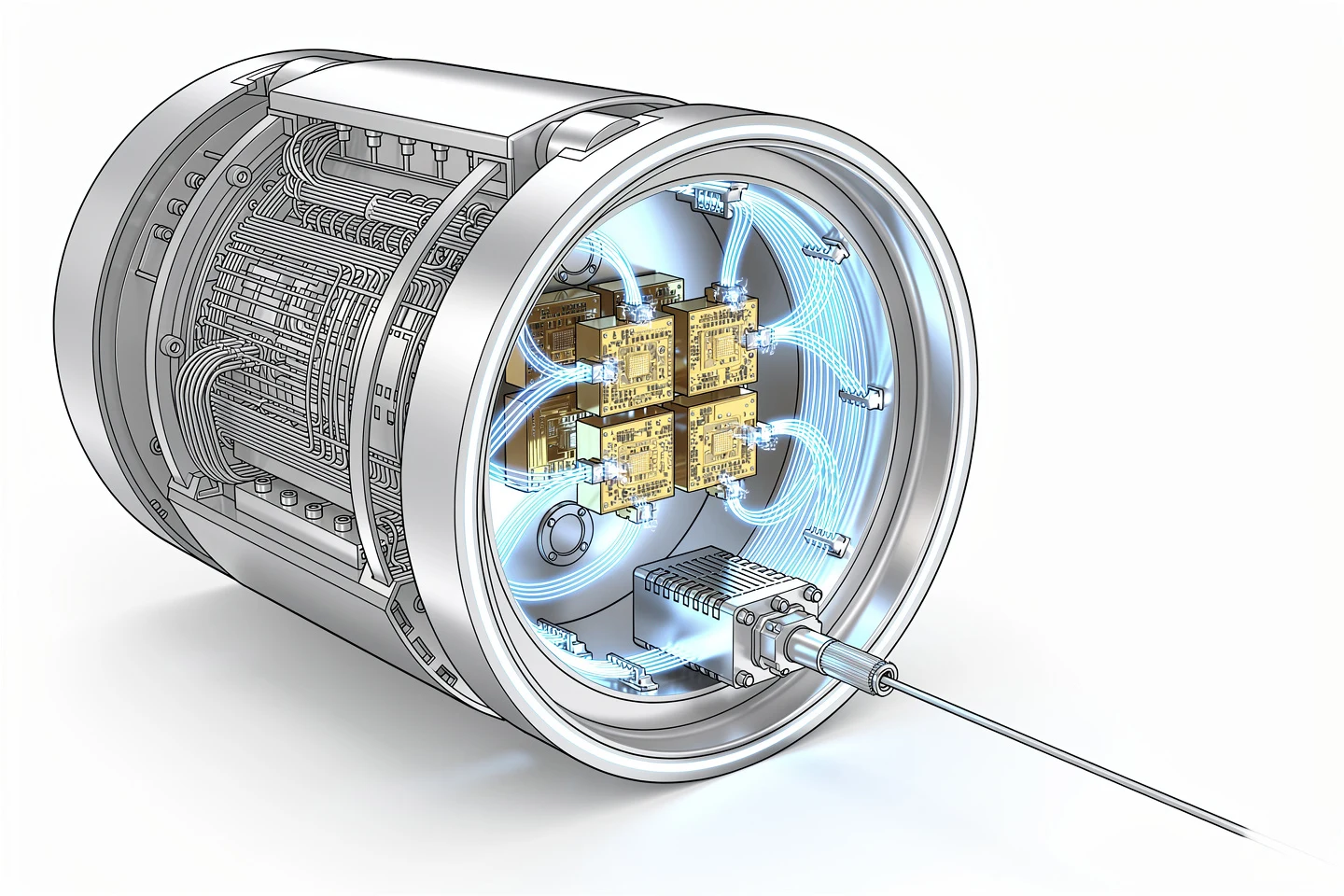
A superconducting quantum processor is like a microscopic metropolis locked in a cryogenic fridge: streets of superconducting lines, blocks of qubits. Each resident demands silence and cold, but expanding the city inside a single cryostat is like stacking skyscrapers in a cramped courtyard — wires heat the environment, noise builds up, coherence threatens to collapse. The city needs external highways — optical lines along which quantum information flies off on nearly weightless photons, without heating the surroundings. For this highway, there's a suspension bridge between worlds: the microwave-to-optical converter. It translates the "language" of qubits (gigahertz) into the "language" of light (hundreds of terahertz).
For now, these bridges resemble rickety rope crossings: conversion efficiency ranges from fractions of a percent to a few tens, and each step adds noise. But researchers didn't wait for perfection. In the spirit of Charles Bennett's ideas on entanglement distillation and John Stewart Bell's on nonlocality, they proposed a protocol where many parallel attempts and state purification compensate for imperfection. Imagine a team of couriers carrying pieces of an encrypted key: even if some lose packets or make mistakes, upon reassembly you can recover an exact copy. The deeper analogy is consensus algorithms in unreliable networks: truth emerges from many distorted voices.
Simulations showed that with realistic parameters (noise 0.1 photons per attempt, repetition rate 1 MHz, 20 parallel lines) an entangled pair is born in 15 microseconds with 91% fidelity. Four rounds of quantum distillation raise it to 99%—above the error-correction threshold. Such a pair can teleport a qubit state between modules or become a link in a large GHZ state for algorithmic breakthroughs. Richard Feynman's idea that quantum systems should simulate nature takes on a real scale.
The future isn't a giant fridge, but an optical web connecting cryogenic islands. Achieving efficiency above 50% and noise below 0.01 will enable lattice surgery: logical qubits, split between modules, will be "stitched" by light at each decoherence correction cycle. It's already clear: we don't have to wait for a perfect converter: it's time to build quantum optical networks from off-the-shelf materials. So the ordinary fiber optic that brings us streaming shows might one day carry the superconducting thoughts of quantum computers.
The optical fiber that streams our videos can carry single photons for hundreds of kilometers with minimal attenuation — precisely the property that makes it the ideal backbone for a quantum internet.