A Glass Loom for Light: 99.7% Fidelity Across 24 Quantum Threads ✛ ✦
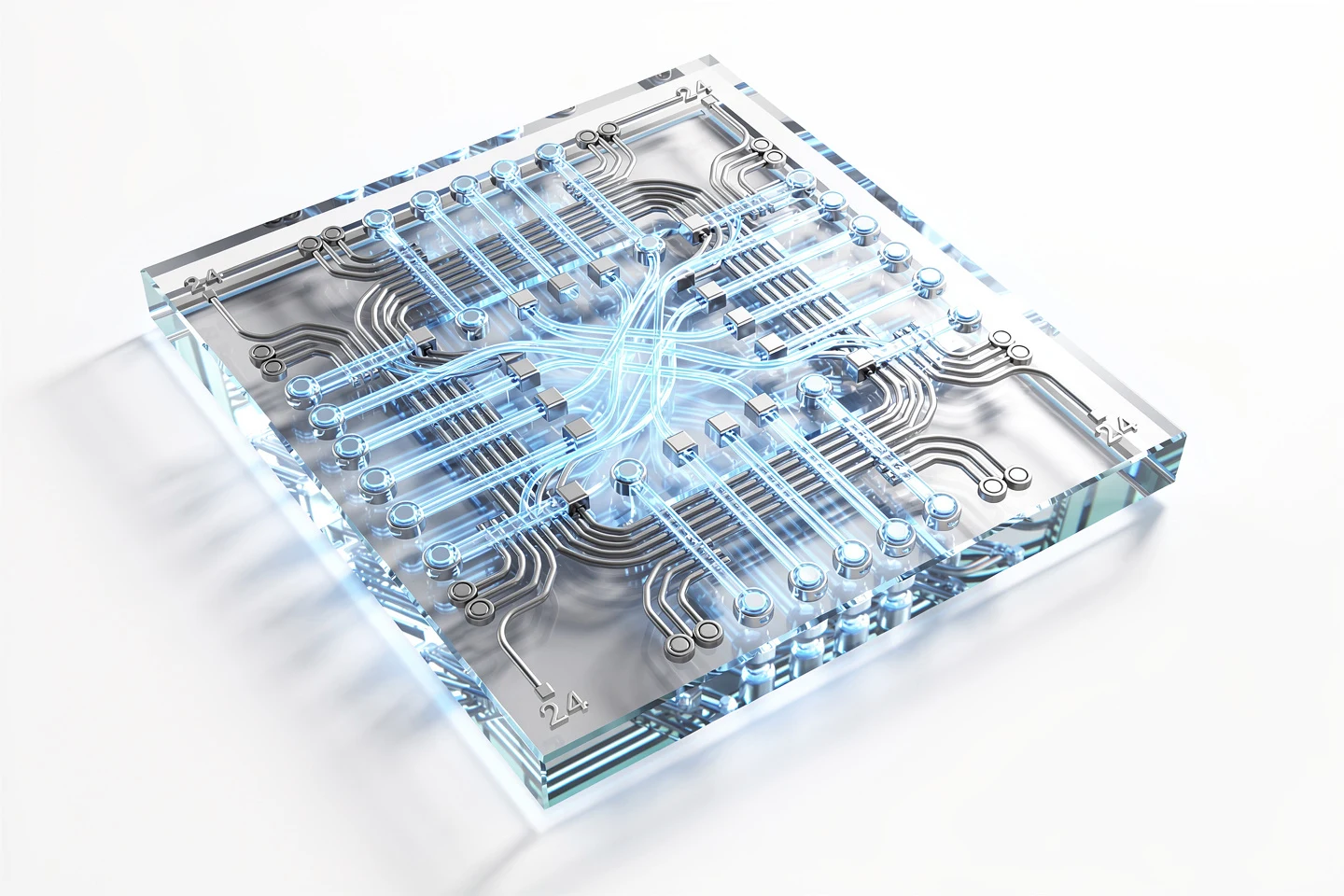
Scaling up a quantum computer is like weaving a web of light: each thread trembles with thermal breath, threatening to tear the nascent pattern. Early on, Richard Feynman and David Deutsch saw that photons are ideal qubits, but they need a stage: a programmable circuit juggling dozens of modes. That's exactly the stage built at Ephos and Milan Polytechnic: a 24-mode universal processor carved by a femtosecond laser straight into glass, like lace made of frozen light.
The glass loom is driven by a laser shuttle: it stitches through a transparent plate, leaving waveguides — threads along which photons will run. At the intersections of these threads, chrome microheater-conductors are placed, controlling the phase of each pulse to a fraction of a degree. All packed with a density unattainable by ordinary microchips: 552 couplers insulated by air trenches half a human hair thick. The architecture yields record-low losses — an average of 4.35 dB from fiber to fiber, and power consumption under 10 watts, like a night-light. The device is designed to work with quantum-optical single-photon sources at 925 nm, ushering in the era of full-fledged quantum information processing.
But the real magic isn't the hardware: it's the calibration. 30,000 quantum measurements, a machine learning model that absorbed knowledge of thermal crosstalk, and a final check on 2,000 random unitary matrices chosen by the entropic Haar measure demonstrated an amplitude fidelity of 99.7%. It's like tuning a piano with 24 strings, where each string affects its neighbors, yet the algorithm solves this puzzle in hours and delivers a nearly flawless chord. The glass loom performs any linear transformation with jeweler's precision, without destroying fragile entangled states. In his time, John von Neumann dreamed of programmable information processing; here it's realized in the language of photons, and low losses directly combat the chief enemy of quantum computers — decoherence.
This result is more than a lab record. It proves that femtosecond writing can give birth to three-dimensional photonic circuits with an unprecedented combination of complexity, stability, and energy efficiency. In the future, such glass chips will integrate single-photon sources, the computational fabric itself, and detectors in a single piece of material — a quantum lab in the palm of your hand. Integration with superconducting electronics at cryogenic temperatures will open the way to hybrid systems where light and matter communicate without losses. Already today, the 24-mode processor is ready to run quantum algorithms like boson sampling — a task beyond classical computers. The next step is hundreds or thousands of modes woven into a glass neural network that will tackle the modeling of molecules, drugs, and materials. And here's a telling detail: the 99.7% fidelity closely approaches the error-correction threshold — perhaps the next generation of these chips will learn to fix their own quantum blunders on their own. Glass ceases to be just a window: its crystal lattice sprouts an intellect woven from photons.
The processor's glass is almost the same as in smartphone displays, but its exceptional transparency and thermal stability turn it into an ideal canvas for laser “embroidery” of waveguides. The thermal isolation trenches, 60 microns deep (thinner than a human hair), reduce thermal crosstalk by orders of magnitude, like soundproofing in a recording studio.
This universal optical processor echoes the light-based computers from Neal Stephenson's “Snow Crash,” where information was processed by holograms and optical neural networks. Today's chips are the first step toward making light not just illuminate, but think.