The Skyrmion Dance: How a Magnetic Vortex Conducts the Quantum Orchestra ✛ ✦
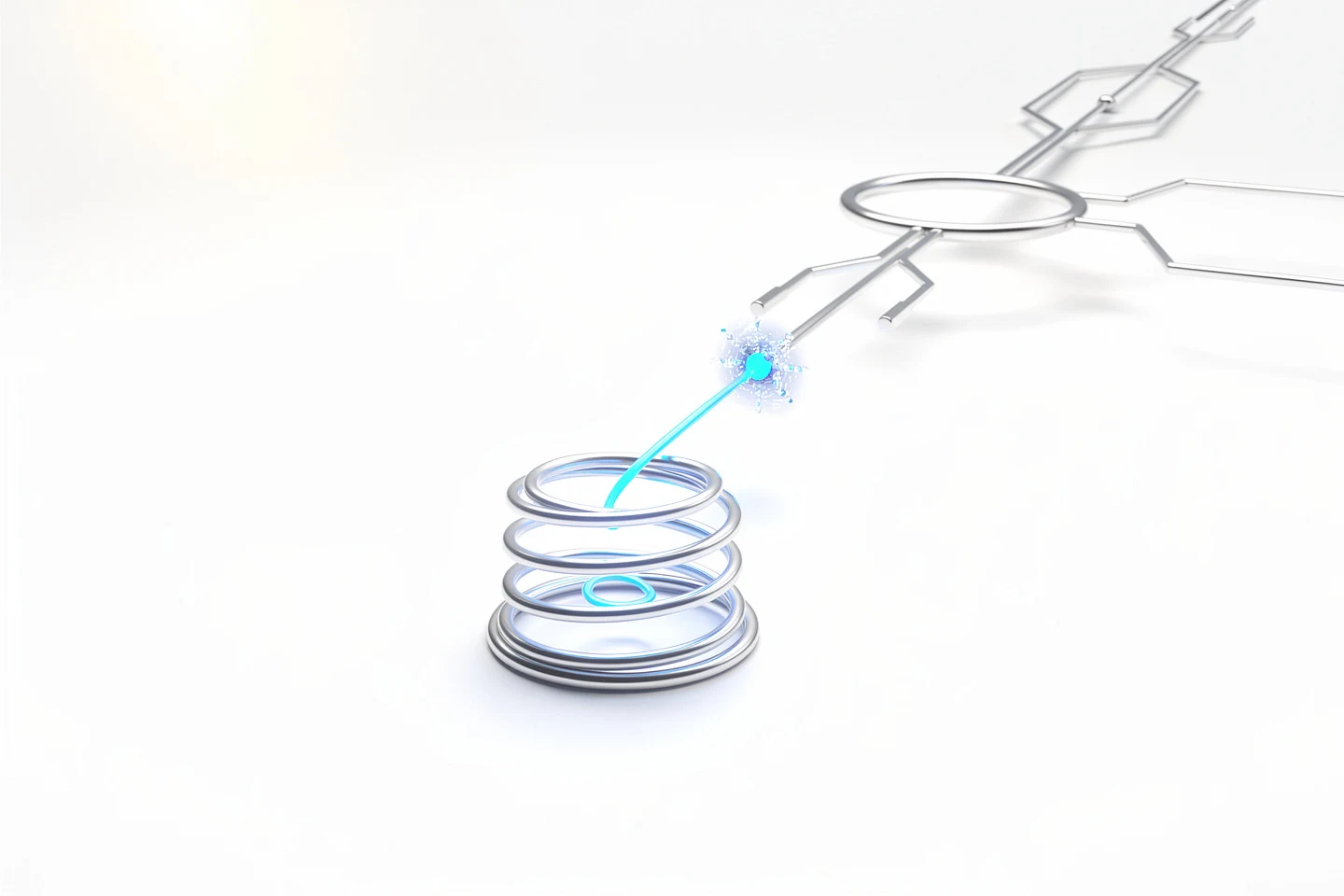
A quantum computer is like an orchestra where strings and brass play in different languages. Superconducting processors operate with microwave photons in centimeter-scale circuits, while spin qubits, such as nitrogen-vacancy centers, store information at the scale of individual atoms. Direct communication between them is as impossible as a dialogue between a whale and an ant. But there is a mediator, capable of dancing on both stages: a magnetic skyrmion — a topological vortex in a thin film.
Instead of a conductor, imagine an ice dancer: he doesn't touch the instruments, but each pirouette sends out waves, making both the cello and the flute sound. This is how a skyrmion works, confined in a nanodisk. Its core oscillates with an amplitude of just half an angstrom — smaller than an atom! This trembling generates an alternating magnetic field that envelops both the single spin of the NV center and the superconducting loop of the transmon. A three-component quantum dance emerges, where the partners don't touch each other but exchange energy and quantum information.
The mathematics of this dance is elegant. The effective Hamiltonian for coherent exchange between the NV center and the transmon takes the form \(\hat{H}_{\text{eff}} = \Lambda_{\text{NT}} (\hat{\sigma}_{+} \hat{\sigma}_{T}^{-} + \hat{\sigma}_{T}^{+} \hat{\sigma}_{-})\), where \(\Lambda_{\text{NT}}\) is the coupling strength arising from virtual absorption and emission of a skyrmion quantum. Another key parameter—\(\Lambda_{\text{SN}} = \frac{\gamma_e \mu_0 M_S r_c}{4R} \mathcal{F}_{\text{SN}}\)—shows how magnetization, precession frequency, and disk geometry set the 'volume' of the conversation. With a disk radius of 100 nm and moderate damping, the coupling reaches 12.5 MHz for the spin and 5 MHz for the transmon. Virtual exchange yields an effective constant of 0.5 MHz — fast enough to outpace decoherence, whose rate is on the order of 10 kHz, and to detect individual state jumps via quantum measurement techniques.
But the most elegant behavior occurs in the nonreciprocal regime. When mode dissipation dominates, the system becomes a quantum diode: information flows from the NV center to the transmon as a quantum superposition, but not the other way. This creates a controllable unidirectional link, essential for protecting sensitive qubits from noise. This work promises an architecture of modular quantum computers with separate memory and logic blocks, united by topological 'dancers.' These vortices are immune to small perturbations: their topology protects quantum information, like a knot in a rope: you can't untie it without cutting. Entanglement, so meticulously tested by Alain Aspect, becomes a working tool here, while David Deutsch's ideas on universal quantum computation find a concrete engineering platform. Experiments at millikelvin temperatures on insulating magnets like Cu2OSeO3 are the next step. And then, chains of skyrmions transmitting qubits without wires no longer seem like science fiction.
The skyrmion is named after British physicist Tony Skyrme, who predicted particle-like solutions in nuclear physics in the 1960s. Today, magnetic skyrmions are seen as 'racetracks' for ultra-dense memory: one bit — one skyrmion, just tens of atoms across.
The concept of a quantum interface using topological patterns resonates with the idea of 'world lines' and stable vortices in Greg Egan's novel 'Diaspora,' where computation is performed on topological defects of multidimensional matter.