Quantum Internet: How Entanglement Became a Data Packet ✛ ✦
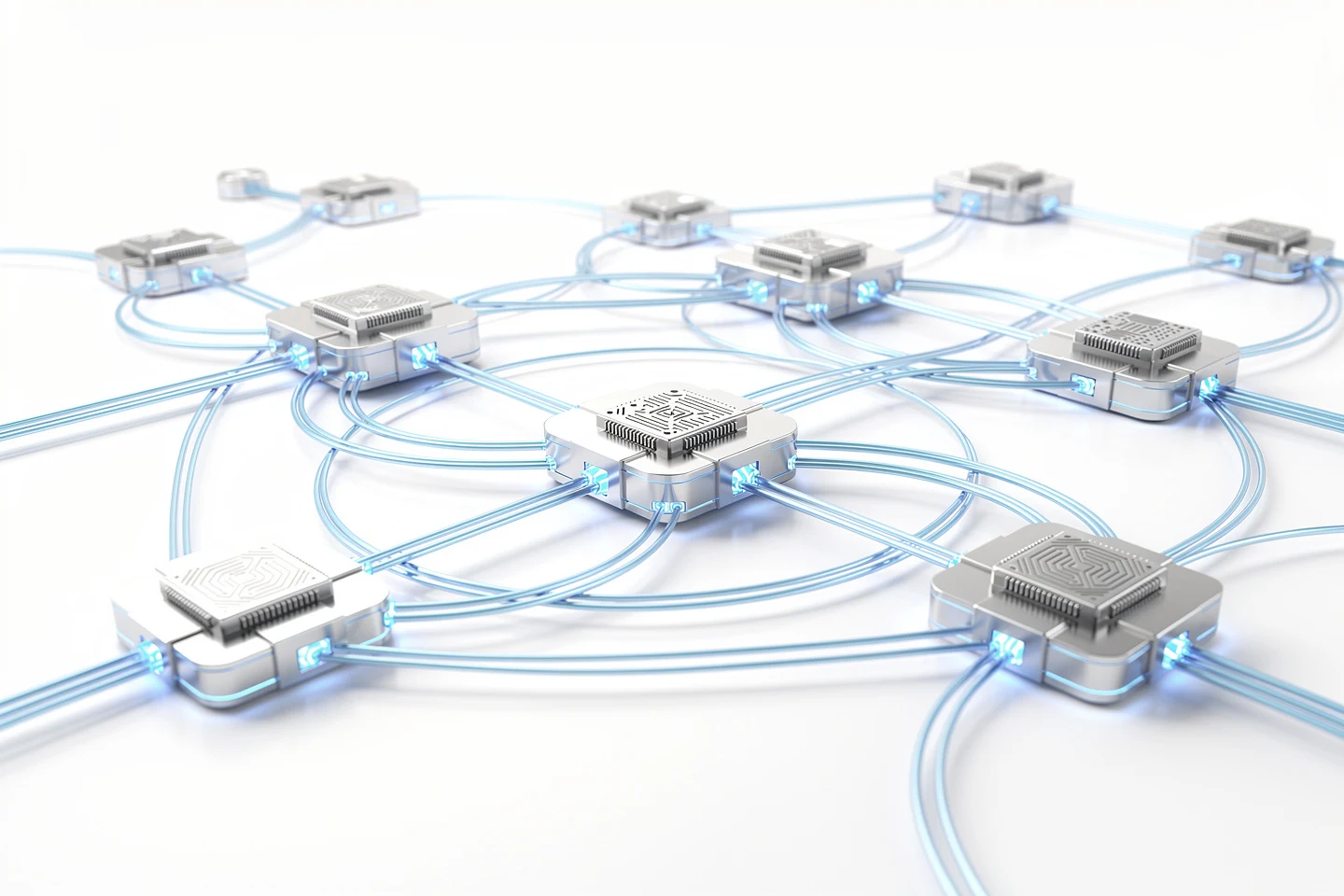
Quantum computing promises a revolution, but its real power will only unfold in a network. The best “brains” — superconducting qubits — communicate at microwave frequencies. The ideal “couriers” — optical photons — fly at hundreds of terahertz. A direct hookup is impossible. It’s like connecting Morse telegraphy to fiber optics: you need a translator that not only transcodes the signal but preserves the quantum state without measurement and the inevitable collapse of the wave function.
For a long time, engineers tried to build such a translator through direct quantum transduction — coherent conversion of an information qubit from microwave to optical form. Physically, this is achieved via the electro-optic effect in nonlinear resonators: the laser pump acts as a quantum bridge, coupling two modes and transferring the state without destruction. However, efficiency hinges on the dimensionless cooperativity C — a parameter combining coupling strength, pump photons, and resonator losses. For direct transduction to succeed, the product of forward and backward efficiencies must be >0.5 — a bar still unreachable.
And here an architectural shift changes the game. Instead of demanding a perfect transducer, network architects remembered the internet’s lesson: packet switching beat direct channels. In the quantum world, the “packets” are entanglement. The “Entanglement Generation by Transduction” (EGT) approach turns the same transducer into a factory of hybrid entangled pairs. The born ebits can be stored, purified, and put to work — data teleportation, where conversion efficiency is no longer critical. Analysis in the language of von Neumann entropy shows: even with modest cooperativity C≈0.17, one can distribute clean entangled states over optical fiber.
Paradoxically, noise and imperfection — fatal for direct transduction — prove tolerable companions when distributing ebits: quantum information theory knows how to extract benefit from disorder. Shifting the focus from information qubits to distributed ebits simplifies the architecture to the level of a postal service. No need to chase perfect conversion at every step — just distribute “envelopes” of entanglement, and superposition can be forwarded on demand. This transition recalls the birth of the World Wide Web from protocol chaos: universal data “packaging” united disparate systems. The pioneers of quantum teleportation — Charles Bennett, Alain Aspect, and Anton Zeilinger — laid the foundation, and today’s transduction work turns their ideas into engineering protocols. Ahead lies a war on decoherence and noise, the search for materials with extreme cooperativity, time synchronization. But the quantum internet is no longer a utopia; it is an ingenious transport for ephemeral states: express mail for what cannot be read in transit.
Five orders of frequency is an abyss: one “tick” of an optical photon is a hundred thousand times shorter than that of a microwave photon. To make them friends in one device takes engineering magic the size of a coin.
This architecture is almost teleportation from Star Trek: we aren’t yet beaming up Captain Kirk, but transferring quantum states without a physical carrier is no longer science fiction.