The Horizon's Silent Roar: The Fading Ring of Analog Black-White Holes ✛ ✦
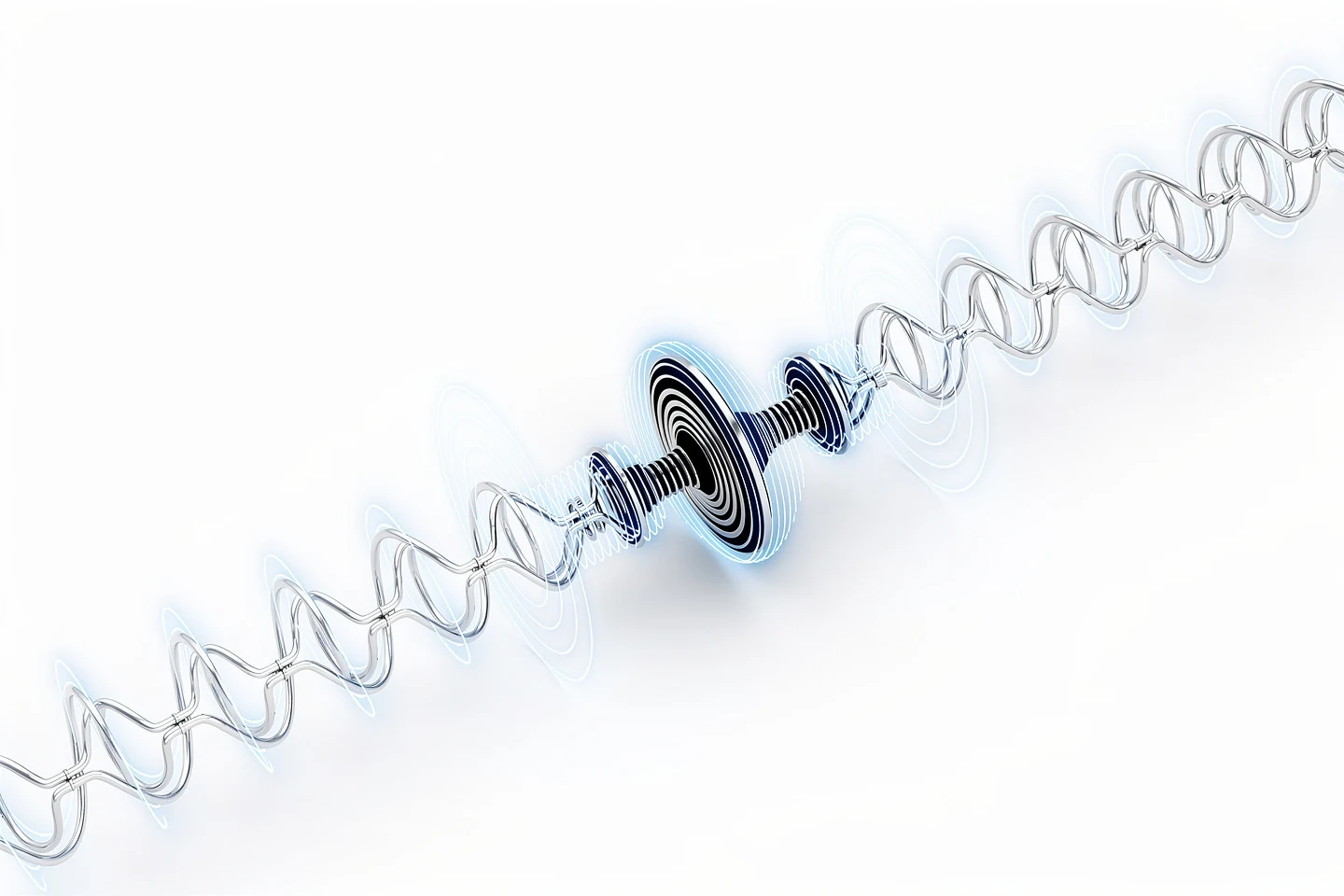
Lab-made black holes from superconducting circuits aren’t a trick: they’re an attempt to grab by the tail the most elusive effects, the ones astrophysics so far only glimpses as faint shadows in telescopes. The vision of Hawking and Penrose comes alive in microwave resonators: solitons in transmission lines bend spacetime for probe signals and create horizons that trap light. And when two solitons meet, a black-white hole is born — a bridge between universes on a printed circuit board. All that’s left is to poke it with a signal and listen to the response.
Instead of the expected ring, there's a dull fade. Miniature singularities don’t hum like a bell; they sink, like a Tibetan singing bowl plunged into thick honey. The impact causes no oscillations, just a pure dissipative decay. The fundamental quasinormal mode turns out to be strictly imaginary. Physicists call this a “silent roar”: an imaginary frequency means the perturbation decays without ever completing a single oscillation. In astrophysical black holes, quasinormal modes always carry a “chirp”—a real part. Here, though, it’s absolute silence, as if the horizon insists that inside there is no time or space, only inexorable decay.
The secret lies in the volcano-shaped potential V(η_*), which rises between the horizons in Schwarzschild’s “tortoise” coordinates. Here, space is stretched so much that the signal speed drops to zero. The Schrödinger equation for perturbations— -d²H/dη_*² + V H = ε² Ω² H — sets the stage. As long as the potential is nonzero at the horizons, the system doesn’t ring up; it quenches any ripple. Stability is proven through an elegant S-deformation from supersymmetric quantum mechanics: the potential is decomposed as W² + dW/dη, and the operator creates and annihilates not modes, but the very certainty of their decay.
The practical takeaway is stunning: in superconducting TWPA amplifiers built on SNAIL elements, you can not just simulate but literally hear this decay — lasting 3–5 cycles until nonlinear dispersion smears the picture. The fundamental frequency |Im Ω| ≈ 0.70 v₀/$w_{phys}$, with a typical soliton speed of 30% the speed of light, is tantalizingly accessible for direct measurement. This means superconducting circuits become a proving ground for testing the most elusive phenomenon — quantum evaporation of horizons. Black-white holes, microscopic wormholes, could be stabilized precisely by such dissipative modes. On the horizon are “black-hole lasers,” where population inversion produces coherent radiation, and experiments on redshift in curved space right on a chip. No telescopes needed, just liquid helium, a cryostat, and patience.
The big picture shifts as well. If analog systems reproduce quasinormal modes so accurately, then future numerical simulations, perhaps with quantum computers, will let us dig to the bottom: how does information burn into the ashes of Hawking radiation? Theorists will have to untangle the quantum fluctuations near the horizon, where nonlinearity is no longer suppressed. Experiments on SNAIL systems are about to begin. Thus, high-energy physics descends from the heavens into a cryostat, and science fiction receives a blueprint for a man-made wormhole.
SNAIL stands for Superconducting Nonlinear Asymmetric Inductive eLement, and in English “snail” means exactly that slow creature. So fast microwaves here literally “slow to a snail’s pace” in tortoise coordinates.
Like in the movie Interstellar, black-white holes connect distant regions of spacetime, only now they can be studied not via a spaceship, but inside a fingernail-sized chip.