Webb observa clima químico en enanas marrones exprés
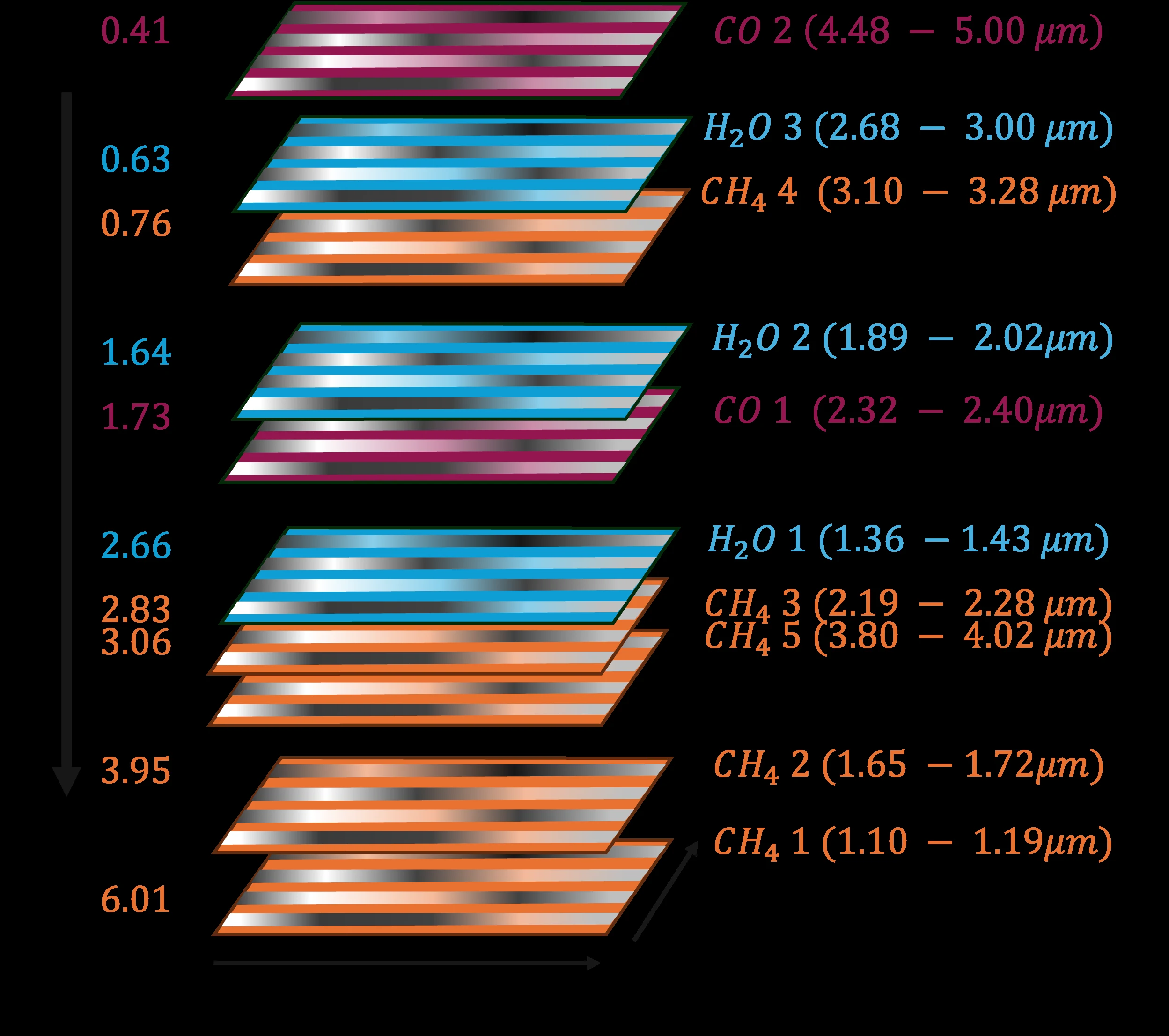
Las enanas marrones son más pesadas que los planetas, pero más ligeras que las estrellas. Su atmósfera es como una olla hirviendo: nubes de arena candente y gotas de hierro suben y bajan. El telescopio Webb observó durante mucho tiempo el par WISE 1049AB y, descomponiendo su luz en colores, notó un misterio: en la enana más cálida, la luz del metano y del monóxido de carbono parpadea mucho más que la del agua, aunque las tres provienen de la misma profundidad. Las nubes no son las culpables: en el interior ocurren reacciones químicas turbulentas. Como en una olla donde algunos condimentos suben más rápido al calentarse, estas reacciones se aceleraban y se detenían, provocando ondas en el brillo.
Además, recorren la atmósfera ondas gigantescas, exactamente como las que crean el clima en la Tierra, pero sin océanos ni tierra. Este baile químico podría ser la clave para predecir el clima en planetas lejanos.
Resumen original
tal como lo escribieron los autores, en inglés arXiv:2511.15667
We present a new analysis of the spectroscopic variability of WISE~J104915.57$$-$$531906.1AB (WISE~1049AB, L7.5+T0.5), observed using the NIRSpec instrument onboard the James Webb Space Telescope (GO 2965 - PI: Biller). We explored the variability of the dominant molecular bands present in their 0.6--5.3~$$\mu$$m spectra (H$$_2$$O, CH$$_4$$, CO), finding that the B component exhibits a higher maximum deviation than the A component in all the wavelength ranges tested. The light curves reveal wavelength-(atmospheric depth) and possibly chemistry-dependent variability. In particular, for the A component, the variability in the light curves at the wavelengths traced by the CH$$_4$$ and CO molecular absorption features is higher than that of H$$_2$$O, even when both trace similar pressure levels. We concluded that clouds alone are unlikely to explain the increased variability of CO and CH$$_4$$ with respect to H$$_2$$O, suggesting that an additional physical mechanism is needed to explain the observed variability. This mechanism is probably due to thermochemical instabilities. Finally, we provide a visual representation of the 3D atmospheric map reconstructed for both components using the molecular band contributions at different pressure levels and the fit of planetary-scale waves.
Ondas químicas similares probablemente azotan también la atmósfera de Júpiter; simplemente no podemos verlas directamente.