Los chorros de SS 433: un baile con desfase exprés
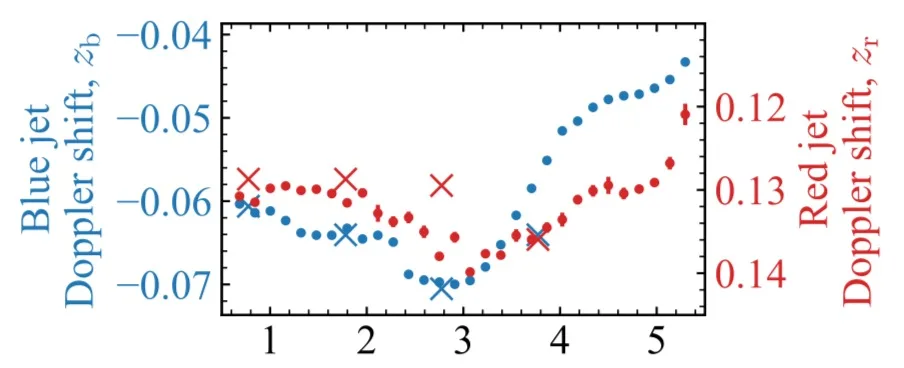
El sistema binario SS 433 expulsa dos chorros finos de gas a casi la velocidad de la luz. Uno vuela hacia nosotros, el otro se aleja. En abril de 2024 y marzo de 2025, tres instrumentos los observaron a la vez: el telescopio de rayos X XRISM, telescopios ópticos convencionales y una cámara de infrarrojo cercano.
Al comparar la velocidad de los chorros en rayos X y en luz visible, se notó un desfase: la emisión óptica parece ir un paso por detrás. Como un intérprete que escucha una frase y solo un instante después la pronuncia en voz alta. Quizás la luz nace un poco más lejos del centro que los rayos X, y necesita tiempo para llegar a nuestros instrumentos.
La velocidad de los chorros no era constante. En 2024 oscilaba alrededor del 26% de la velocidad de la luz; en 2025, ya cerca del 30%. Variaba con un período de aproximadamente 6,3 días. Esto se parece a un ritmo con el que el sistema se balancea: el llamado ciclo de nutación. Pero el desfase de fase fue de unos -90 grados: el chorro alcanza su velocidad máxima no cuando uno esperaría según el balanceo.
Los destellos en luz visible duraron unos 400 segundos en 2024 y 1600 segundos en 2025. El brillo aumentaba hasta un 15%. Pero los rayos X, mientras tanto, permanecieron en silencio: ni un solo destello notable. El canal infrarrojo tampoco vio nada parecido. Resulta que los destellos nacen solo en luz visible, mientras que los rayos X se mantienen tranquilos.
Estas observaciones son como tres testigos distintos de un mismo evento. Cada uno ve algo diferente, y solo juntos forman una imagen completa. En el futuro, XRISM seguirá observando SS 433, y entonces quizás quede claro por qué la luz óptica se retrasa y de dónde vienen esos destellos.
Resumen original
tal como lo escribieron los autores, en inglés arXiv:2602.21661
We present results from coordinated multiwavelength observations of the SS 433, obtained with XRISM, optical telescopes, and near-infrared camera during 2024 April and 2025 March. The XRISM exposures amounted to ~200 ks in 2024 and ~100 ks in 2025. With XRISM/Resolve's high spectral resolution and large effective area, we clearly resolved numerous emission lines even in short time segments, achieving improved accuracy in Doppler-shift measurements relative to earlier observations. The simultaneously obtained X-ray and optical Doppler shifts suggest a possible tendency for the optical emission to lag slightly behind the X-rays. In the Resolve data, the Doppler shifts of the two jet components exhibited apparent asymmetries, with jet speeds fluctuating around ~0.26$$\pm$$0.01$$c$$ in 2024 and ~0.30$$\pm$$0.01$$c$$ in 2025. The velocity variations indicated modulations on a timescale of ~6.3 d, with a phase offset of about -90$$^{\circ}$$ relative to the nutation cycle. The observed line widths and flux of the approaching and receding jets appear consistent with the expected geometrical effects, indicating systematically larger line widths in the inner regions of the jets, as proposed by Shidatsu et al. (2025). Optical light curves show flares of ~400 s in 2024 and ~1600 s in 2025, with amplitudes up to ~15% during out-of-eclipse intervals, while the XRISM/Xtend light curves show no significant variability within the overlapping intervals and given the statistical uncertainties. Near-infrared photometry in 2024, obtained during an out-of-eclipse interval at a different epoch from the optical observations, showed no flare-like variability, and the X-ray band also remained constant within uncertainties. These coordinated observations provide a foundation for future XRISM studies aimed at probing the dynamical properties of the relativistic jets in SS 433.
Los chorros de SS 433 se mueven a una velocidad de aproximadamente el 26–30% de la velocidad de la luz, es decir, unos 80 000 kilómetros por segundo. En un segundo, un chorro así cruzaría el océano Atlántico ocho veces.