Doble arco alrededor de estrellas vampiro exprés
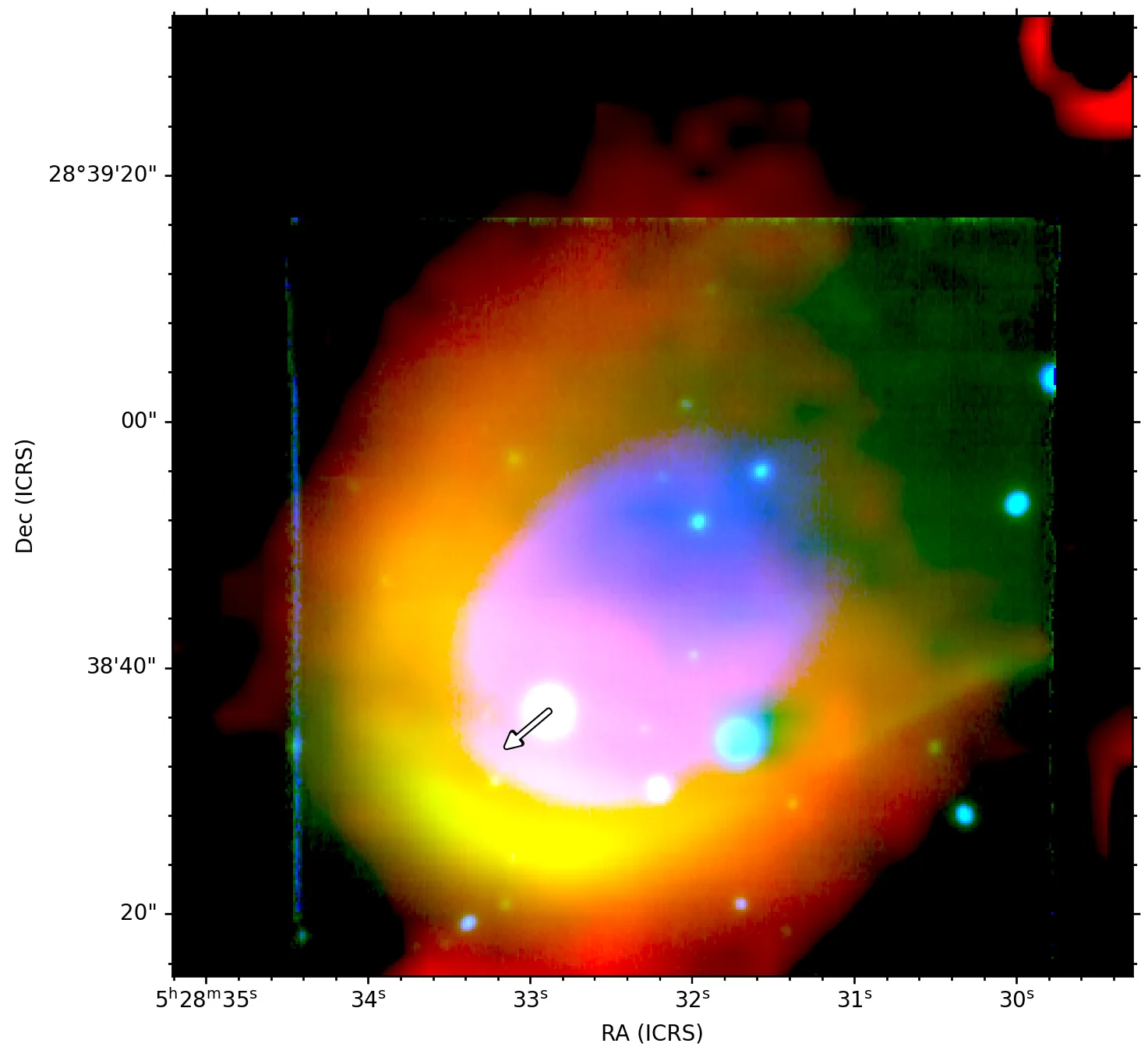
Alrededor de algunas estrellas binarias cercanas, donde una enana blanca arranca materia a su compañera, los astrónomos veían un arco luminoso. Lo consideraban una onda de choque: el lugar donde el rápido viento estelar choca contra el gas interestelar. Pero nuevas observaciones muestran que el arco no es uno solo.
La espectroscopía de imágenes de archivo en ultravioleta, luz visible e infrarrojo reveló en tres sistemas —BZ Cam, V341 Ara y 1RXS J052832.5+283824— una estructura en capas. El brillante arco óptico, que se tomaba por el límite exterior, es en realidad solo el salto interno: aquí el viento de la estrella frena bruscamente. Y más allá, en rayos infrarrojos, se ve un segundo arco, más amplio: esa es la verdadera frontera externa, donde se acumula la materia interestelar.
Resulta que la onda de choque en las variables cataclísmicas es como un pastel en capas: viento rápido, salto interno, cavidad caliente, salto externo. El verdadero tamaño de toda la estructura solo se aprecia cuando se mira más allá de la óptica.
Resumen original
tal como lo escribieron los autores, en inglés arXiv:2603.11742
Bow shocks around cataclysmic variables (CVs) have traditionally been identified with a single bright optical arc. This feature has been interpreted as the bow shock formed by the interaction between a sustained outflow and the interstellar medium (ISM). We show that this interpretation is incomplete. Generic wind-ISM interaction theory predicts a two-shock configuration consisting of an inner terminal wind (reverse) shock and an outer forward shock, separated by a hot, low-density shocked wind cavity. Using archival ultraviolet, optical, and infrared imaging of the nova-like systems BZ Cam and V341 Ara, and the polar 1RXS J052832.5+283824, we find that the nebulae around all three systems exhibit this layered structure. In each case, the previously identified bow shock bright in Halpha and [OIII] corresponds to a compact inner arc, while additional emission components reveal a more extended morphology. Specifically, each system shows an outer arc detected in mid-infrared images, and the region between the optical and infrared arcs is filled with faint Halpha emission and, where available, far ultraviolet emission. We identify this infrared arc, reported here for the first time in these systems, as the sweep-up boundary of the forward shock, while the bright inner optical arc corresponds to the terminal wind shock rather than the forward shock as previously assumed. These results reveal that the true extent and layered structure of bow shocks around CVs only become apparent when observations extend beyond the optical band.
El arco externo infrarrojo en estos tres sistemas se detectó por primera vez: antes simplemente no se hacían observaciones en el rango adecuado.