Cómo el caos gobierna la química de los gigantes exprés
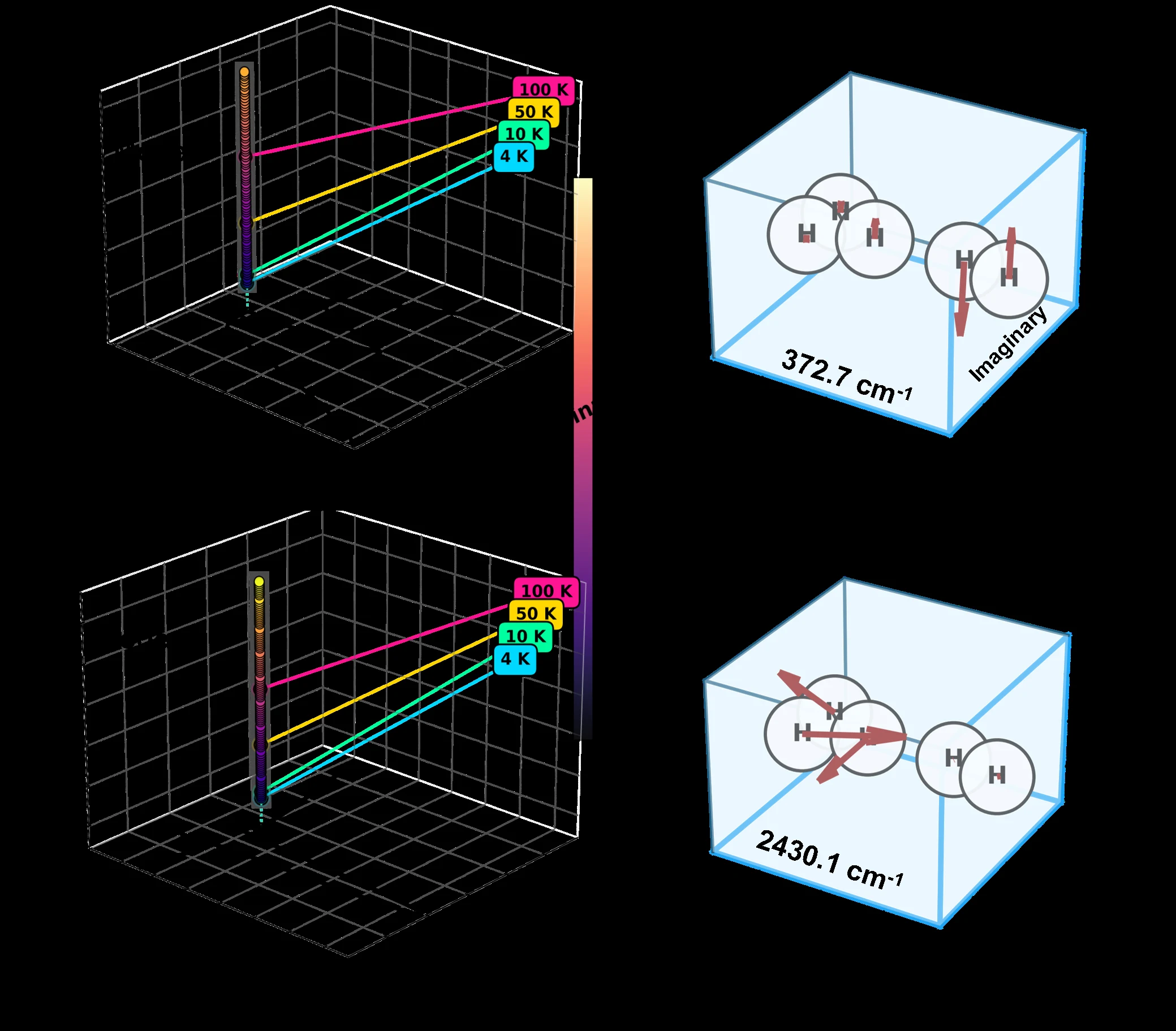
Una reacción química se asemeja al paso por un torniquete: una multitud crea caos y se atasca, mientras que una fila ordenada avanza. Sin embargo, en el mundo cuántico, cuando el tumulto se calma, la barrera puede volverse fantasmal: la partícula la atraviesa como si el torniquete desapareciera. Este efecto túnel gobierna la química de los planetas gigantes.
La investigación mostró que en el estado de transición, cuando las moléculas están a punto de transformarse, el caos se silencia. Es justo entonces cuando los iones de hidrógeno se filtran a través de barreras, formando moléculas críticas para la atmósfera de Júpiter.
Los científicos introdujeron un "índice de fragilidad": este predice qué vibraciones moleculares devuelven el caos y rompen el túnel. Lo más sorprendente: sin esa breve pausa, ni siquiera las colisiones más intensas habrían activado la reacción. Así, en las frías profundidades de Júpiter, no es el calor, sino la supresión del caos lo que enciende las auroras polares.
Resumen original
tal como lo escribieron los autores, en inglés arXiv:2604.21005
Accurate modeling of ion-molecule reaction networks is essential for understanding the chemical evolution of planetary ionospheres, particularly for giant planets where proton-transfer chains drive atmospheric composition. However, predicting reaction rates in these ultracold environments remains a challenge due to the non-trivial interplay between vibrational dynamics and quantum tunneling. In this work we present a chaos-diagnostic framework that integrates multireference electronic structure theory, Adiabatic Gauge Potentials (AGP), and Random Matrix Theory (RMT) to characterize the microscopic dynamics of proton transport. Using the formation of H+3 and the proton-bound cluster H+5 as representative model systems relevant to Jovian atmospheres, we demonstrate that the transition state acts as a dynamical bottleneck where quantum chaos is notably suppressed, effectively enhancing tunneling probabilities. We introduce a fragility index based on the AGP slope to quantify how specific vibrational modes reintroduce chaos and suppress reactivity. This diagnostic approach offers a generalizable, data-driven metric for identifying vibrationally gated pathways in complex astrochemical networks, providing a theoretical basis for refining kinetic models of planetary and interstellar plasmas
El ion H3+ no solo abunda en la atmósfera de Júpiter: es el que enciende sus auroras polares.