Brújula magnética para el cerebro sin interferencias exprés
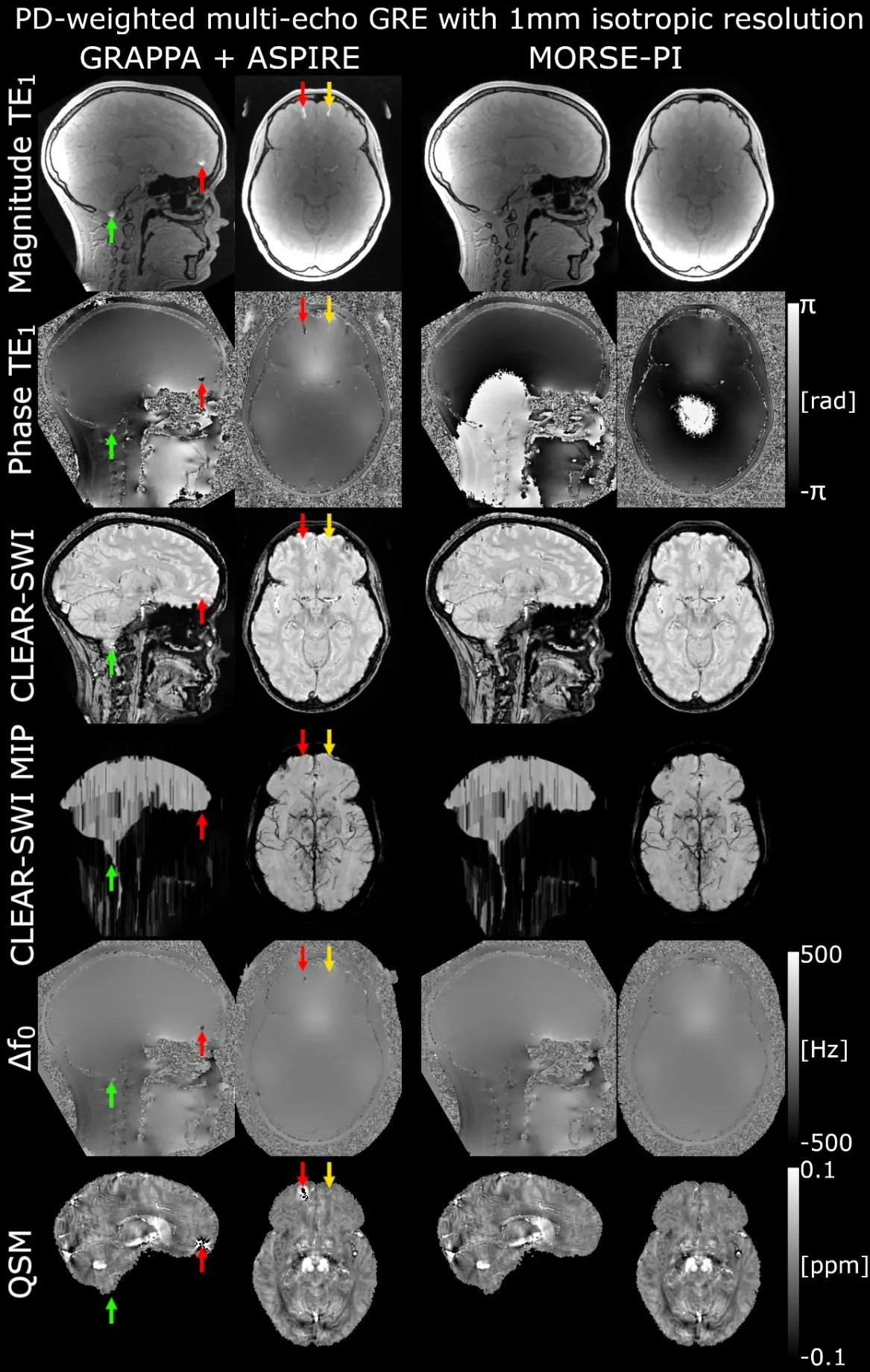
El potente imán del escáner induce corrientes eléctricas débiles en los tejidos. Su fase se comporta como la aguja de una brújula que tiembla con cada ráfaga de viento: la más mínima interferencia convierte el mapa en un ondulado donde, en lugar de pequeños vasos o depósitos de hierro, solo se ve ruido.
MORSE-PI actúa como un director de orquesta inteligente con un conjunto de bobinas receptoras. Crea una bobina de referencia virtual que escucha la señal de todo el cerebro por igual y, con ella, las fases de todas las bobinas se alinean en un único ritmo limpio.
El método no solo elimina el ruido: evita que se convierta en vórtices falsos en el mapa. La aguja de la brújula ya no gira en un remolino de interferencias. Ahora se puede medir de forma fiable la susceptibilidad magnética (QSM), el principal indicador para detectar microsangrados o cambios parkinsonianos. Todo esto funciona en cualquier campo: desde los habituales 3 teslas hasta los experimentales 7 teslas.
Resumen original
tal como lo escribieron los autores, en inglés arXiv:2606.21336
Phase imaging applications such as QSM are highly sensitive to noise amplifications, phase singularities, and other artefacts, particularly in challenging scenarios such as ultra-high field (7T), under-sampled or single-echo acquisitions. We present a novel image reconstruction method, MORSE-PI, designed to produce high-SNR, artefact-free, and singularity-free phase images for both structural and functional phase-based brain imaging. MORSE-PI extends our previous approach, MORSE, by introducing a Virtual Reference Coil (VRC). The VRC is constructed as a linear combination of coil sensitivity maps, with correlations enhanced between coil elements using the noise covariance matrix. Such a VRC ensures robust signal support across the entire brain and is used to correct phase offsets in the MORSE-derived coil sensitivity estimates, resulting in artefact-free, high SNR phase. Compared to GRAPPA with ASPIRE phase correction, MORSE-PI demonstrates greater robustness to artefacts such as noise amplification and aliasing, and shows improved reproducibility in structural imaging at both 3T and 7T. Unlike ESPIRiT and GRAPPA combined with adaptive coil combination methods, MORSE-PI yields singularity-free phase maps. MORSE-PI enables high-SNR reconstructions even for the most challenging scenarios, such as single-echo EPI at 7T. Its efficient, containerised implementation using the Gadgetron framework supports deployment on the MRI scanner console during measurements. MORSE-PI offers a flexible and computationally efficient solution for generating high-SNR, artefact- and singularity-free phase images in both single- and multi-echo GRE and EPI acquisitions. This makes it particularly well-suited for structural and functional QSM, as well as other phase-based MRI applications. Its robustness and rapid computational time facilitate efficient deployment on scanners across field strengths.
El escáner de ultra alto campo de 7 teslas genera un campo magnético 140 000 veces más intenso que el terrestre: podría arrancar un clip del bolsillo desde el otro lado de la habitación.
En la novela «Minority Report», los predictores de crímenes se buscaban mediante anomalías en los mapas magnéticos cerebrales; MORSE-PI habría hecho su búsqueda mucho más precisa.