De qué hornearon el planeta gigante exprés
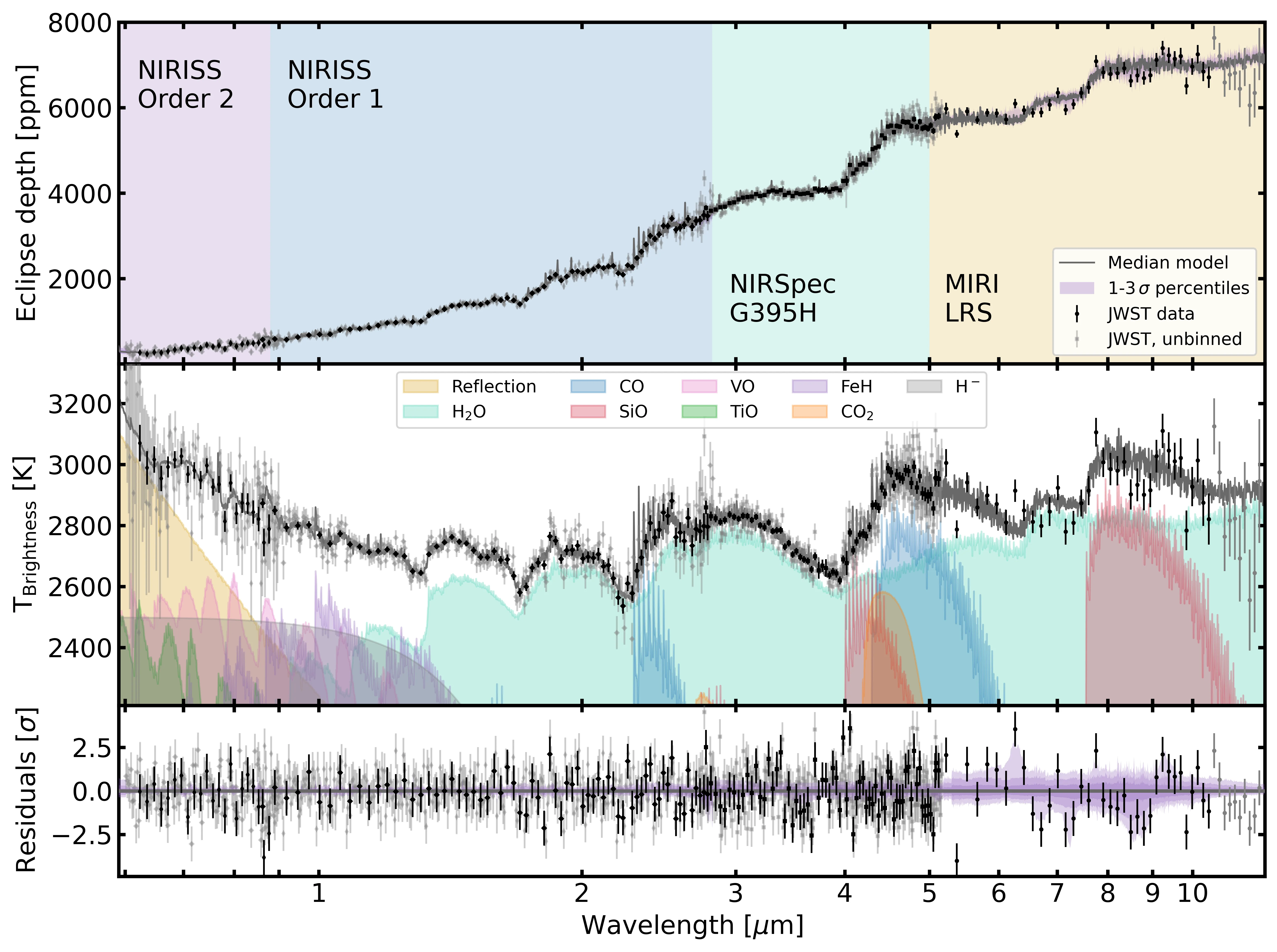
El planeta WASP-121 b no es solo una bola caliente. Es un mundo donde el hierro se evapora y el cielo brilla con su propio calor. Una nueva mirada ha ayudado a entender de qué "ingredientes" se formó.
Los científicos combinaron los datos frescos de tres instrumentos del "James Webb" y añadieron mediciones terrestres de la composición de la estrella madre. El resultado fue una imagen completa: en el aire del planeta hay tanto gases ligeros (agua, monóxido de carbono) como elementos pesados (silicio, hierro). Pero lo más interesante es la proporción. El silicio, en relación con el oxígeno y el carbono, resultó ser más de tres veces más abundante que en la estrella. Semejante "receta" no pudo salir de una sola fuente. Parece que el planeta, en su juventud, recogió material de distintas zonas del disco protoplanetario, parte en forma de cuerpos sólidos y parte en forma de gas. Y luego sufrió un sacudón que inclinó su órbita casi 90 grados respecto al eje de rotación de la estrella. Las simulaciones muestran que pudo ser un encuentro cercano con otro planeta o una larga danza con una estrella compañera lejana.
Resumen original
tal como lo escribieron los autores, en inglés arXiv:2606.21855
One path to understand how planets form is to link their present-day atmospheric composition to predictions from planet formation models. For the hottest planets, the abundances of refractory species can provide a useful formation tracer, complementing the traditionally used C/O and overall metallicity. Here we investigate the refractory abundance in the atmosphere of the ultra-hot Jupiter WASP-121 b, combining new JWST MIRI/LRS observations with archival NIRSpec/G395H and NIRISS/SOSS data to obtain a panchromatic dayside emission spectrum from 0.6 to 12 $$\mu$$m. Our retrieval analysis detects the refractory tracer SiO gas at high confidence, in addition to previously detected volatile species. The atmosphere is enriched in volatile and refractory species, with enhanced refractory-to-volatile ratios of Si/O=$$3.54^{+0.86}_{-0.69}$$x stellar and Si/C=$$3.05^{+1.12}_{-0.80}$$x stellar, relative to new stellar abundance constraints from ESPRESSO data. In addition, we confirm the depletion of TiO and the need for an additional source of reflected light opacity with a geometric albedo of $$0.22\pm0.03$$. The retrieved dayside temperature profile has a strong inversion layer, with a more complex structure than standard parameterizations can accommodate, and an eclipse map analysis indicates a small eastward hotspot offset of $$4.8^{+2.7\circ}_{-2.8}$$. Comparing our results with models of planet formation, we find that the measured enrichment pattern was shaped by accretion from multiple reservoirs, either through a mixture of solid and gas accretion interior to the water ice line or through continued solid accretion during inward migration from farther out in the disk. Finally, we model the planet's dynamical history and find that it could reach its current high-obliquity orbit as a consequence of a post-formation dynamical event, such as planet-planet scattering or von Zeipel-Lidov-Kozai cycles.
La temperatura en el lado diurno de WASP-121 b alcanza los 3000 grados Celsius, suficiente para fundir el acero, y en su atmósfera flotan vapores de metales.
Un mundo similar se describe en la novela "Cita con Rama" de Arthur C. Clarke, solo que allí el objeto ardiente llega desde el espacio interestelar.