Les trous noirs, portails vers un univers miroir express
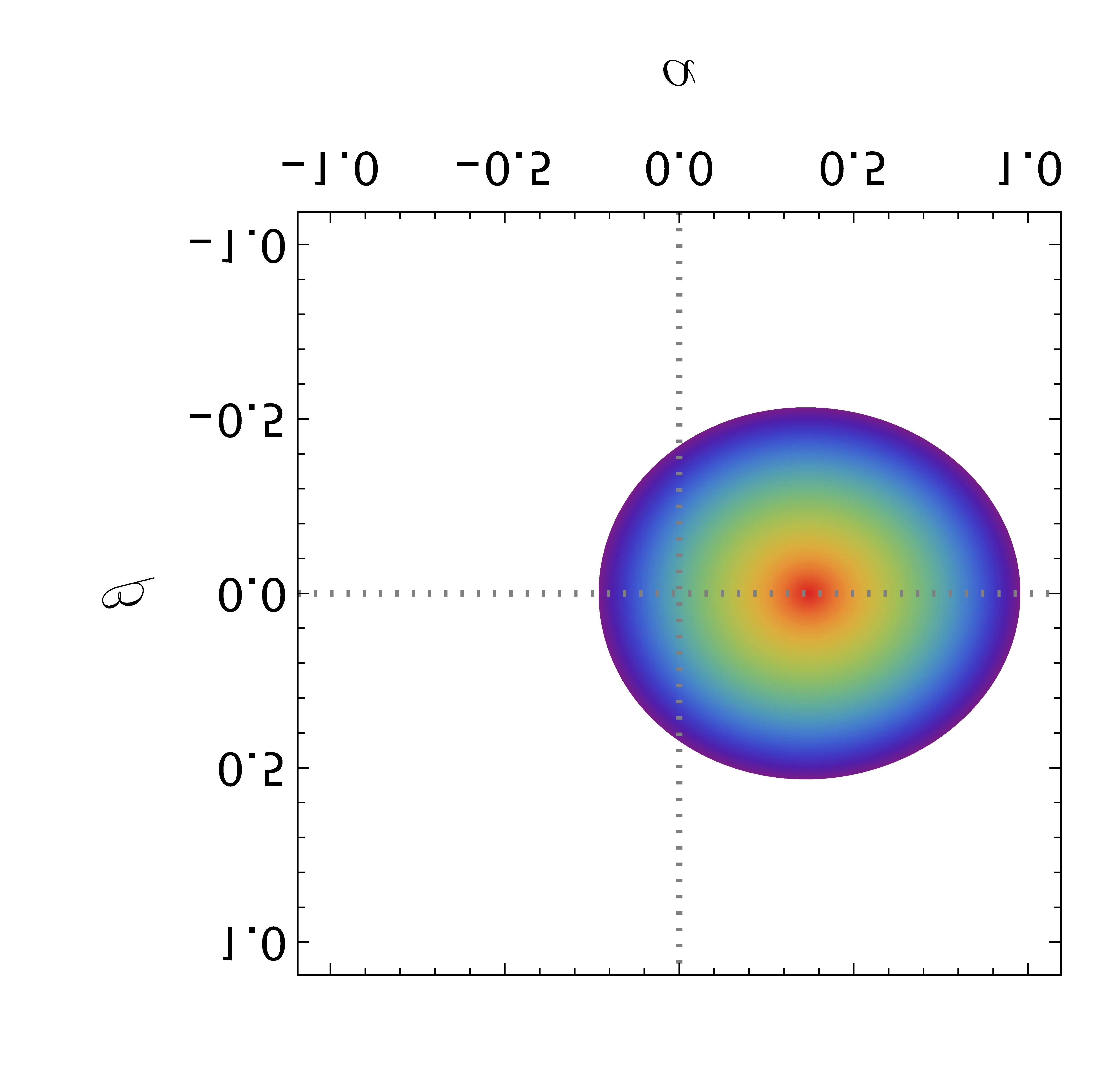
Un trou noir ordinaire est un piège dont rien ne s'échappe. Mais un trou noir en rotation est différent : en son centre, il n'y a pas un point, mais un anneau de matière infiniment comprimée. L'espace y est courbé à l'extrême, et les rayons de lumière y décrivent des boucles inimaginables.
La nouvelle étude révèle que de fins faisceaux de lumière peuvent se glisser à travers cet anneau, comme un fil dans le chas d'une aiguille. Le moindre écart, et le rayon est perdu ; mais une trajectoire parfaite l'emporte dans un univers en miroir, aux lois inversées. De là-bas, notre ciel paraîtrait inversé et déformé.
Ainsi, l'information tombée dans un trou noir ne serait peut-être pas perdue, mais s'infiltrerait à travers l'anneau vers un autre monde.
Résumé original
tel que rédigé par les auteurs, en anglais arXiv:2511.18502
We study null geodesics that connect the two asymptotically flat regions of the maximally extended Kerr spacetime. These vortical geodesics traverse both horizons and pass through the ring singularity, linking the positive-$$r$$ exterior to the negative-$$r$$ asymptotic side. Using impact parameters, we identify a closed subset of parameter space, the inner throat, where the radial potential has no real roots, and photons exhibit no radial turning points. In this region, at most two constant-latitude geodesics exist, one of which is aligned with the principal null direction. We also identify the forbidden polar-angle band that limits the range of geodesics reaching an asymptotic observer. We solve the geodesic equations analytically and numerically in Eddington-Finkelstein-like coordinates, obtaining mutually consistent results that correct and extend previously available formulae. The resulting trajectories are used to construct simulated views for an observer in the negative-$$r$$ domain, revealing strong image distortion and inversion, with possible implications for analogous white-hole configurations.
L'anneau central d'un trou noir en rotation ressemble au chas d'une aiguille : le moindre écart détruit l'objet qui tombe, mais une trajectoire parfaite le projette dans un univers miroir.
Le passage à travers un trou noir en rotation vers un autre univers fait écho à l'idée des trous de ver, popularisée par le film « Interstellar ».