Comment une chaîne se transforme en anneau express
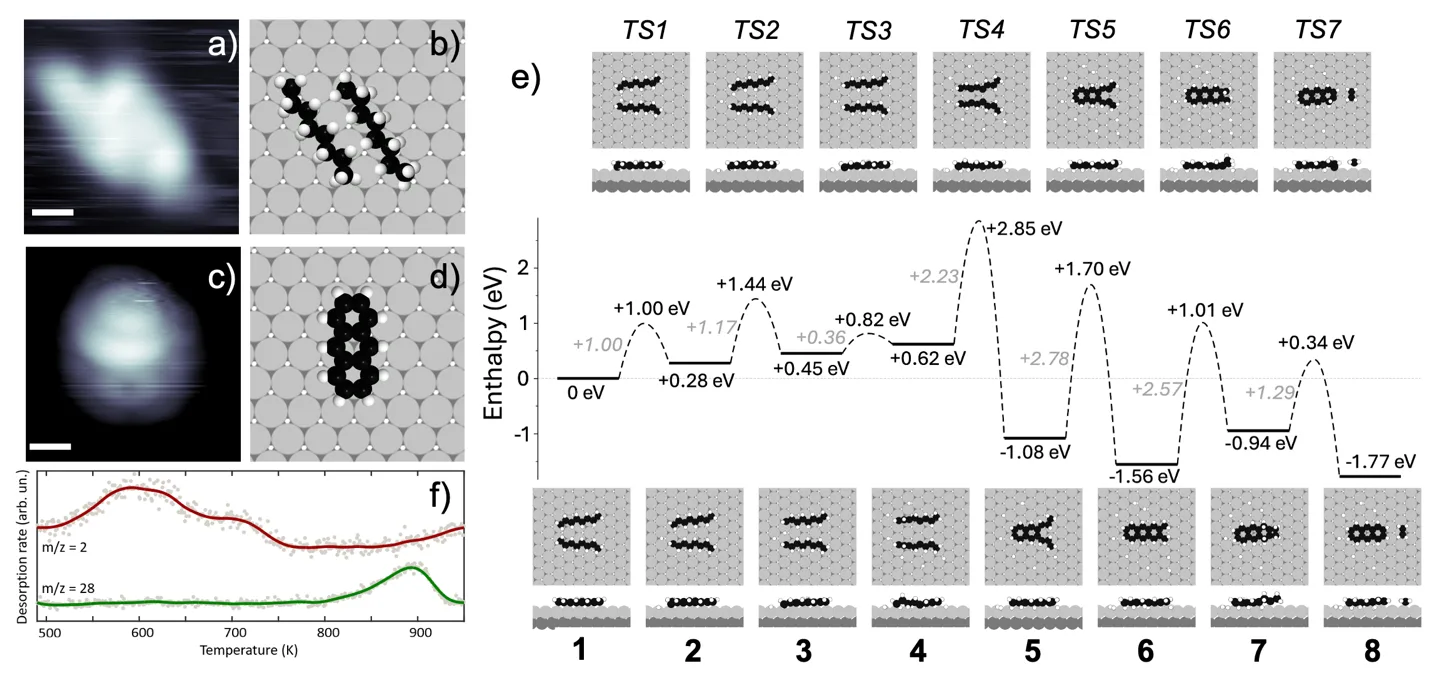
La molécule d'octane ordinaire est une chaîne de huit atomes de carbone, comme un fil flexible. Sur une surface de platine chaude (au-dessus de 600 K), elle ne reste pas tranquille, elle commence à se tortiller. D'abord, la chaîne se courbe de sorte que ses extrémités se rapprochent. Ensuite, des atomes d'hydrogène se détachent, et une liaison solide se forme entre les extrémités — la molécule se referme en un cycle benzénique hexagonal. Cette transformation est appelée aromatisation : d'une chaîne flexible, on obtient un cycle rigide et plat.
Parfois, deux molécules d'octane se trouvent côte à côte. Le platine relie alors leurs extrémités, et la liaison se propage le long des deux chaînes, comme une fermeture éclair. On obtient une longue molécule double qui peut se replier en structures plus complexes. C'est ainsi que naissent à la surface des composés polycycliques — la base de nombreux colorants, médicaments et plastiques.
Résumé original
tel que rédigé par les auteurs, en anglais arXiv:2601.18600
Aliphatic hydrocarbons, such as normal alkanes, constitute a naturally abundant source of carbon atoms. Of special interest is the formation of cyclic and aromatic products from aliphatic reactants. Combining scanning tunneling microscopy and ab initio calculations, we investigate the thermal induced aromatization of linear n octane molecules on the catalytic Pt(111) surface and the reactions of intermolecular homocoupling between them at temperatures above 600 K. The cycloaromatization of individual n octane molecules requires bending the linear adsorbates prior to their dehydrogenation and the formation of an intramolecular C-C bond, yielding adsorbed benzene rings. In addition, the Pt(111) surface catalyzes a homocoupling reaction by initiating the formation of a C-C bond between the dehydrogenated methyl ends of the chemisorbed n octane molecules and then propagating along the carbon backbone in a zipper like fashion. Our findings provide molecular level insight into the heterogeneous catalytic processes underlying the generation of aromatic products and stable on surface polycyclic species.
Le cycle benzénique est l'un des plus solides en chimie : son hexagone d'atomes de carbone ne se brise pas même sous une forte chaleur.