Как птицы видят магнитное поле Земли экспресс
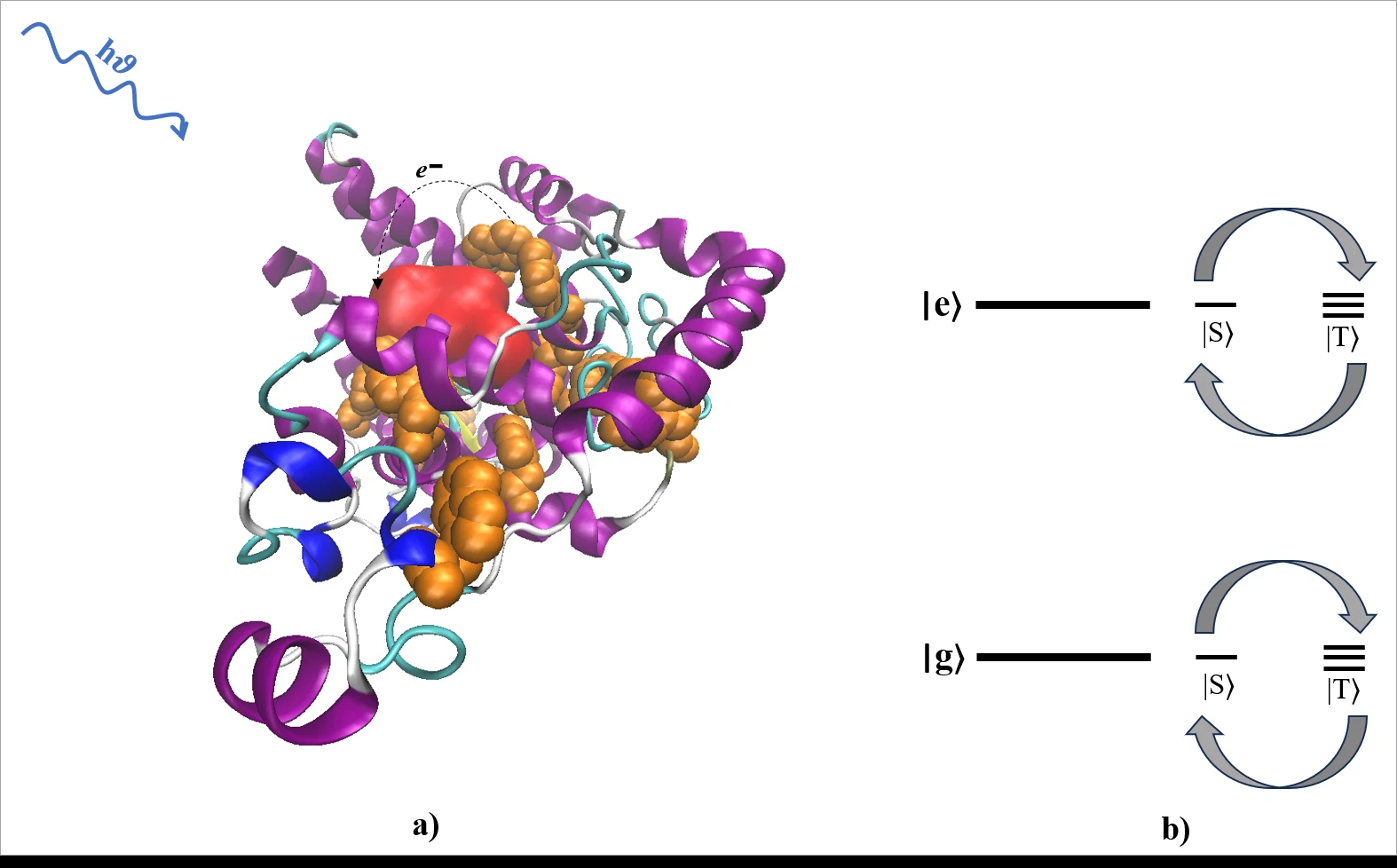
Птицы мигрируют, используя магнитное поле. В их глазах есть белок криптохром. Он улавливает солнечный свет, особенно синий, и запускает реакцию. Поглощение света ведёт к образованию пары частиц, чутко реагирующих на магнитное поле.
Под действием поля эти частицы меняют взаимное положение, что вызывает слабый электрический ток в белке. Этот ток передаётся в мозг и воспринимается как зрительное ощущение — словно на мир накладывается прозрачная сетка магнитных линий. Неожиданно, что компас работает лишь при дневном синем свете; в сумерках система выключается, и ночью птицы полагаются на звёзды.
Понимание механизма не только раскрывает секрет навигации, но и обещает новые технологии. Белок состоит из обычной органики, включая углерод, поэтому учёные надеются создавать биодатчики, более компактные и чувствительные, чем электронные аналоги.
Оригинальная аннотация
как её написали авторы, на английском arXiv:2510.13840
Photoreduction of cryptochrome protein in the retina is a well-known mechanism of navigation of birds through the geomagnetic field, yet the biosignal nature of the mechanism remains unclear. The absorption of blue light by the flavin adenine dinucleotide (FAD) chromophore can alter the distribution of electrons in cryptochrome and create radical pairs with separated charges. In this study, the spin dynamics of electrons in the radical pair including its spin-orbit coupling were investigated by quantum mechanical modeling. Spin-orbit coupling is negligible relative to other terms and has no significant role in the dynamics. However, it engages the spatial states of the radical pair and make possible to study spatial related observables. Several interactions were considered in the presence of an external magnetic field, and the resulting electric dipole moment in cryptochrome was computed as the quantity emerging from this coupling. The computations show the induced electric dipole moment clearly depend on the characteristics of the applied magnetic field even after considering dissipative effects. In fact, our findings indicate that the radical pair in cryptochrome protein is a magnetic biosensor, in the sense that in the presence of the geomagnetic field, variations in spin states can influence its electric dipole moment, which may be interpreted via the bird as an orientation signal. The results can be used in the advancement of bio-inspired technologies which replicate animal magnetic sensitivity.
Этот же белок есть и в глазах человека, но у нас он только настраивает биологические часы, а магнитное поле мы не ощущаем.