Роковой резонанс: как звёзды вышвыривают планеты экспресс
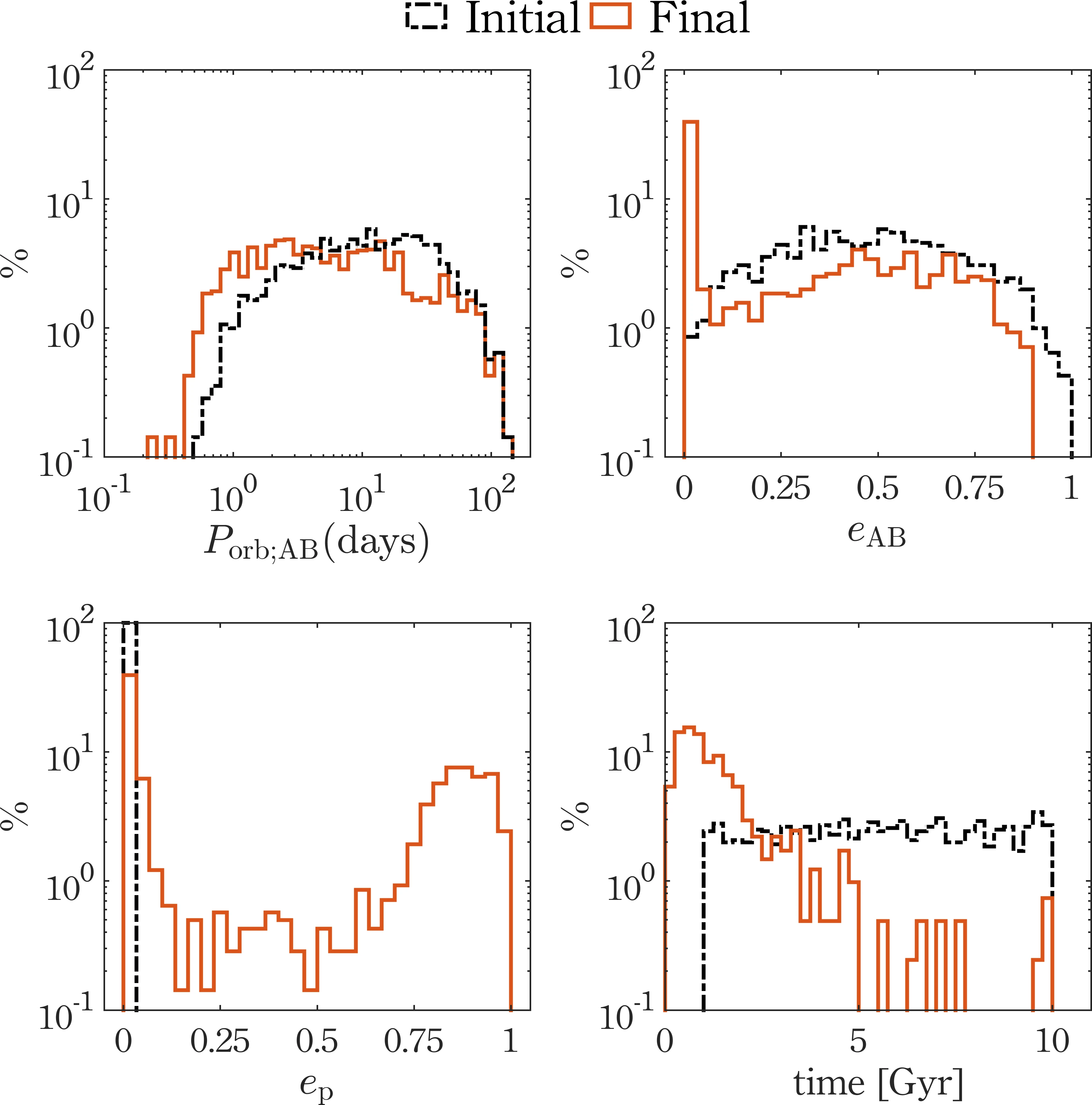
Две звезды, сближаясь в космическом танце, испытывают дополнительное покачивание — последствие искривления пространства-времени (эффект, предсказанный Эйнштейном). Планета, обращающаяся вокруг них, тоже покачивается. Случается, ритмы совпадают: гравитационные толчки от звёзд попадают в такт орбите планеты, словно руки, раскачивающие качели. Это резонанс — орбита вытягивается, и планету срывает с места.
Так рождаются планеты-изгои: восемь из десяти планет у сближающихся двойных попадают в этот смертельный резонанс, и три четверти гибнут. Оставшиеся прячутся вдали. Вот почему у звёздных пар с оборотом короче семи дней не найдено ни одной планеты — само их тесное сожительство безжалостно выметает всё вокруг.
Оригинальная аннотация
как её написали авторы, на английском arXiv:2512.03940
Transiting circumbinary planets (CBPs) are conspicuously rare, and entirely absent around stellar binaries with periods $$\leq 7$$ days. Here, we exploit a secular resonance to stimulate the orbit of a CBP into strong, disruptive interactions with the host binary. The process requires no tertiary companion and is triggered when the general-relativistic precession of a tightening binary matches the Newtonian precession it induces in its companion planet. Adiabatic capture in this resonance sees the binary draining angular momentum from the CBP's orbit which grows steadily in eccentricity until destabilization, and eventual ejection or engulfment. We map this resonance in phase space, then investigate the dynamical outcomes of encounter in the course of tidally shrinking binaries. With the help of orbit averaged simulations of a suite of systems, we find that, around tightening binaries: eight out of ten CBPs encounter and are captured in the resonance; three out of four are `destroyed'; and survivors lurk on remote, low-transit-probability orbits. This suggests that the very process which forms tight binaries effectively clears the region where transiting CBPs could reside.
Некоторые двойные звёзды совершают полный оборот за несколько часов — их «сутки» короче рабочего дня. А расстояние между ними меньше, чем от Солнца до Меркурия.