Чёрная дыра-«повар» мешает звёздам рождаться экспресс
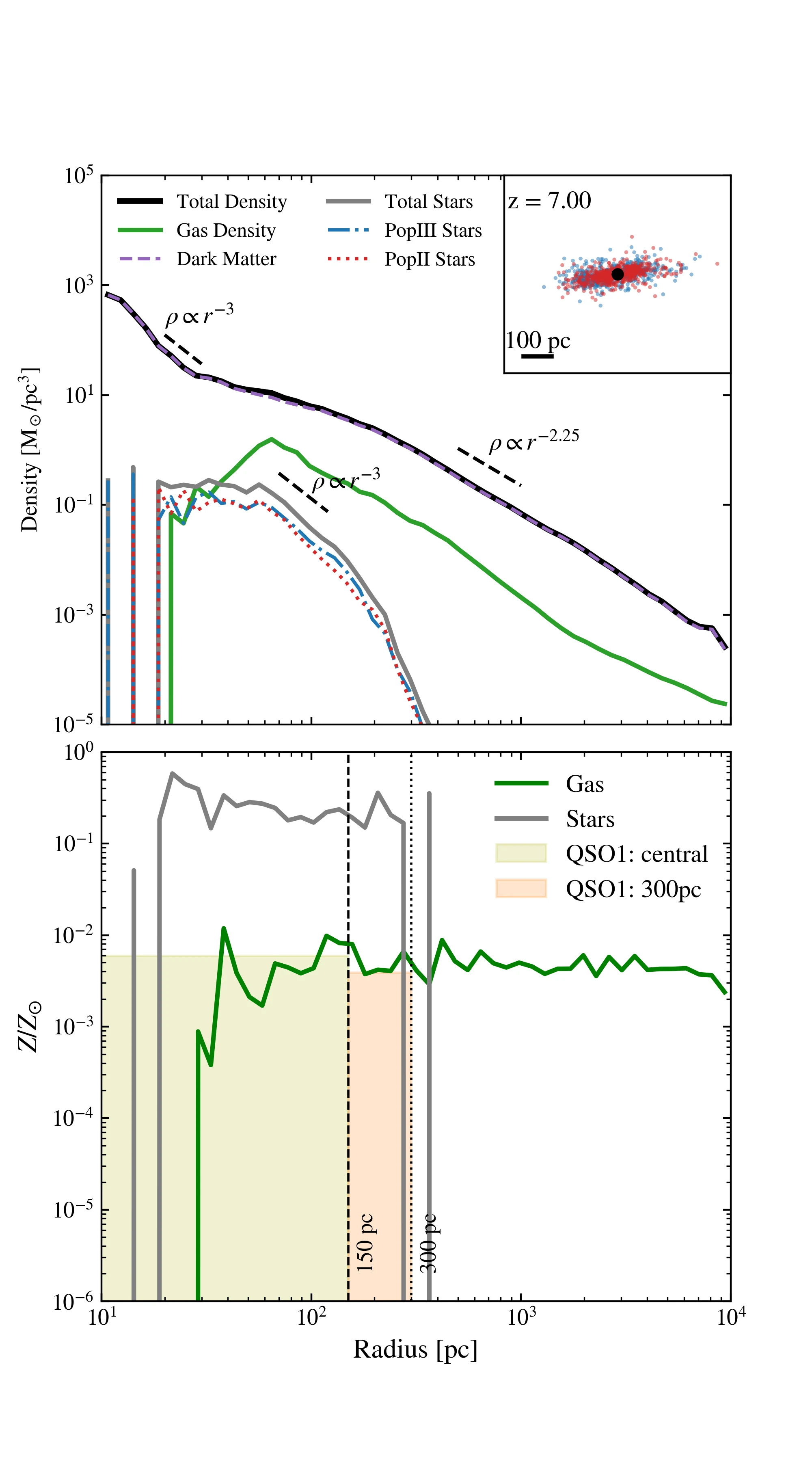
Телескоп Джеймса Уэбба разглядел галактику Abell 2744-QSO1, где почти нет тяжёлых элементов (астрономы называют их металлами), а центральная чёрная дыра весит в сотни раз больше, чем все звёзды вместе. Обычные сценарии не объясняют такой перекос.
Разгадка, возможно, в чёрной дыре особого типа — она родилась не из звезды, а из сгустка сверхплотной материи сразу после Большого взрыва. Такая дыра-гигант (в модели около 50 миллионов солнц) ведёт себя как повар-экстремал. Она жадно заглатывает газ, но при этом так сильно нагревает «духовку» галактики, что звёздное «тесто» не может схватиться — звёзды не зажигаются. Когда первые звёзды всё же вспыхивают, они быстро насыщают газ металлами. Дыра выбрасывает эту «пересоленную» порцию, а втягивает свежее, чистое топливо из межгалактического пространства. Круговорот повторяется, и галактика остаётся почти без металлов, зато с непомерно раздувшейся чёрной дырой.
Неожиданный поворот: эта же бурная готовка делает окрестности дыры ослепительно яркими — словно открытая духовка, подсвечивающая всё вокруг. Именно этот свет и позволил Уэббу заметить галактику на краю наблюдаемой Вселенной.
Оригинальная аннотация
как её написали авторы, на английском arXiv:2512.14066
The James Webb Space Telescope (JWST) has recently identified Abell 2744-QSO1 as a compact, metal-poor, black hole (BH) dominated galaxy at $$z\simeq 7$$. This system exhibits an extreme black-hole-to-stellar mass ratio and unusually low metallicity, posing significant challenges to BH seeding models. Motivated by these discoveries, we perform high-resolution cosmological simulations with a massive primordial black hole (PBH; $$M_{\rm BH}=5\times10^7\,M_\odot$$) seed, incorporating for the first time a fully coupled treatment of PBH accretion, BH feedback, and Population~III/II star formation and stellar feedback. Although PBHs accelerate structure formation through the seed effect, the associated strong thermal feedback from the accretion delays the onset of star formation to $$z\lesssim 10$$, producing short, bursty episodes throughout the subsequent evolution. PBH-driven outflows expel enriched gas from the nucleus, while sustained inflows from the intergalactic medium continuously replenish pristine material. This feedback-regulated cycle naturally yields low accretion rates ($$\dot{m}_{\rm BH}/\dot{m}_{\rm edd} \sim 1-10\%$$), subsolar metallicities ($$Z/Z_\odot\lesssim10^{-2}$$) and extreme $$M_{\rm BH}/M_\star$$ ratios during both the initial star-forming phase and the subsequent quenching phases, in excellent agreement with JWST observations. Our results demonstrate that massive PBHs offer a viable pathway for forming the most extreme high-redshift systems, providing a physically motivated explanation for the extraordinary properties of Abell 2744-QSO1, as a sub-class of the broader population of JWST-discovered "little red dots".
Первичные чёрные дыры первым подробно описал Стивен Хокинг в 1970-х годах. Он предположил, что они могут быть совсем крошечными, но со временем испаряться.