Невидимые доноры в двойных звёздах экспресс
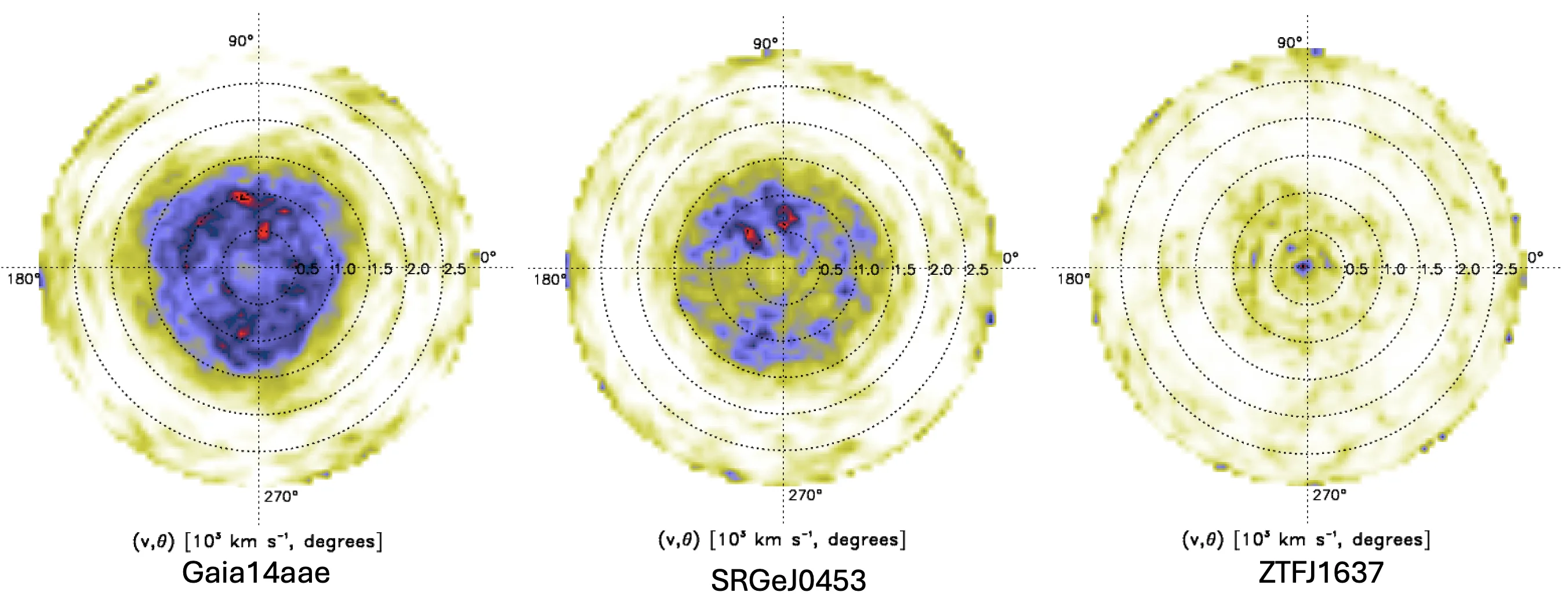
В трёх двойных системах белый карлик — мёртвое ядро звезды — ворует газ у соседки. Соседка так тускла, что в обычный телескоп её не видно. Телескоп Джеймса Уэбба смотрел на эти пары в инфракрасном свете, как камера ночного видения. И впервые поймал свет от самих звёзд-доноров.
Раньше думали, что в инфракрасном диапазоне светит именно звезда-донор. Оказалось, светит диск из горячего газа вокруг белого карлика. Этот диск, как водоворот, закручивает украденное вещество. В нём видны яркие линии гелия — два пика, как два огня на краях водоворота. А вот от донора — лишь слабый след натрия, как отблеск на щеке.
Такое магнитное поле не даёт диску подойти вплотную. Газ застревает на расстоянии, как машина перед шлагбаумом. Это объясняет, почему в спектрах нет быстрых струй: вещество просто не успевает разогнаться. Три звезды-донора оказались похожи друг на друга, хотя раньше их считали разными.
Теперь ясно: инфракрасный избыток в таких системах говорит о диске, а не о звезде-доноре. Значит, звёзды-доноры ещё тусклее, чем предполагали. Они — как тихие партнёры в танце, которых видно только в отблесках натрия.
Оригинальная аннотация
как её написали авторы, на английском arXiv:2601.00945
We present JWST/NIRSpec high-cadence infrared spectroscopy of three long-period, eclipsing AM CVn binaries, Gaia14aae, SRGeJ0453, and ZTFJ1637. These systems have orbital periods of 50-62 minutes and cool donors that are undetectable in the optical. The data cover a wavelength range of 1.6-5.2 $$\mu$$m at resolution $$R=1000-2000$$. We obtained 150-200 spectra of each system over two orbits, split between the G235M and G395M gratings. All three systems show strong, double-peaked He I emission lines dominated by an accretion disk. These lines are nearly stationary but contain radial velocity (RV) variable sub-components that trace stream-disk interactions. In Gaia14aae and SRGeJ0453, we detect two Na I doublets in emission whose RVs track the irradiated face of the donor, marking the first direct detection of the donors of long-period AM CVns. No absorption lines from the donors are detected, implying that the IR excesses observed in many long-period AM CVns primarily trace disks, not donors. The He I emission profiles in all systems lack high-velocity wings and show no emission beyond $$\approx 1500,\rm km,s^{-1}$$. The morphology of the disk eclipses and Doppler tomograms are best reproduced by models in which the disk is truncated well outside the white dwarf and only material at $$r \gtrsim 0.07,R_{\odot}$$ contributes to the disk emission. We interpret this as possible evidence of magnetized white dwarf accretors. For plausible mass transfer rates, the truncation radii imply surface magnetic fields of $$B = 30-100$$ kG, consistent with recent constraints based on X-ray periodicity. The absence of cyclotron humps out to 5 $$\mu$$m rules out stronger MG-level fields. We make the data from the program publicly available to the community.
Периоды обращения этих пар — 50–62 минуты. За время, пока вы читаете этот абзац, белый карлик успевает совершить полный оборот вокруг общего центра масс.