We have retold 7 papers by this author. 1 of them with a full read. most often about: white dwarf, red dwarf, binary star. 30 co-authors across our retellings.
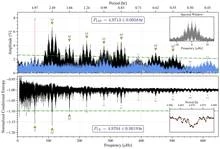
Four hours and fifty-eight minutes. With a rhythm like a metronome, something passes in front of the white dwarf ZTF J1944+4557, dimming its light by a third, sometimes almost by half.
In three binary systems, a white dwarf, the dead core of a star, steals gas from its companion. The companion is so dim that it cannot be seen with an ordinary telescope. The James Webb Space Telescope looked at these pairs in infrared light, like a night-vision camera.
Astronomers have discovered a close pair of stars whose orbital dance is speeding up year after year. These are white dwarfs — superdense, cooled remnants of stars, roughly the size of Earth, where matter is compressed to a degenerate state.
The white dwarf WDJ165335.21-100116.33 is the cooled core of a star, about the size of Earth but with the mass of the Sun. On its surface, there is an unusual hot spot that appears and disappears. Astronomers long puzzled over why the star's brightness changes every 80 hours.
A sugar cube sits on a saucer next to a cup of hot tea. Drop it in, and it dissolves within minutes. But if you lower it slowly, the sugar melts gradually, releasing its sweetness into the drink. Something similar is happening in two newly discovered stellar pairs, except the sugar is a brown dwarf and the tea is a star.
A pulsar is a dead star spinning at breakneck speed, sending out radio pulses like a lighthouse. But for PSR J1928+1815, the signal sometimes cuts out for 3.6 hours. Something is blocking the beacon. A companion star orbits the pulsar, and its shadow falls on us.
A lighthouse blinks every few seconds, but then begins to slowly brighten and dim over the course of a year. That is exactly what about a third of red giants do — huge stars in the late stages of life. Their normal pulsations take days or weeks, but on top of that, long secondary periods are visible: months and years.