Как вращение молодых звёзд ломает их магнитное поле экспресс
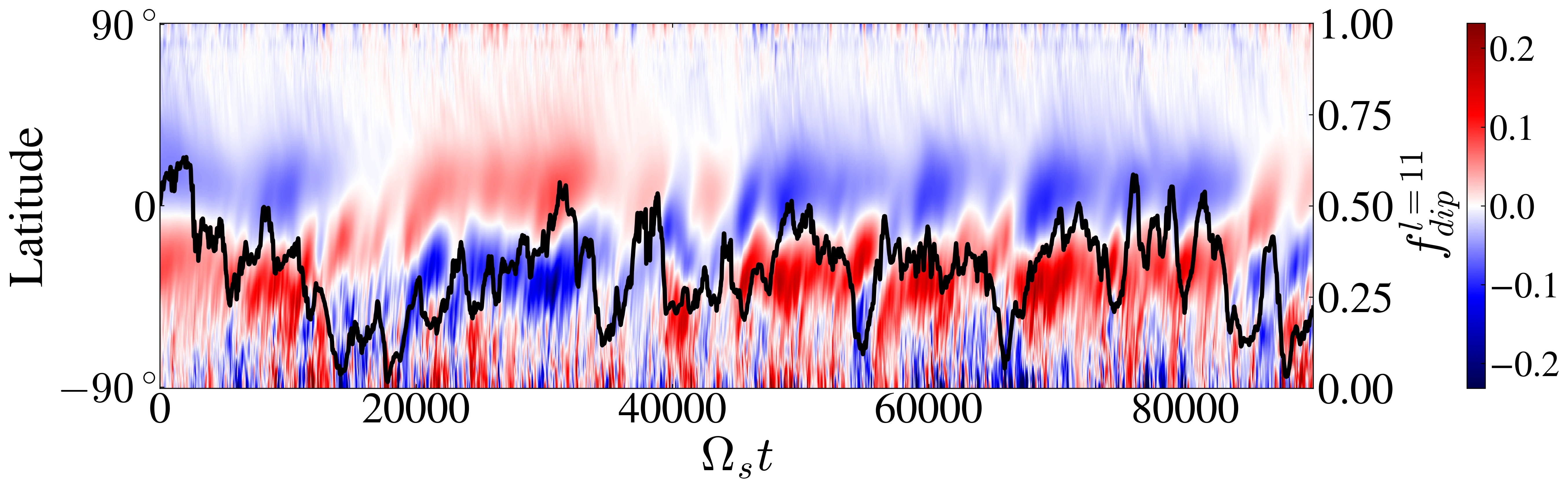
Молодая звезда похожа на многослойный волчок: её внешние слои вращаются медленнее, а внутренние — быстрее. Магнитное поле здесь — как прочные нити, связывающие эти слои. Когда скорости разные, нити начинают скручиваться и натягиваться всё сильнее. В какой-то момент они рвутся — и простое двухполюсное поле (как у прямого магнита) разрушается, сменяясь слабым, беспорядочным.
Именно это и происходит в недрах звёзд, состоящих в основном из водорода и гелия. Анализ их света (спектроскопия) подтверждает: поля хаотичны и нестабильны. Парадокс в том, что быстрое вращение, которое должно было бы усиливать магнит, на деле его ломает.
Для солнцеподобных звёзд эта связка между темпом вращения и магнитным хаосом стала ключом к их прошлому: по нынешнему полю можно понять, как быстро звезда крутилась в юности.
Оригинальная аннотация
как её написали авторы, на английском arXiv:2601.05980v1
Despite progress in the observations of stellar magnetic fields, their physical mechanisms remain poorly understood. During the pre-main sequence (PMS) phase, the inner layers of stars contract and a radiative core gradually develops. In contrast, the convective envelope is gradually braked through magnetic interactions with the accretion disk and winds. With developing differential rotation inside the star, PMS phase is thus a critical period for magnetic properties of stars when strong initial dipoles can get perturbed, leading to the observed diversity in the magnetism on the main sequence (MS). In this work, we study the impact of differential rotation on such fields. We perform three-dimensional anelastic convective dynamo simulations of rotating spherical shells with an imposed differential rotation (shear) between the boundaries. Density, gravity profiles and convective zone thicknesses were set close to those predicted in PMS low-mass stars by one-dimensional stellar evolution code Cesam2k20. Our results show that radial differential rotation can induce dipole collapse leading to weaker, oscillatory magnetic fields. Differential rotation seems to perturb $$\alpha^2$$ dynamo mechanism, responsible for dipolar magnetic fields, by shearing poloidal field lines and by affecting turbulent magnetic transport processes. This collapse is moderated by the relative importance of shear compared to the vigor of convective motions, with exact stability criterion depending on the field strength and the size of the radiative core. Applying DNS-based stability criterion in PMS stellar evolution models, we qualitatively reproduce the trends observed in the magnetic topologies of low-mass stars when assuming an efficient internal angular momentum redistribution. This suggests that stellar magnetic properties are intimately related to the PMS angular momentum evolution.
Солнце переворачивает своё магнитное поле каждые 11 лет, словно гигантский переключатель. Но у многих звёзд из-за внутренней скрутки этот цикл сбивается, и поле живёт своей непредсказуемой жизнью.