Как из цепочки получается кольцо экспресс
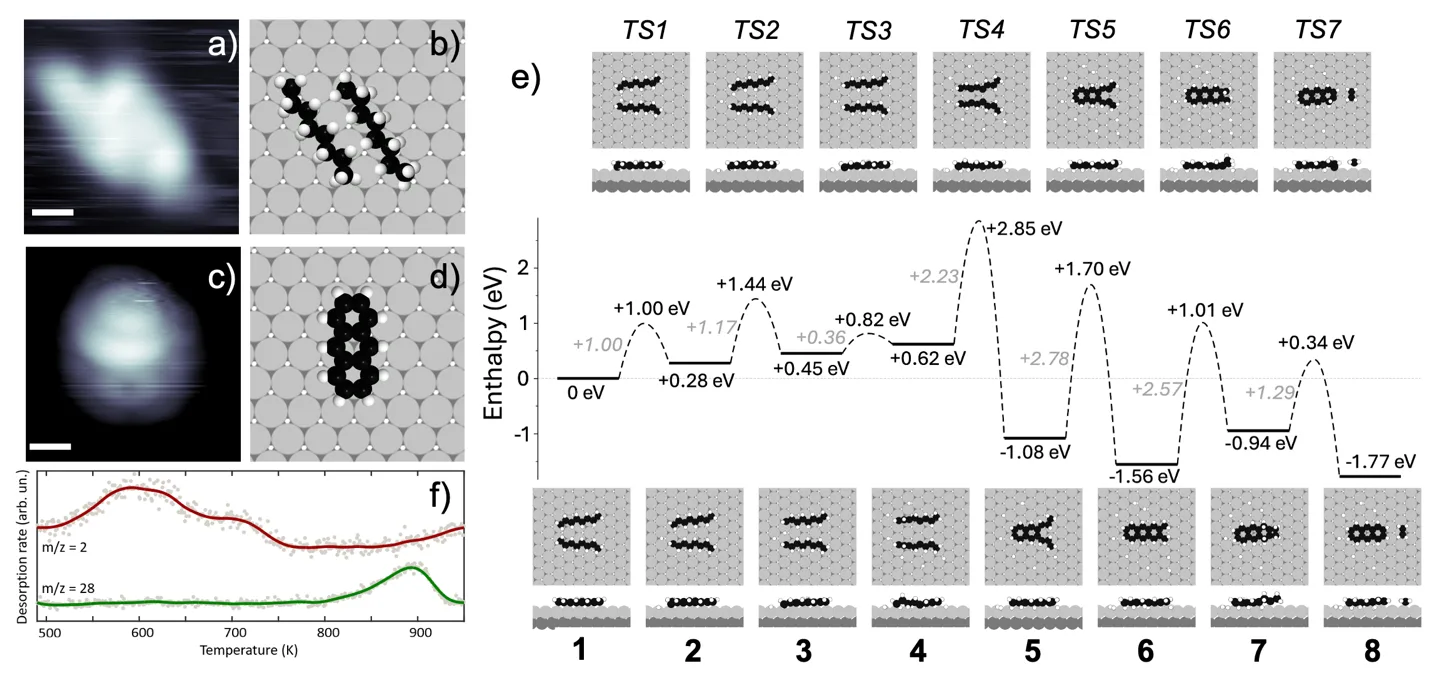
Обычная молекула октана — это цепочка из восьми атомов углерода, как гибкая проволока. На горячей платиновой поверхности (выше 600 K) она не лежит спокойно, а начинает извиваться. Сначала цепочка изгибается так, что её концы сближаются. Потом от неё отрываются атомы водорода, и между концами возникает прочная связь — молекула замыкается в шестиугольное бензольное кольцо. Такое превращение называют ароматизацией: из гибкой цепочки получается жёсткое плоское кольцо.
Иногда две молекулы октана лежат рядом. Тогда платина сшивает их концы, и связь начинает распространяться вдоль обеих цепочек, как застёжка-молния. Получается длинная двойная молекула, которая может свернуться в более сложные структуры. Так на поверхности рождаются полициклические соединения — основа многих красителей, лекарств и пластмасс.
Оригинальная аннотация
как её написали авторы, на английском arXiv:2601.18600
Aliphatic hydrocarbons, such as normal alkanes, constitute a naturally abundant source of carbon atoms. Of special interest is the formation of cyclic and aromatic products from aliphatic reactants. Combining scanning tunneling microscopy and ab initio calculations, we investigate the thermal induced aromatization of linear n octane molecules on the catalytic Pt(111) surface and the reactions of intermolecular homocoupling between them at temperatures above 600 K. The cycloaromatization of individual n octane molecules requires bending the linear adsorbates prior to their dehydrogenation and the formation of an intramolecular C-C bond, yielding adsorbed benzene rings. In addition, the Pt(111) surface catalyzes a homocoupling reaction by initiating the formation of a C-C bond between the dehydrogenated methyl ends of the chemisorbed n octane molecules and then propagating along the carbon backbone in a zipper like fashion. Our findings provide molecular level insight into the heterogeneous catalytic processes underlying the generation of aromatic products and stable on surface polycyclic species.
Бензольное кольцо — одно из самых прочных в химии: его шестиугольник из атомов углерода не рвётся даже при сильном нагреве.