Свет рождает ток без батарейки экспресс
Обычный датчик света — как колодец с воротом: чтобы поднять ведро, нужно крутить ручку. Так и фотоприёмнику нужно внешнее напряжение, чтобы вытащить электрический заряд. Но есть материалы, которые сами превращают свет в ток — как родник, бьющий без насоса. Один из них — оксид цинка, знакомый по белилам и солнцезащитным кремам.
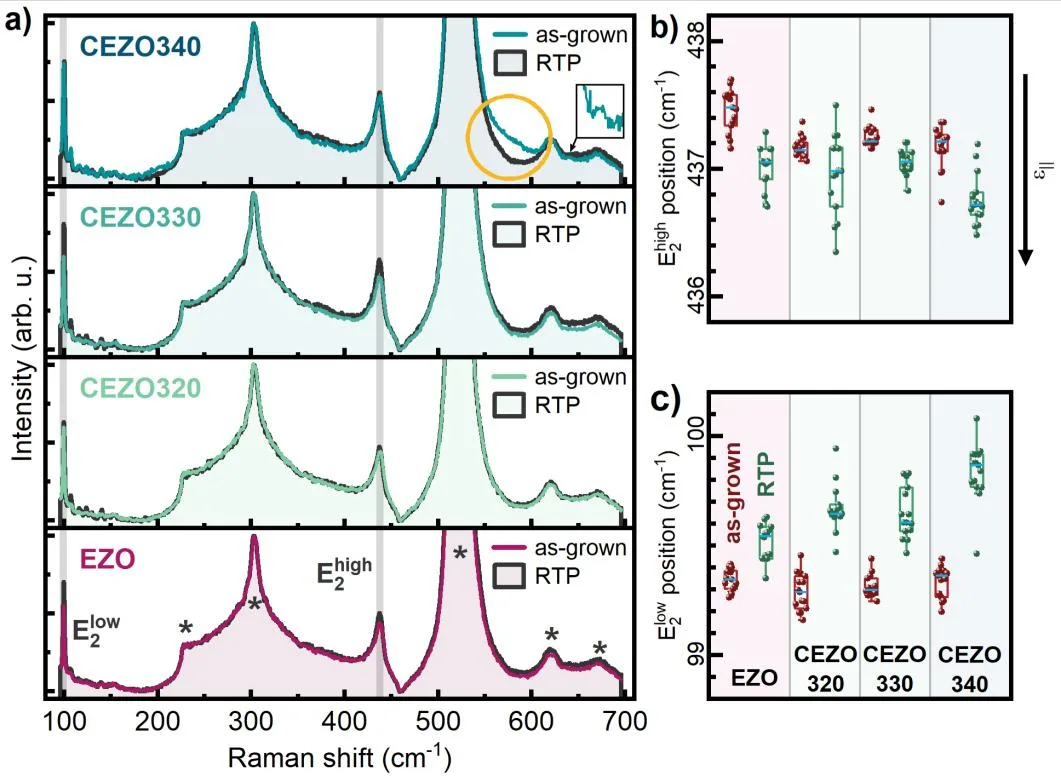
Спектроскопия показала, что в кристаллическую решётку оксида цинка удалось встроить ионы европия — они светятся красным при облучении. А добавка кадмия изменила поведение материала: исчез барьер, который мешал току течь между слоями. Получился переход, пропускающий ток только в одну сторону — как клапан в сердце или диод в старой радиолампе.
Итог: прибор выдаёт ток при освещении от ультрафиолета до ближнего инфракрасного, а откликается за 10 микросекунд. Это быстрее, чем вспышка молнии. Такие датчики смогут работать годами без подзарядки — например, в датчиках дыма или в камерах на космических зондах.
Оригинальная аннотация
как её написали авторы, на английском arXiv:2602.04426
Photodetectors (PDs) are essential in imaging, communication, and sensing technologies. However, their reliance on external power makes them energy-consuming. This creates a strong need for self-powered PDs as a sustainable alternative. ZnO is a promising semiconductor material due to its pyroelectric properties, stemming from non-centrosymmetric wurtzite crystal structure, enabling the pyro-phototronic effect that enhances response speed. Properties of ZnO can be tailored via alloying and doping. Thus, this work explores thin layers of ZnCdO:Eu random alloys grown by molecular beam epitaxy (MBE) on silicon substrates, with varying Cd content. The study shows that doping with Eu notably affects growth kinetics, promoting strong [0001] orientation preference. Moreover, photoluminescence measurements confirm the successful incorporation of Eu3+ ions into the structure. Electrical measurements show that the introduction of Cd eliminates the problem of Schottky barrier formation on the ZnO/Si interface. The n-ZnCdO:Eu/p-Si junctions exhibit rectifying behavior and generate photocurrent across 380-1150 nm wavelength range without external electrical bias. Utilizing the pyro-phototronic effect, these devices achieved ultrafast response times: rise time below 10 us and decay time below 5 us for 405 nm and 650 nm illumination - placing them among the fastest self-powered oxide-based detectors that do not rely on additional performance-enhancing layers.
Оксид цинка — тот самый белый порошок, которым натирали носы спасатели на пляже. Теперь он ловит свет и превращает его в электричество.