Квантовый дуэт олова и лития в кристалле экспресс
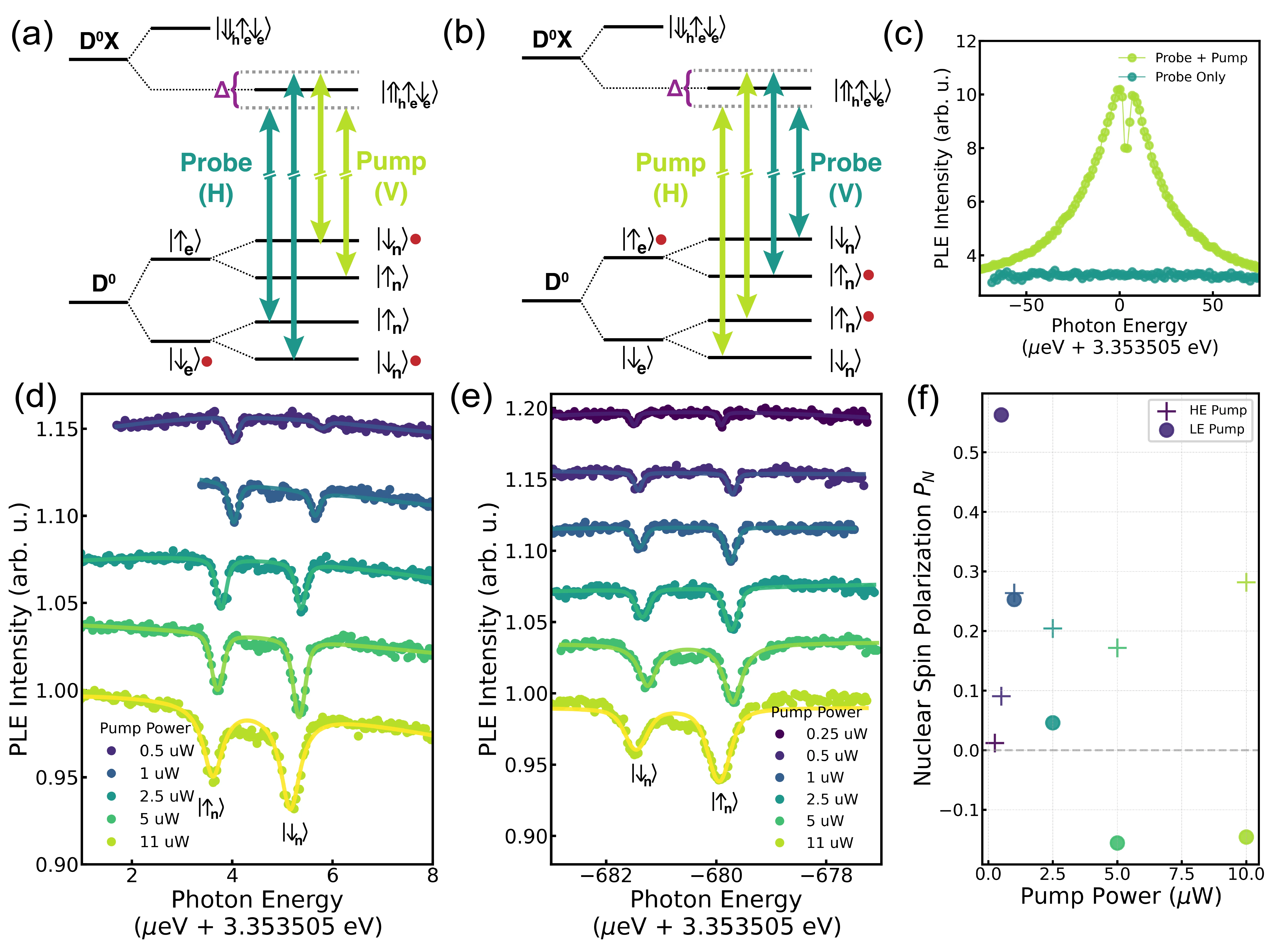
В кристалле оксида цинка спрятан квантовый дуэт: атом олова и атом лития, сидящие рядом. Их связь настолько тесна, что электрон, захваченный этой парой, словно живёт на олове, а литий лишь подыгрывает. Такой комплекс долго искали, но только теперь его удалось создать намеренно и опознать по характерному свечению.
Сила этой сцепки измерена точно: 392 мегагерца. Для сравнения, у обычных доноров в кремнии связь в десятки раз слабее. Такая крепкая пара позволяет очень быстро управлять ядерным спином — буквально за миллиардные доли секунды. А значит, квантовую информацию можно записывать в ядро и считывать её светом.
Работа показывает, что не только одиночные примеси, но и их пары могут служить строительными блоками для квантовых устройств. Комплекс олово–литий открывает новое направление в дизайне квантовых дефектов — с ядерным спином, готовым к диалогу с фотонами.
Оригинальная аннотация
как её написали авторы, на английском arXiv:2603.05615
Donor impurities in wide direct band gap semiconductors provide a promising platform for spin--photon quantum technologies by combining a donor spin qubit with optically addressable transitions. In ZnO, the shallow donor with the largest reported binding energy has long been associated with the I$$_{10}$$ bound exciton line, but its microscopic origin has remained unresolved. Here we demonstrate the controlled formation and identification of this donor as a Sn--Li complex through a combination of ion implantation, annealing, optical spectroscopy, and first-principles calculations. Resonant two-laser coherent population trapping measurements reveal an electron--$$^{119}$$Sn hyperfine interaction of $$392 \pm 15$$\,MHz, establishing a coupled electron--spin--1/2, nuclear--spin--1/2 system with one of the largest hyperfine couplings reported for shallow donors in semiconductors. Density functional theory calculations show that a nearest-neighbor Sn$$_{\mathrm{Zn}}$$--Li$$_{\mathrm{Zn}}$$ complex has favorable formation energetics, donor character with the electron localized on Sn, and an extrapolated hyperfine interaction consistent with experiment. The large donor binding energy and excited-state structure indicate enhanced thermal robustness of the optical transition relative to conventional group--III donors, while the strong hyperfine interaction enables fast electron--nuclear spin control and prospects for direct nuclear--spin--photon interfaces. We further observe efficient optically induced nuclear spin polarization, highlighting a path toward nuclear spin initialization. More broadly, our results reveal how a donor--acceptor complex can access previously unexplored regimes of shallow donor physics, extending the design space of quantum defects beyond isolated substitutional dopants.
Сверхтонкое взаимодействие у этого комплекса настолько сильное, что частота перехода между спиновыми состояниями сравнима с частотами, на которых работают микроволновые печи.