Слои скользят сами: тёплое движение в двумерных кристаллах экспресс
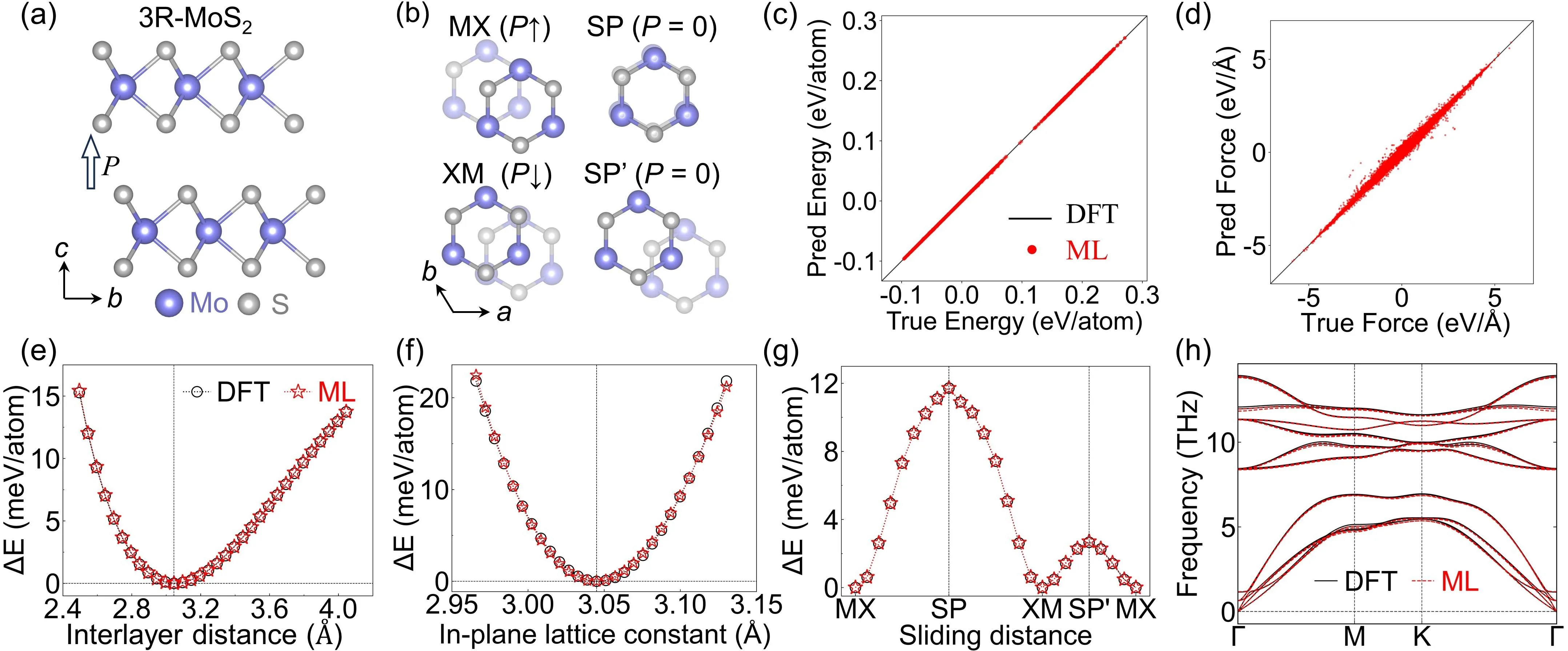
Два листа бумаги, сложенные вместе, при нагреве начинают едва заметно ползти друг по другу. Примерно так ведут себя слои дисульфида молибдена — материала толщиной в один атом. При комнатной температуре они самопроизвольно скользят со скоростью около метра в секунду.
Раньше считалось, что для сдвига слоёв нужно преодолеть барьер, как будто перетаскиваешь тяжёлый ящик через порог. Но расчёты на атомном уровне показали: барьера почти нет. Движение идёт не как сдвиг целого листа, а как волна перестройки на границах между участками с разной ориентацией. Это похоже на то, как складка на ковре перемещается, не сдвигая сам ковёр.
Такое поведение открывает путь к устройствам памяти, где информация записывается сдвигом слоёв почти без затрат энергии.
Оригинальная аннотация
как её написали авторы, на английском arXiv:2604.20277
Sliding ferroelectrics built from stacked nonpolar monolayers enable out-of-plane polarization and unconventional switching via interlayer sliding, yet the microscopic sliding dynamics remain unclear. Using machine-learning molecular dynamics, we reveal spontaneous thermally driven interlayer sliding in ferroelectric MoS2 moir\'e superlattices, with relative velocities on the order of 1 m/s at 300 K. Instead of rigid translation of the entire bilayer, the motion appears as a global drift of the moir\'e pattern. Such thermally driven sliding is inconsistent with the meV/atom-scale rigid-sliding barrier. In contrast, when constrained relaxation is allowed, the sliding proceeds along an almost barrierless pathway that directly reproduces the global drift of the moir\'e pattern. Furthermore, sulfur vacancies trigger a sliding-to-pinning transition, with about 0.1% S vacancies already sufficient to convert the long-range sliding into localized oscillations. Notably, these phenomena are not restricted to small twist angles, but arise generically in twisting-induced multidomain structures. These results reveal that the sliding process is governed by a domain-wall-mediated collective reconstruction pathway with an ultralow barrier, rather than rigid layer translation, deepening the understanding of microscopic dynamics in moir\'e superlattices and sliding ferroelectrics.
Скорость самопроизвольного скольжения слоёв при комнатной температуре — около 1 м/с, как у неторопливо идущего человека.