Как усмирить нагрев наночастиц экспресс
Золотая крупинка размером в сотню атомов попадает под луч света — и раскаляется. В обычной жизни такое не страшно, но в мире нанотехнологий этот крошечный нагрев способен испортить биосенсор или сжечь микросхему. Вентилятор тут не поставишь: на таких масштабах тепло застревает, как в толстом пуховике.
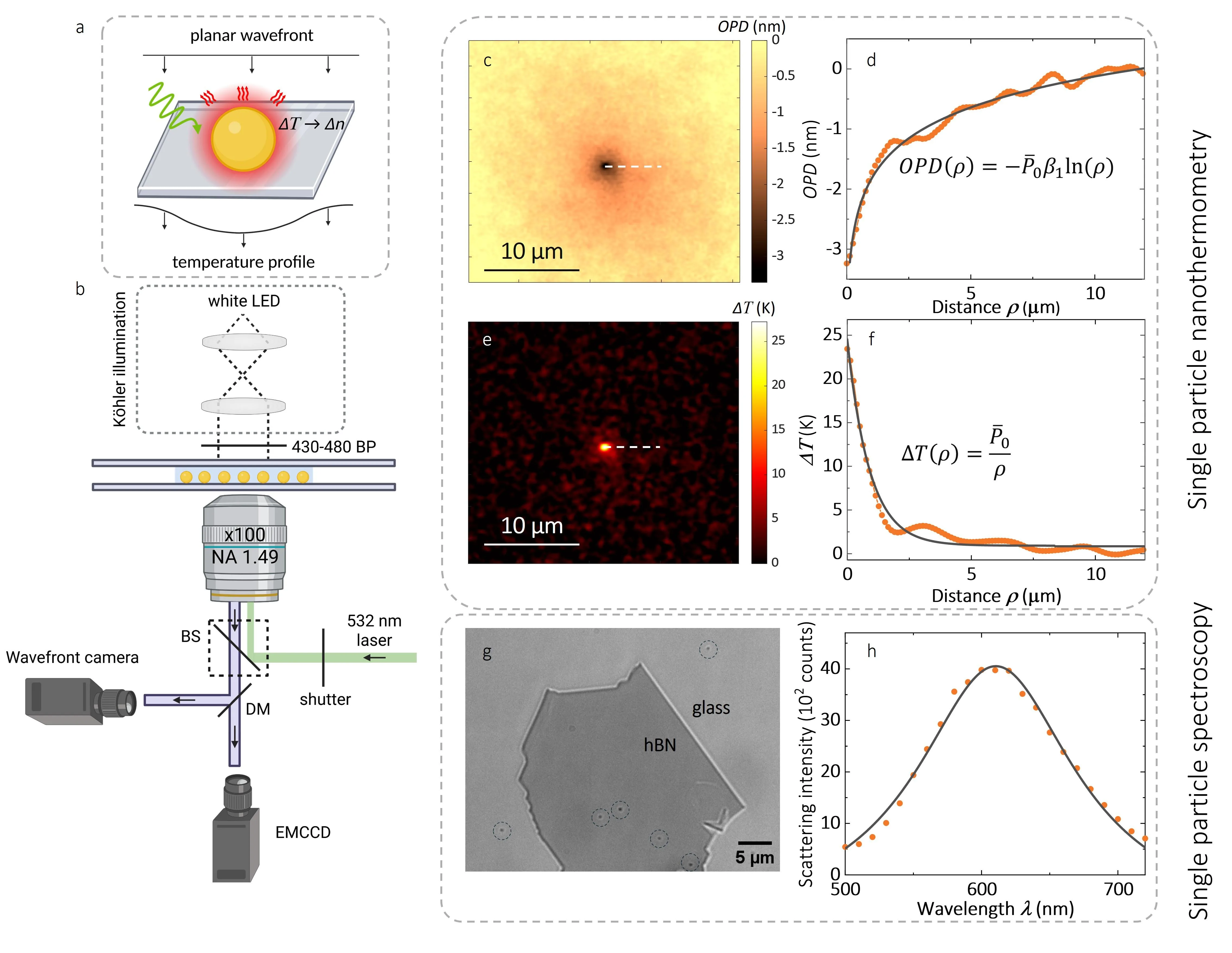
Спасает положение тонкая, почти невидимая плёнка из гексагонального нитрида бора — материала, похожего на графит, но прозрачного и тугоплавкого. В опытах золотые наносферы сажали на чешуйки этого вещества, а затем грели светом и следили за температурой с помощью волновой микроскопии — метода, который ловит малейшие изменения в преломлении лучей. Оказалось, что нитрид бора работает как тепловая губка: он впитывает жар от частицы и размазывает его по своей поверхности, не давая точке перегреться.
Интересно, что тепло уходит двумя путями: напрямую от частицы в чешуйку и окольным маршрутом — через окружающую воду. Вместе эти каналы снижают нагрев до 60 процентов по сравнению с обычным стеклом. Такой подход не требует сложного оборудования и подходит для быстрой проверки новых двумерных материалов.
Оригинальная аннотация
как её написали авторы, на английском arXiv:2605.00587
Optical heating of plasmonic nanostructures is a critical challenge in nanoscale systems. Although plasmonic effects enable enhanced optical functionalities, the associated temperature rise can degrade performance in heat-sensitive applications such as biosensing, nanophotonics, and microelectronics. Conventional cooling strategies fail at these scales due to limited heat transport and high interfacial thermal resistance, motivating the integration of advanced materials for thermal management. Here, we investigate hexagonal boron nitride (hBN) thin flakes as heat spreaders to mitigate plasmonic heating of gold nanospheres immobilized on hBN deposited on glass and surrounded by water. Using finite-element simulations, we quantify the influence of hBN thickness, in-plane thermal conductivity, and interfacial thermal conductance on cooling efficiency. Complementary experiments employ cross-grating wavefront microscopy (CGM) for nanothermometry to map the temperature around optically heated gold nanoparticles and quantify the cooling effect of hBN. We extend the application of CGM for rapid, non-invasive, and all-optical characterization of non-absorbing 2D materials. Our results reveal a strong thickness dependence, where heat dissipation in thin flakes is limited by the heat capacity of hBN and in thick flakes by interfacial thermal conductance. Including hBN, we obtain a reduction in temperature rise by up to 60% compared to glass. In addition, the presence of two main heat dissipation pathways emerges: a direct one from the nanoparticle to the hBN and an indirect one from the particle via water to the hBN. This combined simulation-experiment framework offers a versatile approach to improve thermal management in plasmonic systems and beyond, establishing design guidelines for integrating 2D materials into thermally sensitive platforms such as biosensors and integrated circuits.
Гексагональный нитрид бора иногда называют «белым графеном» за сходную слоистую структуру, но в отличие от графена он не проводит электричество, зато отлично проводит тепло.