Космическая погода по сезонам экспресс
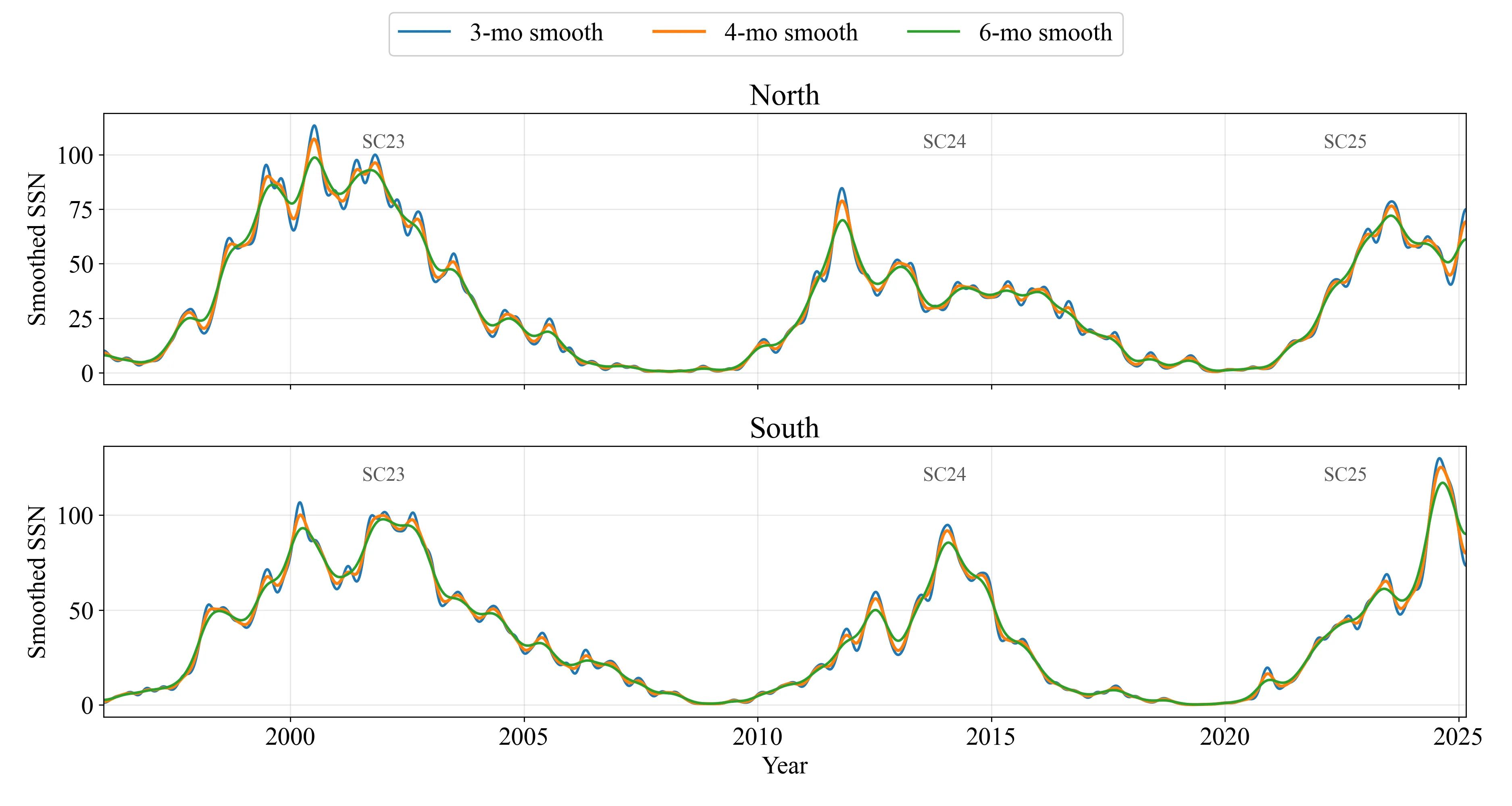
Солнце не тлеет ровно — оно вспыхивает сериями. Как костёр, который то затихает, то вдруг выбрасывает снопы искр. Такие «огненные сезоны» длятся от полугода до полутора лет, и в это время на звезде появляется особенно много пятен. Группа исследователей взяла данные о солнечных пятнах с 1878 года и научила компьютер распознавать приближение очередного огненного приступа.
Вместо того чтобы смотреть на всё Солнце целиком, его разделили на север и юг. Каждое полушарие живёт своим ритмом: северное выдало пик около 70 пятен в марте 2025 года, а южное разошлось сильнее — до 130 пятен почти одновременно. Разницу уловили с помощью математической модели, похожей на предсказание сезонных продаж в магазине: она учитывает и плавный тренд, и резкие скачки.
Дальше в дело вступил «лесной предсказатель» — алгоритм случайного леса, который учится на примерах. Ему скормили сотни прошлых всплесков, и он стал угадывать, какой силы будет следующий. Такой гибрид из статистики и машинного обучения уже верно указал на подъём активности в конце 2024 – начале 2025 года. Следующая вспышка ожидается в декабре 2025-го, причём южное полушарие снова задаст тон. Общая мощность бурь зависит в основном от него.
Оригинальная аннотация
как её написали авторы, на английском arXiv:2605.27057
We present a hybrid forecasting strategy that combines numerical modeling, statistical forecasting, and machine learning methods to predict enhanced bursts of solar activity. These bursts, referred to here as space weather seasons, occur on intermediate timescales of approximately 6 to 18 months. We analyze monthly smoothed sunspot number data from 1878 to 2025 and use Gaussian fitting to identify burst events and characterize their amplitudes and durations. The sunspot number data are divided into training, testing, and forecasting intervals to evaluate both hindcast performance and future predictions. Each solar hemisphere is modeled separately using a seasonal autoregressive integrated moving average approach. This baseline forecast is refined using an asymmetric Gaussian override to represent the rapid rise and gradual decay of burst activity. Burst amplitudes and durations are then estimated using a random forest regression model. The hybrid method successfully reproduces burst timing between November 2024 and May 2025, with the Northern Hemisphere reaching a peak sunspot number of about 70 around March 2025. The next Northern Hemisphere burst is forecast to occur around December 2025, with a slightly lower peak sunspot number of about 60. In contrast, the Southern Hemisphere shows more complex behavior, with multiple burst amplitudes beginning around October 2024 and continuing until October 2025. The dominant Southern Hemisphere burst reaches an amplitude of about 130 in sunspot number, and the next burst is forecast to occur around December 2025. When the hemispheric forecasts are combined, the total sunspot number is found to be mainly controlled by the stronger activity cycle in the Southern Hemisphere.
Солнечное пятно размером с небольшой город способно вызвать магнитную бурю на Земле, которая выведет из строя навигацию.