Как измерили скорости струй у далёких чёрных дыр экспресс
Сверхмассивные чёрные дыры в центрах галактик иногда выбрасывают узкие потоки вещества — струи, которые летят почти со скоростью света. Долгое время астрономы не могли точно сказать, насколько быстры эти струи у разных чёрных дыр. В новой работе учёные собрали данные о сотнях таких струй и применили метод, который раньше использовали в других областях науки.
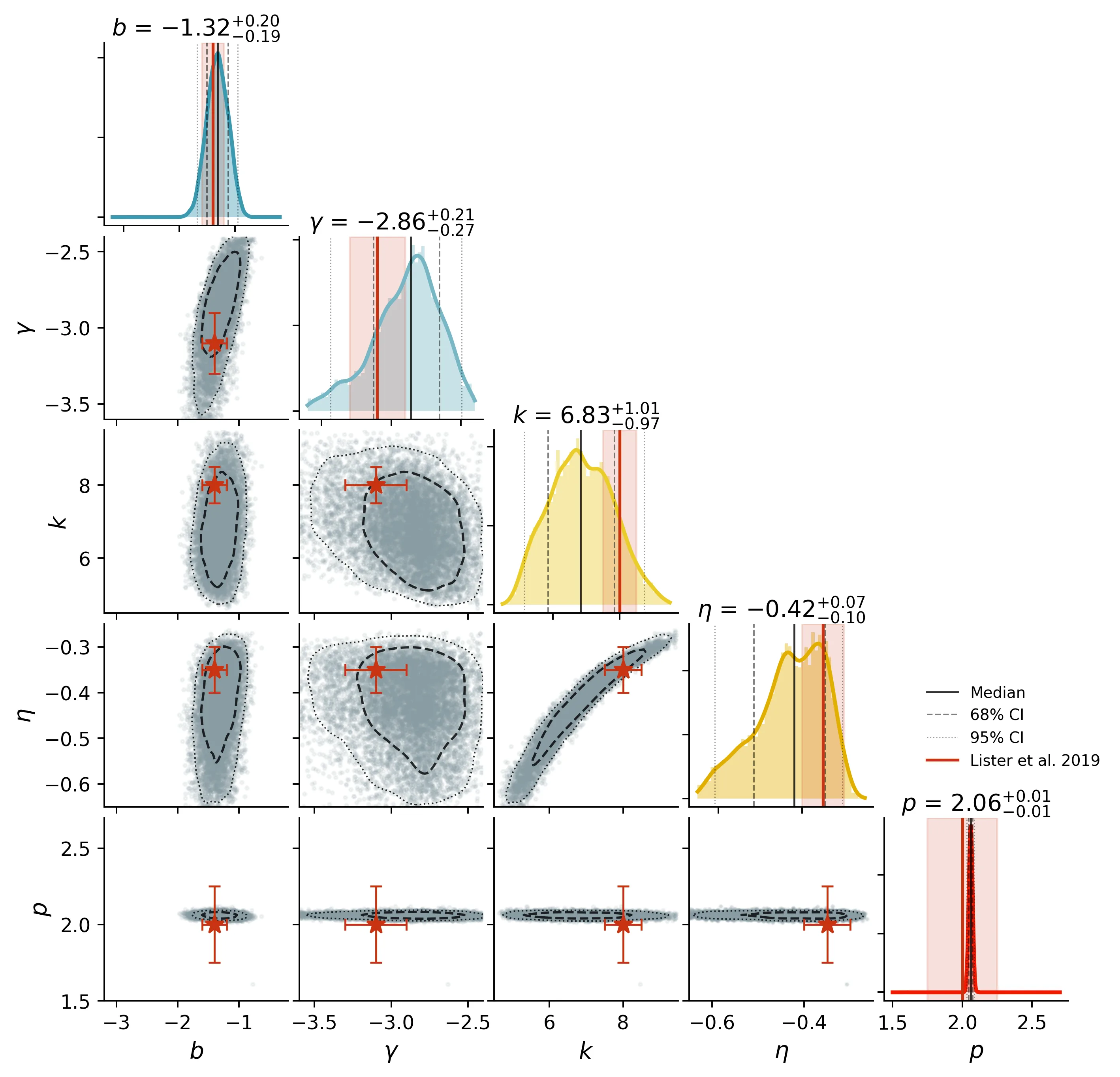
Метод называется «вывод без правдоподобия». Вместо того чтобы пытаться вычислить вероятность каждого варианта напрямую, компьютер учится на множестве смоделированных примеров и потом сравнивает их с реальными наблюдениями. Это позволило учесть искажения, которые вносит ограничение по яркости: слабые струи просто не видны, и если это не учитывать, оценки скоростей ошибочны. Новый подход показал, что прежние ошибки были сильно занижены, а распределение скоростей не похоже на простую кривую.
Результат: у большинства струй скорость близка к 99% от скорости света, но есть и более медленные. Распределение скоростей оказалось похожим на то, что наблюдается у чёрных дыр звёздной массы — тех, что возникают при взрывах массивных звёзд. Это значит, что механизм запуска струй, возможно, одинаков для чёрных дыр любой массы.
Оригинальная аннотация
как её написали авторы, на английском arXiv:2608.08733v1
We present the most complete modelling of the MOJAVE 1.5 Jansky Quarter Century active galactic nuclei (AGN) jet population, using likelihood-free simulation-based inference. Due to the complex impact of a flux-limit on observed AGN data sets, careful modelling of the parent population is required. In particular, when observing and fitting to multiple data distributions likelihoods become non-intuitive. Parameter degeneracies further complicate the problem and make it suitable for likelihood-free, simulation-based inference. This method relies on a normalising flow learning the likelihood surface or posteriors directly. We extensively validate the flow to show that previous parameter estimates for the AGN jet speed distributions underestimated parameter errors significantly and do not capture the non-gaussianity of the parameter posteriors. The new results enable a better statistical comparison to other AGN population studies, but also a more accurate comparison of supermassive black hole jets with their lower mass counterparts, X-ray binaries (XRB). We find that the AGN follow a Lorentz factor distribution of the shape $$N(\Gamma) \propto \Gamma^b$$ with $$b= -1.32_{-0.19}^{+0.20}$$. This slope is consistent with the XRB Lorentz factor distribution at $$2\sigma$$. Simulation-based inference as a method is generally well-suited to many astrophysical problems, and this paper shows the convenient applicability of this methodology to parent population studies of jetted AGN with multiple observables specifically.
Струи от сверхмассивных чёрных дыр могут быть длиннее, чем расстояние от Земли до соседней галактики.