Как измерить Млечный Путь по пыльным звёздам экспресс
Красные гиганты в центре Млечного Пути похожи на далёкие маяки, которые то разгораются, то гаснут. Их свет пробивается сквозь густую пыль, но обычные способы измерения расстояний здесь дают сбой: звёзды слишком яркие и нестабильные, а пыль искажает картину.
Астрономы нашли обходной путь. Они взяли звёзды, у которых расстояние уже было известно по другим данным, и научили компьютерную модель связывать это расстояние с цветом звезды в инфракрасных лучах. Модель, похожая на умный калькулятор, теперь оценивает расстояние по нескольким «оттенкам» инфракрасного свечения. Ошибка получилась небольшой — около 6% на проверочных данных.
С новым инструментом астрономы измерили расстояния до более чем 36 000 красных гигантов — от 0,5 до 20 тысяч световых лет. Это как если бы у нас появилась подробная карта глубин океана, где раньше были только отдельные промеры.
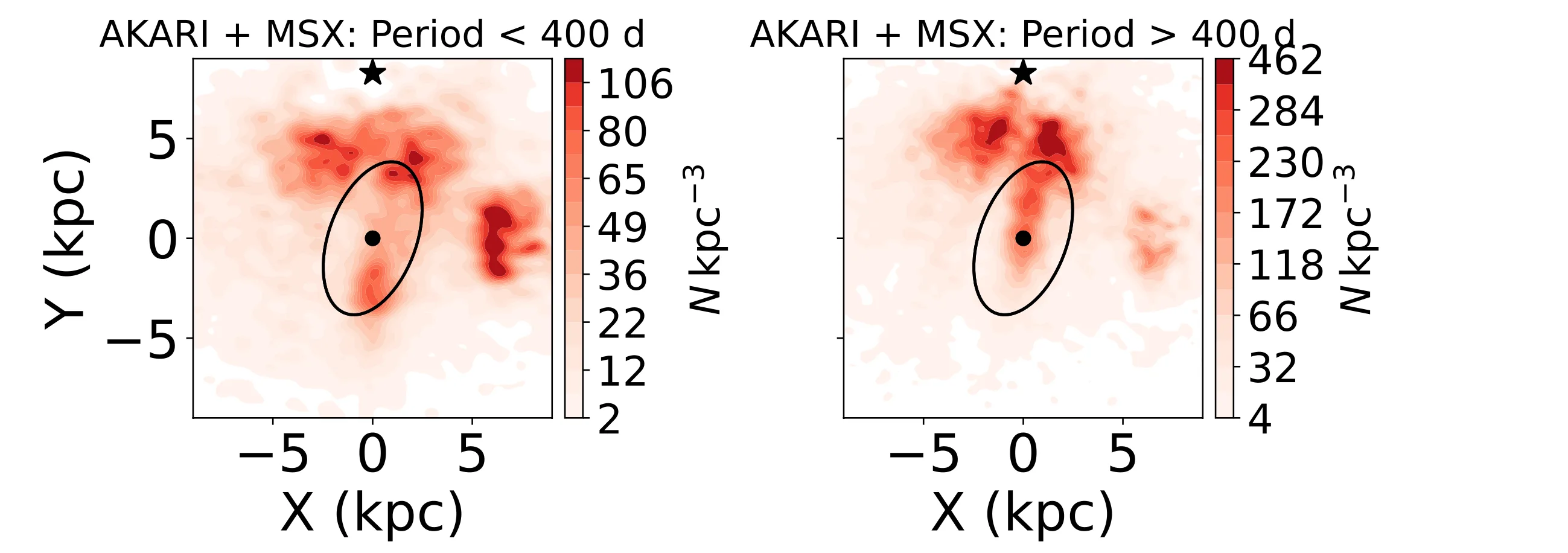
Особый интерес вызвали переменные звёзды типа Миры. Те, что пульсируют медленнее, сгрудились в центре Галактики, повторяя форму вытянутой перемычки — бара нашей Галактики. Быстрые пульсары рассыпались по диску. Разница в «росте» этих звёздных слоёв подсказывает, как формировался Млечный Путь.
Оригинальная аннотация
как её написали авторы, на английском arXiv:2608.10577v1
The structure and evolution of the Milky Way (MW) can be traced with distance estimates to the evolved stellar populations in the inner galactic region. However, direct astrometric distances remain unavailable or highly uncertain for the majority of these sources due to instrumental limitations, large angular diameters, and complex variability. In this work, we develop a supervised machine-learning model to estimate statistical distances to oxygen-rich asymptotic giant branch (AGB) stars selected from the AKARI mid-infrared survey. We build an XGBoost regression model that maps multi-band IR photometry to distance using a training set of AGB stars with previously derived SED-based distances achieving a mean absolute percentage error (MAPE) of 6% on an independent test set. Distance estimates for over 36,000 AGB sources are obtained within a 36% total error margin, greatly expanding distance coverage (0.5-20 kpc) for dust-obscured AGB populations in the Galactic plane. We find good agreement with reported distances for Galactic Mira variables and independent period-luminosity relations. Utilizing the expanded distance set, we further investigate the spatial distribution of Mira variables in the Galactic bulge and disk. Longer-period Miras preferentially trace the bulge's barred morphology compared to their shorter-period counterparts that populate the disk. We also find roughly constant, but differing, relative scale heights for the bulge and disk, with the bulge vertical dispersion about 30% larger. These findings show that IR photometry-derived statistical distances can recover large-scale Galactic structures and establish long-period Mira variables as efficient tracers of stellar populations in heavily obscured regions of the MW.
Инфракрасный телескоп AKARI, данные которого использовали астрономы, был запущен Японией в 2006 году и проработал на орбите более пяти лет, хотя топливо закончилось раньше.